Philippines Potassium phosphate Market Size, Share & Growth Rate
The Philippines Potassium phosphate Market was estimated at USD 377 Million in 2025 and is projected to reach USD 507 Million by 2032, growing at a CAGR of 4.3% from 2026 to 2032. This growth trajectory is primarily driven by rising agricultural productivity needs and an increasing focus on sustainable farming practices. Moreover, heightened consumer awareness about nutritional benefits, particularly in food preservation and supplementation, further amplifies the demand for potassium phosphate across diverse sectors.
Philippines Potassium phosphate Market Year-wise Growth Rate and Key Drivers
This graph highlights how the Philippines Potassium phosphate Market has steadily grown over the years, supported by major growth factors.
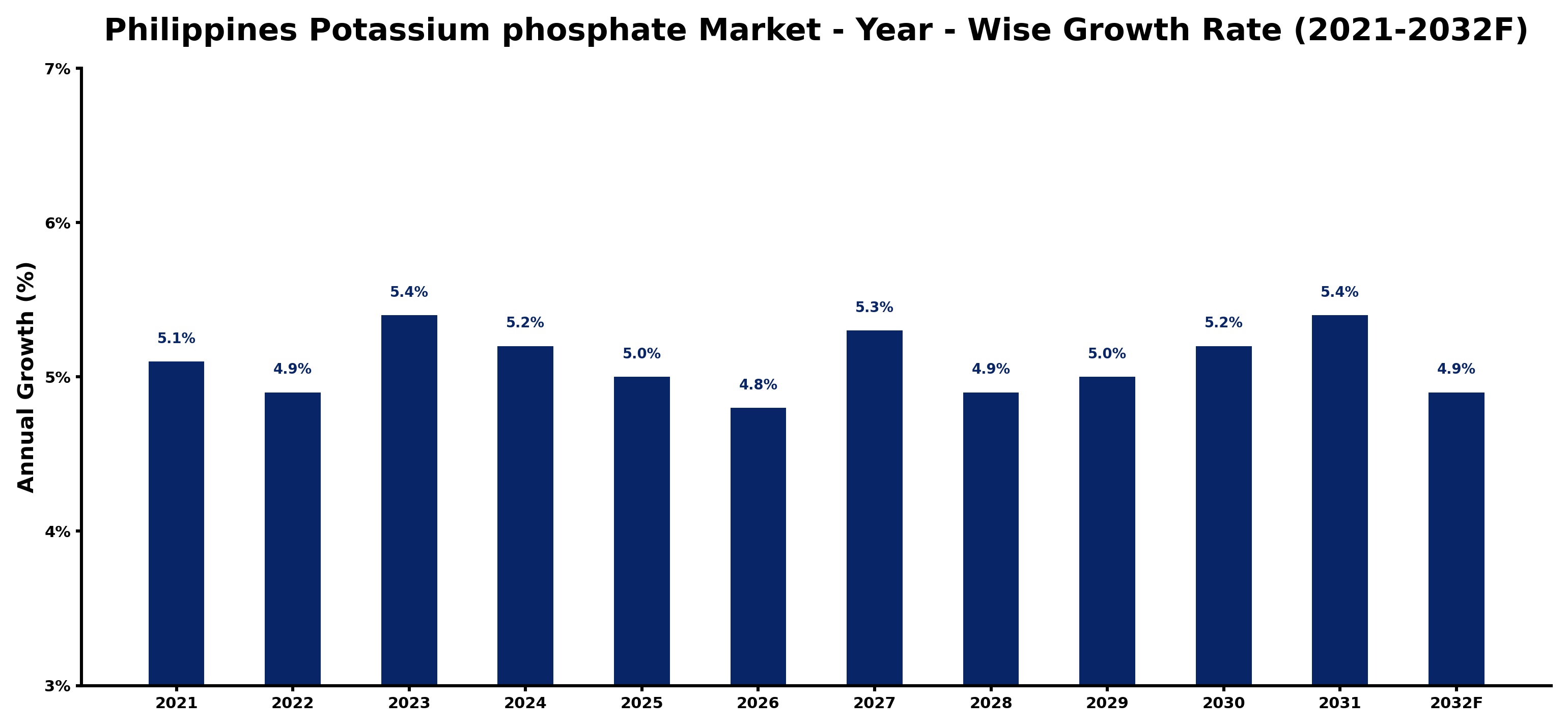
The table below presents the year‑wise growth rates along with the key drivers influencing the market
| Year | Growth Rate | Major Drivers |
| 2021 | 5.1% | Local fertilizer production investments boost potassium phosphate output efficiency |
| 2022 | 4.9% | New fertilizer production facilities boost potassium phosphate manufacturing output |
| 2023 | 5.4% | Export demand for agricultural fertilizers boosts potassium phosphate production |
| 2024 | 5.2% | Domestic fertilizer production integration boosts potassium phosphate supply chain efficiency |
| 2025 | 5.0% | Domestic fertilizer production growth spurred potassium phosphate manufacturing investments |
| 2026 | 4.8% | New fertilizer production facilities boost potassium phosphate demand growth |
| 2027 | 5.3% | Precision agriculture technologies boost potassium phosphate fertilizer application efficiency |
| 2028 | 4.9% | Strengthened fertilizer manufacturing capabilities enhanced potassium phosphate production output |
| 2029 | 5.0% | Export driven fertilizer demand boosts potassium phosphate manufacturing capacity |
| 2030 | 5.2% | Production expansion in agriculture fuels potassium phosphate manufacturing demand |
| 2031 | 5.4% | Manufacturing investments in automation boost potassium phosphate production capacity |
| 2032 | 4.9% | Domestic fertilizer demand surge drives potassium phosphate production capacity expansion |
Note - Market size estimations and growth projections presented in this report are based on 6Wresearch’s advanced forecasting approach, validated with industry datasets as of June 2026.
Philippines Potassium phosphate Market Synopsis
In recent years, the Philippines potassium phosphate market has witnessed robust growth, largely fueled by the agricultural sector's increasing demands. Fertilizer usage has surged as farmers strive to enhance crop quality and yield, responding to both local and international market pressures. Looking ahead, the market is anticipated to shift further towards eco-friendly practices and innovations that optimize nutrient delivery in soils.
As we progress, the market is expected to not only expand in volume but also evolve in its applications. Stakeholders are increasingly integrating potassium phosphate into food products, recognizing its role as a health-enhancing additive. This dual demand from agriculture and the food industry is indicative of a market poised for continued evolution and responsiveness to consumer trends.
Philippines Potassium phosphate Market Key Takeaways
- Increasing agricultural productivity is a primary driver for potassium phosphate demand.
- Heightened health consciousness among consumers is reshaping product applications.
- Sustainable agriculture practices are becoming essential in market strategies.
- Ongoing developments in food safety regulations influence potassium phosphate use in food processing.
- The recovery from COVID-19 disruptions is anticipated to stabilize demand in industrial sectors.
Evaluation of Restraints in Philippines Potassium phosphate Market
The Philippines Potassium phosphate market faces several restraints, particularly concerning the environmental implications of fertilizer use. Striking a balance between agricultural productivity and ecological stewardship poses a significant challenge. Additionally, the regulatory landscape regarding food additives necessitates diligent compliance from manufacturers, often complicating operational processes. Ensuring safety in food applications without compromising on efficacy remains a critical focus for market players.
Philippines Potassium phosphate Market Trends
A trend towards sustainable and organic farming practices is gaining momentum in the Philippines, with potassium phosphate playing a crucial role in this shift. Innovations in fertilizer technology are leading to more efficient nutrient delivery systems, which not only enhance crop yields but also minimize environmental impact. Furthermore, the food industry is exploring the potential of potassium phosphate as a natural preservative, responding to consumer demands for cleaner labels and healthier options.
Philippines Potassium phosphate Market Opportunities
As awareness of health and wellness continues to grow, opportunities abound for potassium phosphate in the nutritional supplement space. The potential for fortifying food products with phosphates to improve overall health outcomes is significant. Moreover, the push for sustainable agricultural practices presents avenues for investment in research and development of innovative potassium phosphate applications that align with ecological goals.
Government Initiatives in the Philippines Potassium phosphate Market
The Philippine government has implemented various initiatives aimed at promoting sustainable agricultural practices, which indirectly benefit the potassium phosphate market. Programs encouraging responsible fertilizer use and enhancing soil health are gaining traction. Furthermore, public spending on agricultural technology and research supports innovations in nutrient management, fostering an environment conducive to market growth.
Future Insights of the Philippines Potassium phosphate Market
Looking forward to the period between 2026 and 2032, the Philippines potassium phosphate market is poised for significant advancements. The confluence of increasing population, rising food demand, and sustainability efforts will drive the market landscape. Companies are likely to adapt their strategies to focus on efficient nutrient use and environmental preservation, ensuring that potassium phosphate remains a key component of both agricultural and nutritional sectors.
Philippines Potassium phosphate Market Latest Developments (May 2025 - June 2026)
Recently, there has been a notable uptick in research initiatives aimed at understanding the broader impacts of potassium phosphate in enhancing soil fertility. Additionally, industry stakeholders are actively participating in discussions surrounding regulatory frameworks to ensure food safety while utilizing potassium phosphate in food applications. The movement towards adopting more sustainable practices in agriculture is also gaining momentum, reflecting a shift in market dynamics.
Philippines Potassium phosphate Market - Key Attractiveness of the Report
- 10 Years of Market Numbers
- Historical Data Starting from 2022 to 2025
- Base Year: 2025
- Forecast Data until 2032
- Key Performance Indicators Impacting the Market
- Major Upcoming Developments and Projects
Key Highlights of the Report:
- Philippines Potassium phosphate Market Outlook
- Market Size of Philippines Potassium phosphate Market, 2025
- Forecast of Philippines Potassium phosphate Market, 2032
- Historical Data and Forecast of Philippines Potassium phosphate Revenues & Volume for the Period 2022-2032F
- Philippines Potassium phosphate Market Trend Evolution
- Philippines Potassium phosphate Market Drivers and Challenges
- Philippines Potassium phosphate Price Trends
- Philippines Potassium phosphate Porter's Five Forces
- Philippines Potassium phosphate Industry Life Cycle
- Historical Data and Forecast of Philippines Potassium phosphate Market Revenues & Volume By Distribution Channel for the Period 2022-2032F
- Historical Data and Forecast of Philippines Potassium phosphate Market Revenues & Volume By Online Retailing for the Period 2022-2032F
- Historical Data and Forecast of Philippines Potassium phosphate Market Revenues & Volume By Offline Retailing for the Period 2022-2032F
- Historical Data and Forecast of Philippines Potassium phosphate Market Revenues & Volume By Application for the Period 2022-2032F
- Historical Data and Forecast of Philippines Potassium phosphate Market Revenues & Volume By Acidulant for the Period 2022-2032F
- Historical Data and Forecast of Philippines Potassium phosphate Market Revenues & Volume By Diuretic for the Period 2022-2032F
- Historical Data and Forecast of Philippines Potassium phosphate Market Revenues & Volume By Buffering & Sequestering Agent for the Period 2022-2032F
- Historical Data and Forecast of Philippines Potassium phosphate Market Revenues & Volume By Other Applications for the Period 2022-2032F
- Historical Data and Forecast of Philippines Potassium phosphate Market Revenues & Volume By End-use Verticals for the Period 2022-2032F
- Historical Data and Forecast of Philippines Potassium phosphate Market Revenues & Volume By Food & Beverage Industry for the Period 2022-2032F
- Historical Data and Forecast of Philippines Potassium phosphate Market Revenues & Volume By Medical & Pharmaceutical for the Period 2022-2032F
- Historical Data and Forecast of Philippines Potassium phosphate Market Revenues & Volume By Personal Care Products for the Period 2022-2032F
- Historical Data and Forecast of Philippines Potassium phosphate Market Revenues & Volume By Others for the Period 2022-2032F
- Philippines Potassium phosphate Import Export Trade Statistics
- Market Opportunity Assessment By Distribution Channel
- Market Opportunity Assessment By Application
- Market Opportunity Assessment By End-use Verticals
- Philippines Potassium phosphate Top Companies Market Share
- Philippines Potassium phosphate Competitive Benchmarking By Technical and Operational Parameters
- Philippines Potassium phosphate Company Profiles
- Philippines Potassium phosphate Key Strategic Recommendations






































