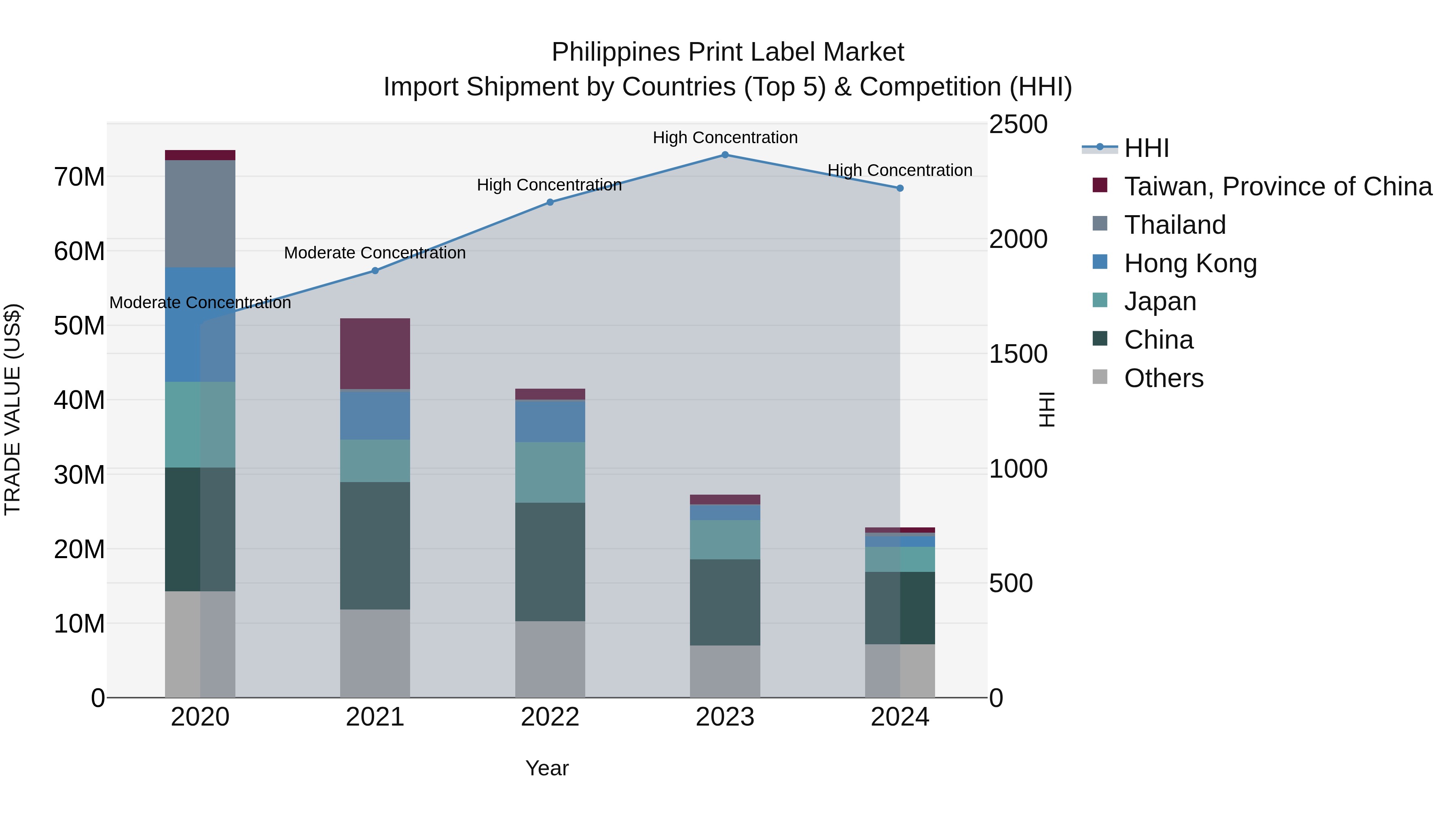
Philippines Print Label Market Top 5 Importing Countries and Market Competition (HHI) Analysis
The Philippines continues to see a significant influx of print label imports from top exporting countries such as China, Japan, South Korea, Hong Kong, and Malaysia in 2024. Despite a high concentration level indicated by the Herfindahl-Hirschman Index (HHI), the market experienced a notable decline with a compound annual growth rate (CAGR) of -25.34% from 2020 to 2024. The growth rate in 2024 stands at -16.11%, reflecting ongoing challenges and changes within the industry. Monitoring these trends and market dynamics will be crucial for stakeholders navigating the import landscape in the Philippines.
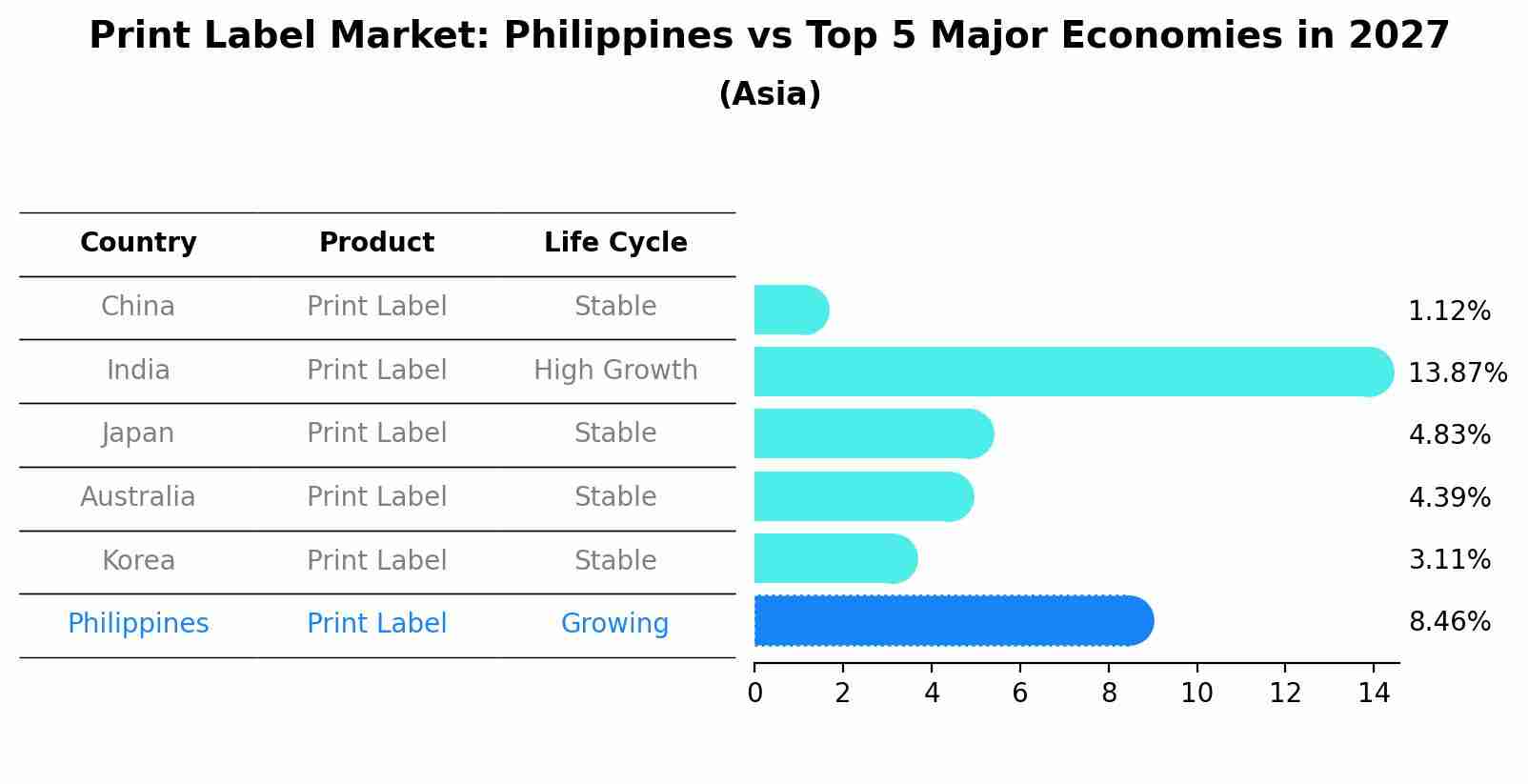
Print Label Market: Philippines vs Top 5 Major Economies in 2027 (Asia)
In the Asia region, the Print Label market in Philippines is projected to expand at a growing growth rate of 8.46% by 2027. The largest economy is China, followed by India, Japan, Australia and South Korea.
philippines rayon fancy yarn market Synopsis
The Philippines rayon fancy yarn market is set to experience a positive trajectory in the foreseeable future. Real market data indicates an expected growth rate of 6% over the next five years. This growth is underpinned by the fashion and textiles industry`s constant pursuit of unique and aesthetically appealing materials. Rayon fancy yarn, known for its luxurious texture and vibrant appearance, finds applications in high-end clothing, accessories, and interior decoration. As consumer preferences lean towards sustainable and visually captivating products, the market is anticipated to benefit from this shift, prompting investments in yarn production and innovative dyeing techniques.
Drivers of the Market
The Philippines rayon fancy yarn market is expected to experience growth due to various factors. The fashion and textile industry`s continuous demand for creative and unique textiles is driving the adoption of rayon fancy yarn. These yarns offer a wide range of textures, colors, and finishes, making them popular for high-fashion and apparel applications. Furthermore, the increasing consumer preference for sustainable and natural-looking fabrics is expected to support the demand for rayon fancy yarn, as it offers a natural aesthetic and comfortable wear.
Challenges of the Market
The rayon fancy yarn market encounters challenges in terms of competition from other synthetic and natural yarns. Rayon`s environmental impact and the increasing popularity of organic and sustainable fibers could impact the market`s growth. Manufacturers will need to find ways to differentiate rayon fancy yarn and address concerns about its ecological footprint.
COVID-19 Impact on the Market
The COVID-19 pandemic disrupted the supply chain and led to a decline in consumer spending on non-essential items, affecting the market. However, as the economy recovers and consumer confidence improves, the rayon fancy yarn market is likely to regain its momentum.
Key Players in the Market
The rayon fancy yarn market in the Philippines showcases artistic and creative growth, with a consistent demand in the fashion and textile industry. Leading companies such as Century Rayon and Global Textile Alliance stand out by delivering unique and high-quality rayon fancy yarns that cater to evolving fashion trends.
Key Highlights of the Report:
- Philippines Print Label Market Outlook
- Market Size of Philippines Print Label Market, 2024
- Forecast of Philippines Print Label Market, 2031
- Historical Data and Forecast of Philippines Print Label Revenues & Volume for the Period 2021-2031
- Philippines Print Label Market Trend Evolution
- Philippines Print Label Market Drivers and Challenges
- Philippines Print Label Price Trends
- Philippines Print Label Porter's Five Forces
- Philippines Print Label Industry Life Cycle
- Historical Data and Forecast of Philippines Print Label Market Revenues & Volume By Print Process for the Period 2021-2031
- Historical Data and Forecast of Philippines Print Label Market Revenues & Volume By Offset lithography for the Period 2021-2031
- Historical Data and Forecast of Philippines Print Label Market Revenues & Volume By Gravure for the Period 2021-2031
- Historical Data and Forecast of Philippines Print Label Market Revenues & Volume By Flexography for the Period 2021-2031
- Historical Data and Forecast of Philippines Print Label Market Revenues & Volume By Screen for the Period 2021-2031
- Historical Data and Forecast of Philippines Print Label Market Revenues & Volume By Letterpress for the Period 2021-2031
- Historical Data and Forecast of Philippines Print Label Market Revenues & Volume By Electrophotography for the Period 2021-2031
- Historical Data and Forecast of Philippines Print Label Market Revenues & Volume By Inkjet for the Period 2021-2031
- Historical Data and Forecast of Philippines Print Label Market Revenues & Volume By Label Format for the Period 2021-2031
- Historical Data and Forecast of Philippines Print Label Market Revenues & Volume By Wet-glue labels for the Period 2021-2031
- Historical Data and Forecast of Philippines Print Label Market Revenues & Volume By Pressure-sensitive labels for the Period 2021-2031
- Historical Data and Forecast of Philippines Print Label Market Revenues & Volume By Linerless labels for the Period 2021-2031
- Historical Data and Forecast of Philippines Print Label Market Revenues & Volume By Multi-part tracking labels for the Period 2021-2031
- Historical Data and Forecast of Philippines Print Label Market Revenues & Volume By In-mold labels for the Period 2021-2031
- Historical Data and Forecast of Philippines Print Label Market Revenues & Volume By Sleeves for the Period 2021-2031
- Historical Data and Forecast of Philippines Print Label Market Revenues & Volume By End-User for the Period 2021-2031
- Historical Data and Forecast of Philippines Print Label Market Revenues & Volume By Food for the Period 2021-2031
- Historical Data and Forecast of Philippines Print Label Market Revenues & Volume By Beverage for the Period 2021-2031
- Historical Data and Forecast of Philippines Print Label Market Revenues & Volume By Healthcare for the Period 2021-2031
- Historical Data and Forecast of Philippines Print Label Market Revenues & Volume By Cosmetics for the Period 2021-2031
- Historical Data and Forecast of Philippines Print Label Market Revenues & Volume By Household for the Period 2021-2031
- Historical Data and Forecast of Philippines Print Label Market Revenues & Volume By Industrial for the Period 2021-2031
- Historical Data and Forecast of Philippines Print Label Market Revenues & Volume By Logistics for the Period 2021-2031
- Historical Data and Forecast of Philippines Print Label Market Revenues & Volume By Other for the Period 2021-2031
- Philippines Print Label Import Export Trade Statistics
- Market Opportunity Assessment By Print Process
- Market Opportunity Assessment By Label Format
- Market Opportunity Assessment By End-User
- Philippines Print Label Top Companies Market Share
- Philippines Print Label Competitive Benchmarking By Technical and Operational Parameters
- Philippines Print Label Company Profiles
- Philippines Print Label Key Strategic Recommendations






































