Philippines Printed Circuit Boards Market Summary
The philippines printed circuit boards market was estimated at USD 257 Million in 2025 and is projected to reach USD 359 Million by 2032, growing at a CAGR of 5.9% from 2026 to 2032.
Philippines Printed Circuit Boards Market Year-wise Growth Rate and Key Drivers
This graph highlights how the Philippines Printed Circuit Boards Market has steadily grown over the past five years, supported by major growth factors.
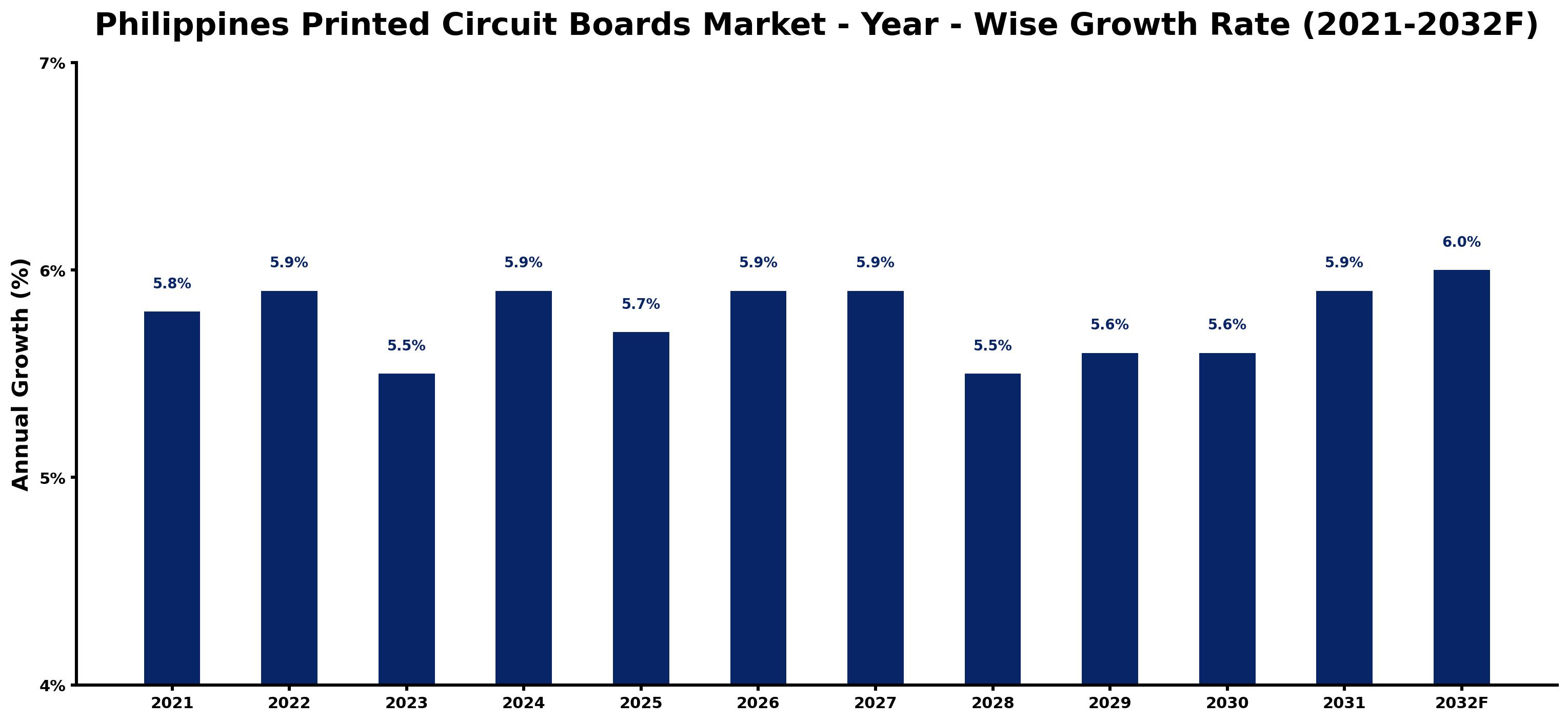
The table below presents the year wise growth rates along with the key drivers influencing the market
| Year | Growth Rate | Major Drivers |
| 2021 | 5.8% | The ongoing digital transformation supports increased interest in electronic manufacturing services. |
| 2022 | 5.9% | Emerging applications in IoT spark considerable demand for customized printed circuit boards. |
| 2023 | 5.5% | Greater investment in smart home devices drives innovation and local PCB production capabilities. |
| 2024 | 5.9% | Proactive supply chain enhancements are essential for reducing dependency on imports. |
| 2025 | 5.7% | Technological collaborations between local firms and global leaders bolster manufacturing efficiencies. |
| 2026 | 5.9% | Increased capacity for renewable energy projects creates opportunities for specialized circuit boards. |
| 2027 | 5.9% | The automotive sector's electrification trend boosts demand for reliable PCB technology. |
| 2028 | 5.5% | Emerging sectors, such as AI, create significant requirements for advanced circuit designs. |
| 2029 | 5.6% | Investment in educational initiatives supports skill development in PCB design and manufacturing. |
| 2030 | 5.6% | The push for smart city projects drives demand for robust electronic infrastructure. |
| 2031 | 5.9% | Consumer electronics' evolution fuels constant innovation in PCB materials and production methods. |
| 2032 | 6.0% | Regional trade agreements enhance access to international markets for Filipino PCB manufacturers. |
Note - Market size estimations and growth projections presented in this report are based on 6Wresearch's advanced forecasting approach, validated with industry datasets as of June 2026.
Philippines Printed Circuit Boards Market Synopsis
The Philippines Printed Circuit Boards Market is projected to reach 5.9% and witness significant growth during the forecast period (2026-2032). This growth is primarily driven by the increasing demand for printed circuit boards (PCBs) used in various electronics applications, including computers, smartphones, medical devices, and home appliances. As the electronic industry continues to expand in the Philippines, the market for printed circuit boards is expected to benefit from a multitude of opportunities arising from advancements in technology and increased consumption.
Philippines Printed Circuit Boards Market Growth Drivers
The growth of the Philippines Printed Circuit Boards Market can be attributed to several key drivers:
- The rise in demand for electronic devices such as smartphones and computers has significantly increased the need for high-quality printed circuit boards. As consumers seek advanced technology, manufacturers are compelled to innovate in PCB design and production.
- The expanding automotive sector in the Philippines is also contributing to the market's growth. As vehicles become more technologically advanced, the need for sophisticated PCB solutions in automotive electronics is rising.
- Cost-effectiveness, coupled with improved performance and flexibility of printed circuit boards, makes them suitable for a wide range of applications across various industries. This versatility enhances their adoption in emerging sectors.
- Ongoing advancements in manufacturing technologies, including automation and enhanced production processes, are driving down costs and improving the quality of printed circuit boards available in the market.
- The integration of Internet of Things (IoT) technologies is propelling growth in the PCB market, as increased connectivity demands more advanced circuit designs and capabilities within electronic products.
Philippines Printed Circuit Boards Market Challenges and Restraints
Despite the optimistic growth forecast for the Philippines Printed Circuit Boards Market, several challenges persist:
- One significant challenge facing manufacturers is the rising cost of raw materials. Environmental protection regulations related to hazardous substances used in PCB production have made sourcing some materials more expensive, impacting overall production costs.
- Local manufacturers are contending with intense competition from international suppliers, particularly from China, where lower production costs allow for competitive pricing of high-quality products.
- The COVID-19 pandemic has severely disrupted global supply chains, leading to delays and losses for companies operating in the PCB sector. This has created challenges in maintaining production schedules and fulfilling orders.
- Environmental considerations and sustainability pressures are compelling the industry to adopt eco-friendly materials and practices, which may require substantial investment and innovation.
- Technological advancements, while beneficial, also require continuous adaptation from PCB manufacturers. Companies must invest in research and development to keep pace with evolving consumer demands and technological standards.
Philippines Printed Circuit Boards Market Government Investment and Initiatives
The Philippine government is actively promoting the development of the electronics sector, which plays a crucial role in the growth of the Printed Circuit Boards Market. Several initiatives and policies aim to attract investments and foster innovation:
- The government has implemented various incentives, including tax holidays and grants, to encourage both local and foreign investments in electronics manufacturing and assembly.
- Public spending on infrastructure improvement projects enhances logistics and production capacities, indirectly supporting PCB manufacturers in achieving better operational efficiencies.
- Programs aimed at workforce development are being established to ensure a skilled labor pool for the electronics sector, which is necessary for the sophisticated manufacturing processes involved in PCB production.
- Partnerships with international organizations and educational institutions are being pursued to boost research and development initiatives, encouraging local PCB manufacturers to adopt cutting-edge technologies.
- The government's focus on sustainability and environmental standards demands compliance from PCB manufacturers, prompting them to invest in eco-friendly technologies and practices, which could increase market competitiveness.
Philippines Printed Circuit Boards Market Latest Developments (May 2025 - June 2026)
Recent developments within the Philippines Printed Circuit Boards Market indicate a strategic shift towards automation and enhanced technological capabilities. Manufacturers are increasingly investing in advanced production techniques to improve efficiency and reduce dependency on manual labor. Moreover, the push for green technologies is encouraging companies to explore sustainable materials and production methods.
The semiconductor supply chain continues to pose challenges, with many firms adapting their procurement strategies to combat potential shortages. Continued engagement with governmental policies has led to increased collaborations aimed at localizing supply chains for raw materials.
Overall, the market is witnessing a blend of traditional PCB manufacturing with new technological advancements, positioning the Philippines as a competitive player in Southeast Asia's electronics landscape.
Philippines Printed Circuit Boards Market - Key Attractiveness of the Report
- 10 Years of Market Numbers
- Historical Data Starting from 2022 to 2025
- Base Year: 2025
- Forecast Data until 2032
- Key Performance Indicators Impacting the Market
- Major Upcoming Developments and Projects
Key Highlights of the Report:
- Philippines Printed Circuit Boards Market Outlook
- Market Size of Philippines Printed Circuit Boards Market, 2025
- Forecast of Philippines Printed Circuit Boards Market, 2032F
- Historical Data and Forecast of Philippines Printed Circuit Boards Revenues & Volume for the Period 2022-2032F
- Philippines Printed Circuit Boards Market Trend Evolution
- Philippines Printed Circuit Boards Market Drivers and Challenges
- Philippines Printed Circuit Boards Price Trends
- Philippines Printed Circuit Boards Porter's Five Forces
- Philippines Printed Circuit Boards Industry Life Cycle
- Historical Data and Forecast of Philippines Printed Circuit Boards Market Revenues & Volume By Types for the Period 2022-2032F
- Historical Data and Forecast of Philippines Printed Circuit Boards Market Revenues & Volume By Single Sided for the Period 2022-2032F
- Historical Data and Forecast of Philippines Printed Circuit Boards Market Revenues & Volume By Double Sided for the Period 2022-2032F
- Historical Data and Forecast of Philippines Printed Circuit Boards Market Revenues & Volume By Multi-Layer for the Period 2022-2032F
- Historical Data and Forecast of Philippines Printed Circuit Boards Market Revenues & Volume By HDI for the Period 2022-2032F
- Historical Data and Forecast of Philippines Printed Circuit Boards Market Revenues & Volume By Substrate for the Period 2022-2032F
- Historical Data and Forecast of Philippines Printed Circuit Boards Market Revenues & Volume By Rigid for the Period 2022-2032F
- Historical Data and Forecast of Philippines Printed Circuit Boards Market Revenues & Volume By Flexible for the Period 2022-2032F
- Historical Data and Forecast of Philippines Printed Circuit Boards Market Revenues & Volume By Rigid-Flex for the Period 2022-2032F
- Historical Data and Forecast of Philippines Printed Circuit Boards Market Revenues & Volume By End-users for the Period 2022-2032F
- Historical Data and Forecast of Philippines Printed Circuit Boards Market Revenues & Volume By Industrial Electronics for the Period 2022-2032F
- Historical Data and Forecast of Philippines Printed Circuit Boards Market Revenues & Volume By Healthcare for the Period 2022-2032F
- Historical Data and Forecast of Philippines Printed Circuit Boards Market Revenues & Volume By Aerospace & Defense for the Period 2022-2032F
- Historical Data and Forecast of Philippines Printed Circuit Boards Market Revenues & Volume By Automotive for the Period 2022-2032F
- Historical Data and Forecast of Philippines Printed Circuit Boards Market Revenues & Volume By IT & Telecom for the Period 2022-2032F
- Historical Data and Forecast of Philippines Printed Circuit Boards Market Revenues & Volume By Consumer Electronics for the Period 2022-2032F
- Historical Data and Forecast of Philippines Printed Circuit Boards Market Revenues & Volume By Others for the Period 2022-2032F
- Philippines Printed Circuit Boards Import Export Trade Statistics
- Market Opportunity Assessment By Types
- Market Opportunity Assessment By Substrate
- Market Opportunity Assessment By End-users
- Philippines Printed Circuit Boards Top Companies Market Share
- Philippines Printed Circuit Boards Competitive Benchmarking By Technical and Operational Parameters
- Philippines Printed Circuit Boards Company Profiles
- Philippines Printed Circuit Boards Key Strategic Recommendations






































