Philippines Printed Signage Market Top 5 Importing Countries and Market Competition (HHI) Analysis
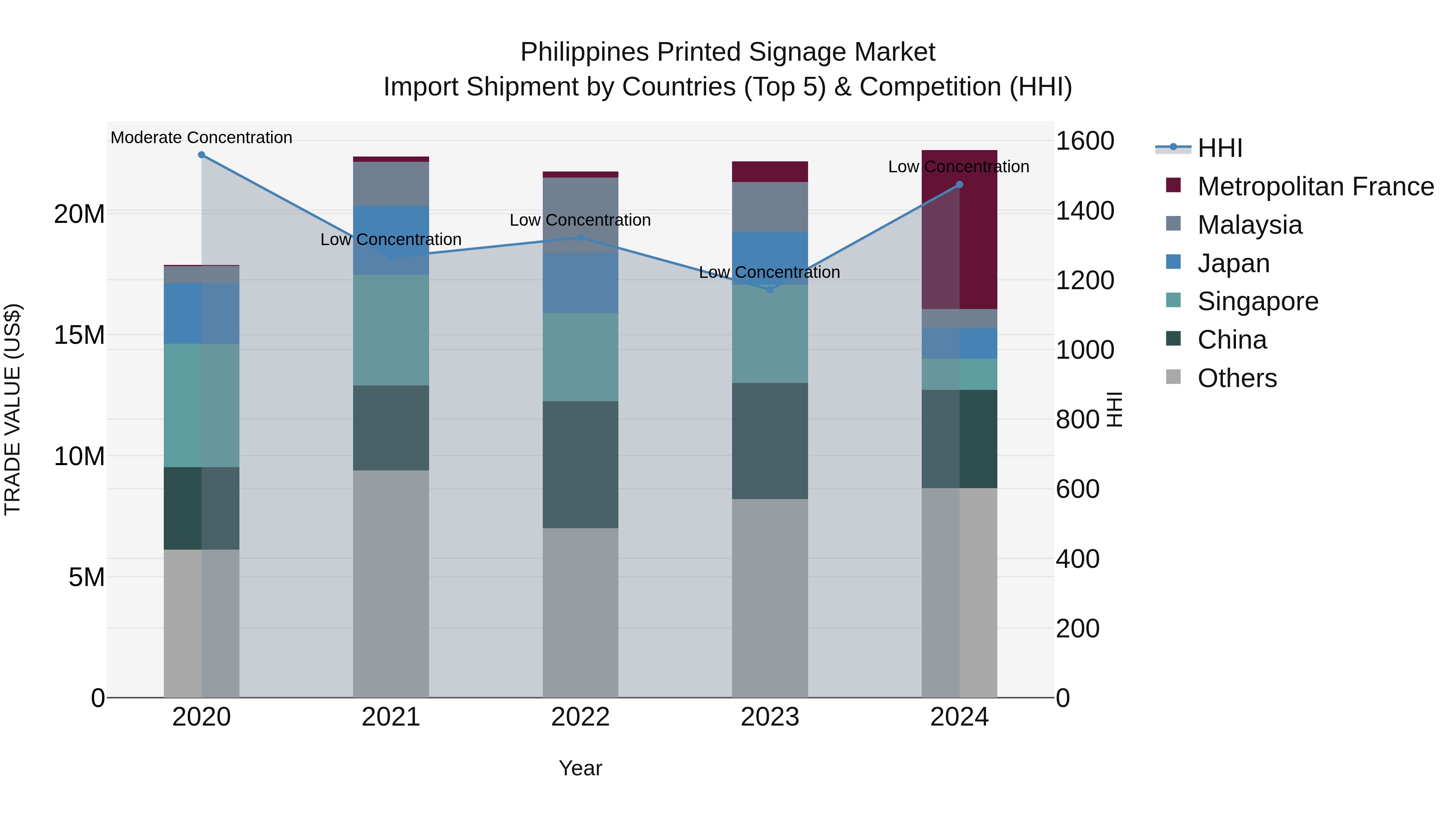
In 2024, the Philippines continued to see a steady influx of printed signage imports, with top exporting countries including Metropolitan France, China, Canada, Singapore, and Japan. The market remained competitive with low concentration, indicating a diverse range of suppliers. The compound annual growth rate (CAGR) from 2020 to 2024 stood at a healthy 6.06%, reflecting sustained demand. Although the growth rate slightly decreased from 2023 to 2024 at 2.08%, the market outlook for printed signage imports in the Philippines remains positive and dynamic.
Philippines Printed Signage Market Synopsis
The Philippines Printed Signage Market is experiencing steady growth driven by the increasing demand for visually appealing and informative signage in various sectors such as retail, healthcare, hospitality, and transportation. The market is characterized by a wide range of products including banners, posters, billboards, and vehicle wraps, catering to different advertising and promotional needs. With the rise of digital printing technology, customization options and high-quality graphics are becoming more accessible, attracting businesses to invest in printed signage for brand visibility and marketing purposes. Additionally, the government`s infrastructure development projects and urbanization trends are creating opportunities for signage companies to provide wayfinding and informative signage solutions. Overall, the Philippines Printed Signage Market is poised for further expansion as businesses recognize the importance of effective visual communication in a competitive market landscape.
Philippines Printed Signage Market Trends
The Printed Signage Market in the Philippines is experiencing a shift towards more sustainable and eco-friendly materials, driven by increasing awareness of environmental issues among businesses and consumers. There is a growing demand for signage that is not only visually appealing but also produced using recyclable or biodegradable materials. Digital printing technology is also gaining popularity, allowing for more customization and quicker turnaround times. Another trend is the integration of interactive elements such as QR codes and augmented reality in printed signage to enhance customer engagement. Overall, the market is witnessing a move towards innovative and sustainable solutions that cater to both aesthetic preferences and environmental consciousness.
Philippines Printed Signage Market Challenges
In the Philippines Printed Signage Market, some of the key challenges include increasing competition among signage providers, price pressure due to market saturation, and the need for continuous innovation to stand out in a crowded market. The industry also faces challenges related to changing consumer preferences, technological advancements, and the shift towards digital advertising platforms. Additionally, regulatory hurdles and compliance requirements for outdoor advertising can pose obstacles for signage companies. To overcome these challenges, businesses in the Philippines Printed Signage Market need to focus on providing unique value propositions, investing in advanced printing technologies, and offering personalized and innovative solutions to meet the evolving needs of customers. Staying abreast of industry trends and leveraging digital marketing strategies can also help companies stay competitive in this dynamic market.
Philippines Printed Signage Market Investment Opportunities
The Philippines Printed Signage Market offers attractive investment opportunities due to the country`s growing economy and increasing demand for advertising and promotional materials. With the rise of businesses across various industries, there is a continuous need for high-quality and visually appealing signage to attract customers. Investing in advanced printing technology and innovative designs can help businesses differentiate themselves and stand out in a competitive market. Additionally, the Philippines` strategic location in Southeast Asia makes it a hub for trade and commerce, further driving the demand for printed signage. By tapping into this market, investors can capitalize on the country`s robust economic growth and the expanding opportunities in the advertising and marketing sector.
Jordan Agar Market Government Policies
The government policies related to the Philippines Printed Signage Market primarily revolve around regulations set by the Department of Trade and Industry (DTI) and local government units. These regulations cover areas such as the standard size and design of signs, permits for signage installation, and compliance with safety and environmental standards. Additionally, the Advertising Board of the Philippines (AdBoard) regulates advertising content to ensure it is truthful, decent, and not offensive. Importantly, businesses operating in the printed signage market must also adhere to intellectual property rights laws to prevent copyright infringement. Overall, these government policies aim to promote fair competition, consumer protection, and the orderly development of the signage industry in the Philippines.
Philippines Printed Signage Market Future Outlook
The future outlook for the Philippines Printed Signage Market appears promising, driven by the growth in the retail, hospitality, and real estate sectors. As businesses continue to invest in marketing and branding efforts, the demand for high-quality printed signage is expected to rise. Additionally, the increasing focus on experiential marketing and the adoption of digital printing technologies are likely to fuel market expansion. Furthermore, government initiatives promoting tourism and infrastructure development are anticipated to create opportunities for printed signage companies to cater to the growing number of businesses and events in the country. Overall, the Philippines Printed Signage Market is poised for steady growth in the coming years, with a shift towards innovative and customized solutions driving market competitiveness and profitability.
Key Highlights of the Report:
- Philippines Printed Signage Market Outlook
- Market Size of Philippines Printed Signage Market, 2024
- Forecast of Philippines Printed Signage Market, 2031
- Historical Data and Forecast of Philippines Printed Signage Revenues & Volume for the Period 2021- 2031
- Philippines Printed Signage Market Trend Evolution
- Philippines Printed Signage Market Drivers and Challenges
- Philippines Printed Signage Price Trends
- Philippines Printed Signage Porter's Five Forces
- Philippines Printed Signage Industry Life Cycle
- Historical Data and Forecast of Philippines Printed Signage Market Revenues & Volume By Product for the Period 2021- 2031
- Historical Data and Forecast of Philippines Printed Signage Market Revenues & Volume By Billboard for the Period 2021- 2031
- Historical Data and Forecast of Philippines Printed Signage Market Revenues & Volume By Backlit Display for the Period 2021- 2031
- Historical Data and Forecast of Philippines Printed Signage Market Revenues & Volume By Pop Display for the Period 2021- 2031
- Historical Data and Forecast of Philippines Printed Signage Market Revenues & Volume By Banner for the Period 2021- 2031
- Historical Data and Forecast of Philippines Printed Signage Market Revenues & Volume By Corporate Graphics for the Period 2021- 2031
- Historical Data and Forecast of Philippines Printed Signage Market Revenues & Volume By Others for the Period 2021- 2031
- Historical Data and Forecast of Philippines Printed Signage Market Revenues & Volume By Type for the Period 2021- 2031
- Historical Data and Forecast of Philippines Printed Signage Market Revenues & Volume By Indoor Printed Signage for the Period 2021- 2031
- Historical Data and Forecast of Philippines Printed Signage Market Revenues & Volume By Outdoor Printed Signage for the Period 2021- 2031
- Historical Data and Forecast of Philippines Printed Signage Market Revenues & Volume By End-user Vertical for the Period 2021- 2031
- Historical Data and Forecast of Philippines Printed Signage Market Revenues & Volume By BFSI for the Period 2021- 2031
- Historical Data and Forecast of Philippines Printed Signage Market Revenues & Volume By Retail for the Period 2021- 2031
- Historical Data and Forecast of Philippines Printed Signage Market Revenues & Volume By Sports and Leisure for the Period 2021- 2031
- Historical Data and Forecast of Philippines Printed Signage Market Revenues & Volume By Entertainment for the Period 2021- 2031
- Historical Data and Forecast of Philippines Printed Signage Market Revenues & Volume By Transportation and Logistics for the Period 2021- 2031
- Historical Data and Forecast of Philippines Printed Signage Market Revenues & Volume By Healthcare for the Period 2021- 2031
- Historical Data and Forecast of Philippines Printed Signage Market Revenues & Volume By Others for the Period 2021- 2031
- Philippines Printed Signage Import Export Trade Statistics
- Market Opportunity Assessment By Product
- Market Opportunity Assessment By Type
- Market Opportunity Assessment By End-user Vertical
- Philippines Printed Signage Top Companies Market Share
- Philippines Printed Signage Competitive Benchmarking By Technical and Operational Parameters
- Philippines Printed Signage Company Profiles
- Philippines Printed Signage Key Strategic Recommendations






































