Zambia Printed Signage Market: Top 5 Importing Countries and Market Competition (HHI) Analysis
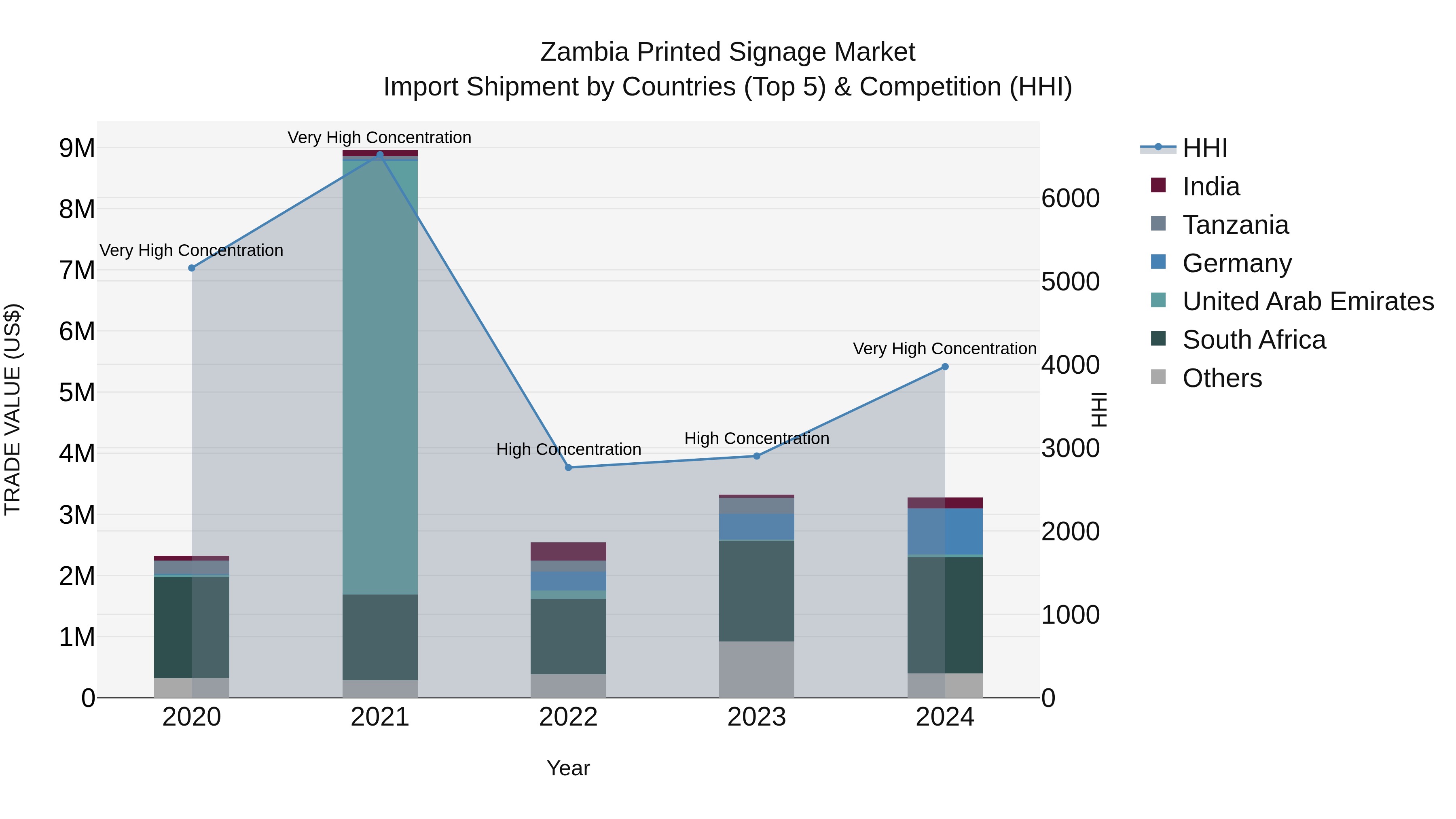
The printed signage import market in Zambia saw a significant increase in concentration levels in 2024, with top exporting countries being South Africa, Germany, China, India, and the United Arab Emirates. Despite a slight decline in growth rate from 2023 to 2024, the compound annual growth rate (CAGR) over the period 2020-2024 remained strong at 8.93%. This data suggests a competitive landscape with key players dominating the market, indicating potential opportunities for further market penetration and expansion strategies in the coming years.
Zambia Printed Signage Market Synopsis
The Zambia Printed Signage Market is experiencing steady growth driven by increasing demand from various sectors such as retail, hospitality, and construction. The market is characterized by a wide range of printed signage products including banners, posters, billboards, and vehicle wraps. Key factors contributing to market growth include the rising trend of outdoor advertising, the need for effective visual communication, and the expansion of businesses across different industries. Additionally, advancements in printing technology and a growing focus on sustainability are influencing market trends. Major players in the Zambia Printed Signage Market are focusing on innovation, customization, and quality to meet the diverse requirements of customers. Overall, the market is expected to continue its growth trajectory fueled by the country`s developing economy and increasing investment in marketing and advertising strategies.
Zambia Printed Signage Market Trends
In the Zambia Printed Signage Market, the current trends revolve around sustainability and digitalization. There is a growing demand for eco-friendly materials and production processes to align with the country`s increasing focus on environmental conservation. Additionally, businesses are increasingly incorporating digital signage solutions for more dynamic and interactive advertising. This shift towards digitalization allows for greater flexibility in content management and real-time updates, catering to the evolving needs of consumers. Furthermore, personalized and customized printed signage options are gaining popularity as companies seek to stand out in a competitive market. Overall, the Zambia Printed Signage Market is witnessing a transformation towards sustainable practices, digital innovation, and personalized branding strategies.
Zambia Printed Signage Market Challenges
In the Zambia Printed Signage Market, challenges include limited access to advanced printing technology and materials, resulting in lower-quality products compared to international standards. Additionally, the industry faces stiff competition from informal and unregistered signage providers, leading to pricing pressures and potential quality inconsistencies. Moreover, fluctuating economic conditions and political instability in the region can impact businesses` ability to invest in marketing and advertising, affecting the demand for printed signage services. Lack of standardized regulations and enforcement mechanisms also contribute to issues related to copyright infringement and unfair business practices. Overall, addressing these challenges through investment in technology, industry regulations, and market education could help the Zambia Printed Signage Market achieve sustainable growth and competitiveness.
Zambia Printed Signage Market Investment Opportunities
The Zambia Printed Signage Market offers promising investment opportunities due to the country`s growing economy and increasing business activities. With the expansion of industries such as retail, hospitality, and construction, there is a rising demand for high-quality printed signage for advertising and branding purposes. Investing in this market can be lucrative for companies offering innovative and customized signage solutions, including digital signage, vehicle wraps, banners, and billboards. Additionally, the government`s focus on infrastructure development and urbanization further boosts the need for signage to enhance visibility and communication. By leveraging the latest printing technologies and materials, investors can capitalize on the growing demand for visually appealing and effective signage solutions in Zambia`s thriving market.
Jordan Agar Market Government Policies
Government policies related to the Zambia Printed Signage Market include regulations on advertising content, size, and placement to ensure compliance with cultural norms and standards. Additionally, there are guidelines on environmental sustainability, with a focus on using eco-friendly materials and practices in signage production. The government also enforces strict licensing and registration requirements for signage companies to maintain industry standards and quality control. Import regulations may also impact the market, with tariffs and restrictions on certain materials used in signage production. Overall, the government aims to balance economic growth and development with environmental conservation and cultural preservation in the printed signage industry in Zambia.
Zambia Printed Signage Market Future Outlook
The Zambia Printed Signage Market is poised for steady growth in the coming years as businesses increasingly recognize the importance of effective visual communication. With the expansion of industries such as retail, hospitality, and construction, the demand for printed signage for advertising, branding, and wayfinding purposes is expected to rise. Additionally, the growing trend of customization and personalization in signage solutions is likely to drive market growth as businesses seek to differentiate themselves in a competitive market. Furthermore, advancements in printing technology are making it easier and more cost-effective for businesses to produce high-quality printed signage. Overall, the future outlook for the Zambia Printed Signage Market appears positive, with opportunities for market players to capitalize on the increasing demand for visually appealing and impactful signage solutions.
Key Highlights of the Report:
- Zambia Printed Signage Market Outlook
- Market Size of Zambia Printed Signage Market, 2024
- Forecast of Zambia Printed Signage Market, 2031
- Historical Data and Forecast of Zambia Printed Signage Revenues & Volume for the Period 2021- 2031
- Zambia Printed Signage Market Trend Evolution
- Zambia Printed Signage Market Drivers and Challenges
- Zambia Printed Signage Price Trends
- Zambia Printed Signage Porter's Five Forces
- Zambia Printed Signage Industry Life Cycle
- Historical Data and Forecast of Zambia Printed Signage Market Revenues & Volume By Product for the Period 2021- 2031
- Historical Data and Forecast of Zambia Printed Signage Market Revenues & Volume By Billboard for the Period 2021- 2031
- Historical Data and Forecast of Zambia Printed Signage Market Revenues & Volume By Backlit Display for the Period 2021- 2031
- Historical Data and Forecast of Zambia Printed Signage Market Revenues & Volume By Pop Display for the Period 2021- 2031
- Historical Data and Forecast of Zambia Printed Signage Market Revenues & Volume By Banner for the Period 2021- 2031
- Historical Data and Forecast of Zambia Printed Signage Market Revenues & Volume By Corporate Graphics for the Period 2021- 2031
- Historical Data and Forecast of Zambia Printed Signage Market Revenues & Volume By Others for the Period 2021- 2031
- Historical Data and Forecast of Zambia Printed Signage Market Revenues & Volume By Type for the Period 2021- 2031
- Historical Data and Forecast of Zambia Printed Signage Market Revenues & Volume By Indoor Printed Signage for the Period 2021- 2031
- Historical Data and Forecast of Zambia Printed Signage Market Revenues & Volume By Outdoor Printed Signage for the Period 2021- 2031
- Historical Data and Forecast of Zambia Printed Signage Market Revenues & Volume By End-user Vertical for the Period 2021- 2031
- Historical Data and Forecast of Zambia Printed Signage Market Revenues & Volume By BFSI for the Period 2021- 2031
- Historical Data and Forecast of Zambia Printed Signage Market Revenues & Volume By Retail for the Period 2021- 2031
- Historical Data and Forecast of Zambia Printed Signage Market Revenues & Volume By Sports and Leisure for the Period 2021- 2031
- Historical Data and Forecast of Zambia Printed Signage Market Revenues & Volume By Entertainment for the Period 2021- 2031
- Historical Data and Forecast of Zambia Printed Signage Market Revenues & Volume By Transportation and Logistics for the Period 2021- 2031
- Historical Data and Forecast of Zambia Printed Signage Market Revenues & Volume By Healthcare for the Period 2021- 2031
- Historical Data and Forecast of Zambia Printed Signage Market Revenues & Volume By Others for the Period 2021- 2031
- Zambia Printed Signage Import Export Trade Statistics
- Market Opportunity Assessment By Product
- Market Opportunity Assessment By Type
- Market Opportunity Assessment By End-user Vertical
- Zambia Printed Signage Top Companies Market Share
- Zambia Printed Signage Competitive Benchmarking By Technical and Operational Parameters
- Zambia Printed Signage Company Profiles
- Zambia Printed Signage Key Strategic Recommendations






































