Philippines Recycled Textiles Market Size, Share & Growth Rate
The Philippines Recycled Textiles Market was estimated at USD 814 Million in 2025 and is projected to reach USD 1161 Million by 2032, growing at a CAGR of 5.2% from 2026 to 2032. This impressive growth trajectory is primarily fueled by a burgeoning consumer demand for sustainable textiles, driven by heightened environmental awareness and a shift towards circular fashion. Initiatives promoting eco-friendly practices further bolster the market, positioning it for substantial expansion over the coming years.
Philippines Recycled Textiles Market Year-wise Growth Rate and Key Drivers
This graph highlights how the Philippines Recycled Textiles Market has steadily grown over the years, supported by major growth factors.
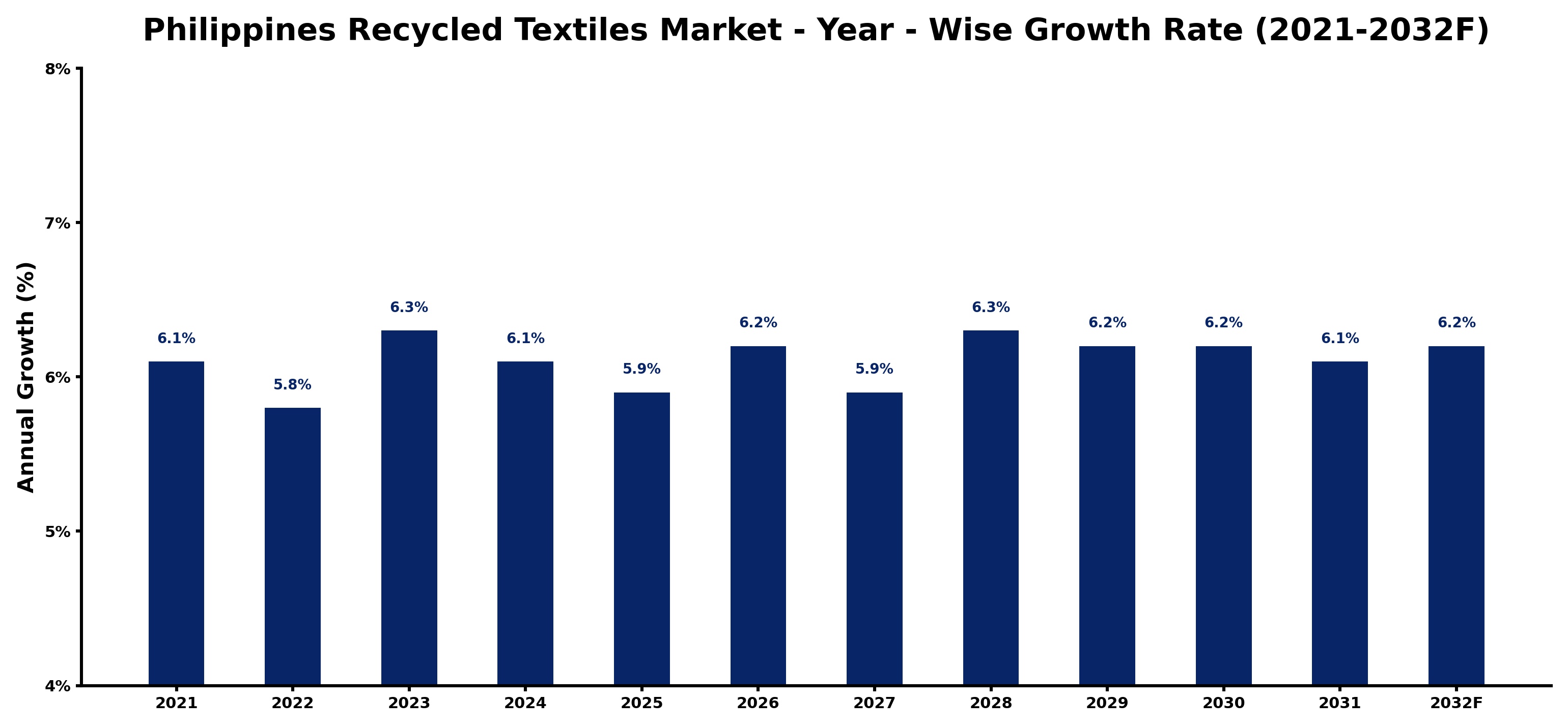
The table below presents the year‑wise growth rates along with the key drivers influencing the market
| Year | Growth Rate | Major Drivers |
| 2021 | 6.1% | Sustainability awareness drove demand |
| 2022 | 5.8% | Government policies encouraged recycling |
| 2023 | 6.3% | Fashion industry embraced sustainability |
| 2024 | 6.1% | Consumer preferences shifted towards eco-friendly |
| 2025 | 5.9% | Technological advancements improved efficiency |
| 2026 | 6.2% | Increased collaboration with NGOs emerged |
| 2027 | 5.9% | Circular economy initiatives gained traction |
| 2028 | 6.3% | Industrial activity supported growth |
| 2029 | 6.2% | E-commerce platforms expanded reach |
| 2030 | 6.2% | Innovative recycling methods enhanced quality |
| 2031 | 6.1% | Community engagement fostered awareness |
| 2032 | 6.2% | Global partnerships strengthened supply chains |
Note - Market size estimations and growth projections presented in this report are based on 6Wresearch’s advanced forecasting approach, validated with industry datasets as of June 2026.
Philippines Recycled Textiles Market Synopsis
Sustainability is the predominant force shaping the Philippines Recycled Textiles Market today. As consumers increasingly recognize the ecological repercussions of traditional textile production, the demand for recycled fabrics is on the rise. This has led to a growing number of companies entering the sector, which provides innovative and sustainable fabric options to meet evolving consumer preferences.
The sector is marked by a diverse array of players committed to offering eco-friendly solutions. With the rise in government initiatives promoting green practices and the increasing emphasis on waste reduction, the recycled textiles market in the Philippines is set for robust growth as both consumers and businesses align with sustainable values.
Philippines Recycled Textiles Market Key Takeaways
- The market is valued at approximately USD 11 million and is growing rapidly.
- Increasing consumer preference for sustainable alternatives is a significant driver.
- Government initiatives play a critical role in promoting eco-friendly textile practices.
- Challenges include the need for improved recycling infrastructure and consumer education.
- COVID-19 has accelerated shifts towards sustainable products in consumer behavior.
Evaluation of Restraints in Philippines Recycled Textiles Market
Despite the positive growth outlook, the Philippines Recycled Textiles Market is not without its challenges. One key restraint is the current lack of a comprehensive recycling infrastructure, which hampers the effective collection and processing of used textiles. Additionally, many consumers remain unaware of the benefits of using recycled textiles, which hinders potential demand. Quality assurance in recycled products also presents a hurdle that companies need to address to maintain consumer trust and encourage widespread adoption.
Philippines Recycled Textiles Market Trends
Several trends are shaping the landscape of the Philippines Recycled Textiles Market. First, the rise of e-commerce platforms has made sustainable fashion more accessible to consumers. Second, an increasing number of collaborations between fashion brands and environmental organizations aim to raise awareness and promote recycled fabrics. Lastly, technological advancements in textile processing are enhancing the quality and appeal of recycled materials, making them a more viable alternative in mainstream fashion.
Philippines Recycled Textiles Market Opportunities
Opportunities for growth in the Philippines Recycled Textiles Market are abundant. As consumer demand for sustainable products continues to rise, brands that prioritize eco-friendly practices can capture a dedicated segment of the market. Additionally, investments in education and infrastructure development could greatly enhance the effectiveness of recycling initiatives. Moreover, expanding collaborations between businesses and non-profits focused on sustainability can drive innovation and resource sharing, further strengthening the sector.
Government Initiatives in the Philippines Recycled Textiles Market
The Philippine government has initiated various programs aimed at promoting sustainability in the textiles sector. These include policies encouraging waste reduction, recycling, and the adoption of eco-friendly practices within the industry. Furthermore, public awareness campaigns are being launched to educate consumers on the benefits of recycled textiles, fostering a culture of sustainability that aligns with global environmental goals.
Future Insights of the Philippines Recycled Textiles Market
Looking ahead to the period from 2026 to 2032, the Philippines Recycled Textiles Market is poised for substantial growth, driven by increasing consumer awareness and a collective push towards sustainability. As technology advances, the quality and variety of recycled textiles will likely improve, attracting a broader consumer base. Moreover, ongoing governmental support will play a pivotal role in establishing a more robust recycling ecosystem, ultimately positioning the market for significant advancement.
Philippines Recycled Textiles Market Latest Developments (May 2025 - June 2026)
Recent trends indicate a significant pivot towards sustainability within the Philippines Recycled Textiles Market. Companies are increasingly integrating eco-friendly practices into their operations, with a surge in product offerings highlighting recycled materials. Additionally, new partnerships among industry stakeholders aimed at boosting recycling capabilities and consumer outreach have emerged, reflecting the growing commitment to sustainability in the fashion sector.
Philippines Recycled Textiles Market - Key Attractiveness of the Report
- 10 Years of Market Numbers
- Historical Data Starting from 2022 to 2025
- Base Year: 2025
- Forecast Data until 2032
- Key Performance Indicators Impacting the Market
- Major Upcoming Developments and Projects
Key Highlights of the Report:
- Philippines Recycled Textiles Market Outlook
- Market Size of Philippines Recycled Textiles Market, 2025
- Forecast of Philippines Recycled Textiles Market, 2032
- Historical Data and Forecast of Philippines Recycled Textiles Revenues & Volume for the Period 2022-2032F
- Philippines Recycled Textiles Market Trend Evolution
- Philippines Recycled Textiles Market Drivers and Challenges
- Philippines Recycled Textiles Price Trends
- Philippines Recycled Textiles Porter's Five Forces
- Philippines Recycled Textiles Industry Life Cycle
- Historical Data and Forecast of Philippines Recycled Textiles Market Revenues & Volume By Type for the Period 2022-2032F
- Historical Data and Forecast of Philippines Recycled Textiles Market Revenues & Volume By Recycled Cotton for the Period 2022-2032F
- Historical Data and Forecast of Philippines Recycled Textiles Market Revenues & Volume By Recycled Wool for the Period 2022-2032F
- Historical Data and Forecast of Philippines Recycled Textiles Market Revenues & Volume By Recycled Polyester for the Period 2022-2032F
- Historical Data and Forecast of Philippines Recycled Textiles Market Revenues & Volume By Recycled Nylon for the Period 2022-2032F
- Historical Data and Forecast of Philippines Recycled Textiles Market Revenues & Volume By Others for the Period 2022-2032F
- Historical Data and Forecast of Philippines Recycled Textiles Market Revenues & Volume By End-use Industry for the Period 2022-2032F
- Historical Data and Forecast of Philippines Recycled Textiles Market Revenues & Volume By Automotive for the Period 2022-2032F
- Historical Data and Forecast of Philippines Recycled Textiles Market Revenues & Volume By Retail for the Period 2022-2032F
- Historical Data and Forecast of Philippines Recycled Textiles Market Revenues & Volume By Mining for the Period 2022-2032F
- Historical Data and Forecast of Philippines Recycled Textiles Market Revenues & Volume By Building & Construction for the Period 2022-2032F
- Historical Data and Forecast of Philippines Recycled Textiles Market Revenues & Volume By Others for the Period 2022-2032F
- Philippines Recycled Textiles Import Export Trade Statistics
- Market Opportunity Assessment By Type
- Market Opportunity Assessment By End-use Industry
- Philippines Recycled Textiles Top Companies Market Share
- Philippines Recycled Textiles Competitive Benchmarking By Technical and Operational Parameters
- Philippines Recycled Textiles Company Profiles
- Philippines Recycled Textiles Key Strategic Recommendations






































