Philippines Renewable Chemicals Market Size, Share & Growth Rate
The Philippines Renewable Chemicals Market was estimated at USD 436 Million in 2025 and is projected to reach USD 605 Million by 2032, growing at a CAGR of 4.8% from 2026 to 2032. This impressive growth trajectory is primarily fueled by increasing demand for sustainable products across various sectors, including agriculture, cosmetics, and packaging. As businesses pivot towards eco-friendly solutions, the shift to bio-based chemicals derived from renewable resources positions the Philippines as an emerging player in the global renewable chemicals landscape.
Philippines Renewable Chemicals Market Year-wise Growth Rate and Key Drivers
This graph highlights how the Philippines Renewable Chemicals Market has steadily grown over the years, supported by major growth factors.
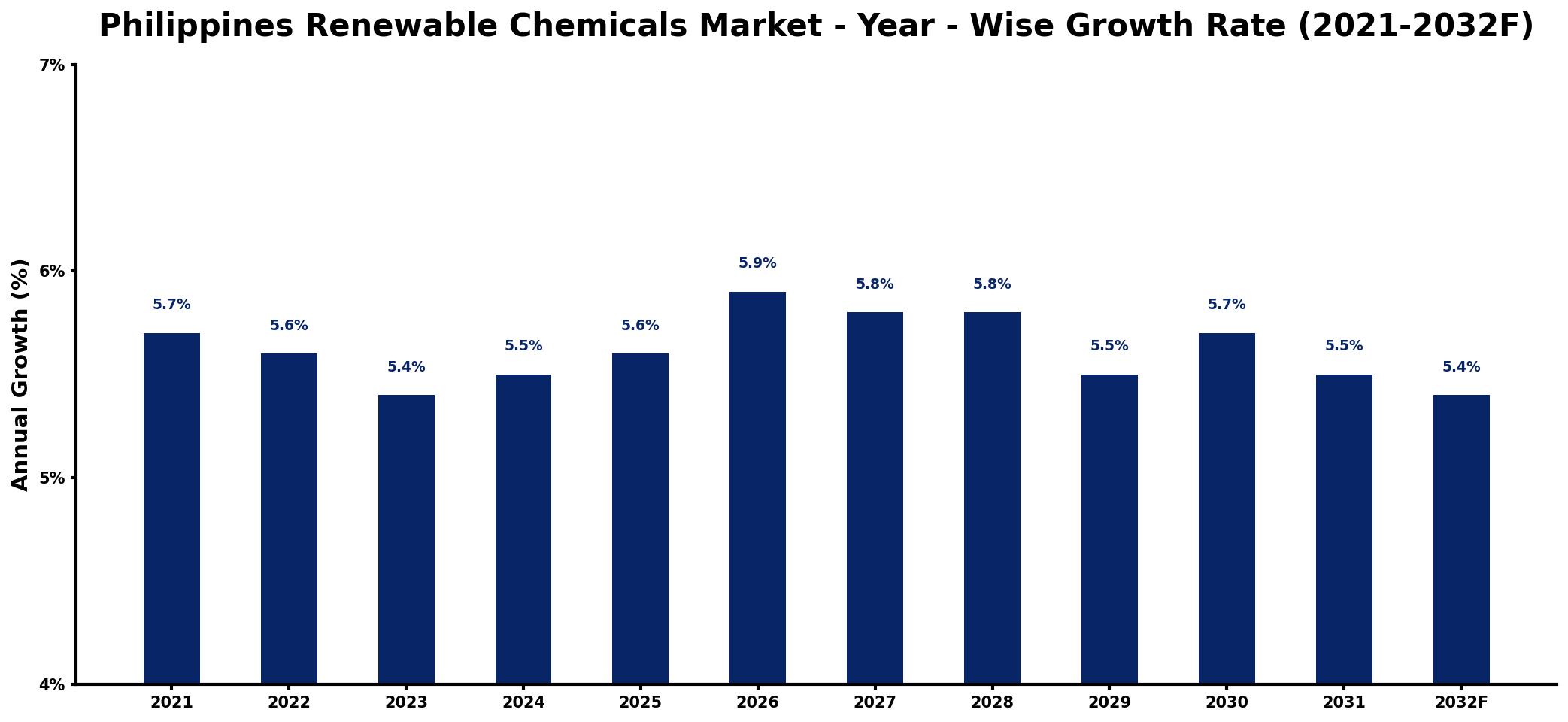
The table below presents the year‑wise growth rates along with the key drivers influencing the market
| Year | Growth Rate | Major Drivers |
| 2021 | 5.7% | Rising consumer sustainability awareness |
| 2022 | 5.6% | Growing investments in bio-based technologies |
| 2023 | 5.4% | Expansion of green supply chains |
| 2024 | 5.5% | Increased government policy support |
| 2025 | 5.6% | Surge in eco-friendly product demand |
| 2026 | 5.9% | Development of innovative production methods |
| 2027 | 5.8% | Strengthening of circular economy initiatives |
| 2028 | 5.8% | Partnerships with agricultural sectors |
| 2029 | 5.5% | Growing market for sustainable packaging |
| 2030 | 5.7% | Advancements in waste-to-energy solutions |
| 2031 | 5.5% | Higher adoption of cleaner alternatives |
| 2032 | 5.4% | Increased consumer preference for sustainability |
Note: Market size estimations and growth projections presented in this report are based on 6Wresearch's proprietary forecasting methodology, utilizing the latest available industry data, government publications, and primary research inputs.
Philippines Renewable Chemicals Market Synopsis
Recent years have seen momentum in the Philippines' renewable chemicals sector, driven by heightened awareness of sustainability and environmental responsibility. As the market evolves, projections indicate significant expansion, supported by investments in biotechnology and bio-based feedstocks, which enhance the production capabilities of renewable chemicals.
However, as the sector prepares for rapid growth, the journey ahead is not without hurdles. The need for technological advancements, reliable supply chains, and broader market acceptance remains crucial for establishing a robust renewable chemicals framework that meets the rising demand.
Philippines Renewable Chemicals Market Key Takeaways
- The market is estimated to grow significantly, reaching USD 605 Million by 2032.
- Increasing focus on sustainable practices drives demand for bio-based chemicals.
- Investment in R&D will enhance production methods and feedstock availability.
- Government policies are becoming more favorable towards renewable chemical initiatives.
- The market has experienced temporary setbacks due to the COVID-19 pandemic but shows resilience.
Evaluation of Restraints in Philippines Renewable Chemicals Market
Despite the optimistic growth outlook, the Philippines Renewable Chemicals Market faces several significant restraints. One major limitation is the current technological capacity for large-scale production of bio-based chemicals. Companies often encounter challenges when scaling up production to meet market needs, which can lead to inefficiencies. Additionally, establishing a reliable supply chain for renewable feedstocks is crucial. Inadequate availability can hinder manufacturers from producing competitively priced products that appeal to both consumers and businesses.
Philippines Renewable Chemicals Market Trends
Current trends highlight a substantial shift towards environmentally friendly materials, emphasizing the growing preference for renewable chemicals across various industries. Notable developments include the increased adoption of bioplastics in packaging and a surge in eco-conscious consumer behavior in sectors like cosmetics and personal care. Moreover, innovative startups are emerging, focusing on sustainable solutions, thus enriching the market landscape with diverse offerings that prioritize environmental stewardship.
Philippines Renewable Chemicals Market Opportunities
The Philippines Renewable Chemicals Market presents numerous growth opportunities for stakeholders. As sectors prioritize sustainability, there is a significant demand for bio-based alternatives in packaging, textiles, and agriculture. This trend opens avenues for investment in R&D focused on improving bio-refinery processes and expanding the range of renewable chemical products. Additionally, partnerships between corporations and research institutions can lead to advancements in technology, further pushing the boundaries of what is possible within the renewable chemicals arena.
Government Initiatives in the Philippines Renewable Chemicals Market
The Philippine government is increasingly recognizing the importance of renewable chemicals as part of its broader sustainability agenda. Initiatives to promote green technologies and bio-based materials are being implemented, fostering a conducive environment for the growth of this market. Policies encouraging the use of renewable resources and offering incentives for research and development are crucial to attracting investments and accelerating the adoption of renewable chemicals across industries.
Future Insights of the Philippines Renewable Chemicals Market
Looking ahead, the Philippines Renewable Chemicals Market is poised for robust growth between 2026 and 2032. As sustainability continues to be a priority across industries, the demand for bio-based chemicals will likely accelerate, driven by advancements in technology and increased regulatory support. Market players who embrace innovation and sustainability will find themselves well-positioned to capitalize on emerging opportunities, thereby contributing to a greener future.
Philippines Renewable Chemicals Market Latest Developments (2025 - 2026)
Recently, there has been an uptick in collaborations between private sector players and academic institutions aimed at developing new bio-based products. Additionally, the exploration of alternative renewable feedstocks has gained traction, signaling a shift towards diversifying sources for bio-based chemicals. Notably, regulatory frameworks are evolving to better support the industry's growth, which could lead to increased investments and enhanced consumer awareness around renewable chemical products.
Philippines Renewable Chemicals Market - Key Attractiveness of the Report
- 10 Years of Market Numbers
- Historical Data Starting from 2022 to 2025
- Base Year: 2025
- Forecast Data until 2032
- Key Performance Indicators Impacting the Market
- Major Upcoming Developments and Projects
Key Highlights of the Report:
- Philippines Renewable Chemicals Market Outlook
- Market Size of Philippines Renewable Chemicals Market, 2025
- Forecast of Philippines Renewable Chemicals Market, 2032
- Historical Data and Forecast of Philippines Renewable Chemicals Revenues & Volume for the Period 2022-2032F
- Philippines Renewable Chemicals Market Trend Evolution
- Philippines Renewable Chemicals Market Drivers and Challenges
- Philippines Renewable Chemicals Price Trends
- Philippines Renewable Chemicals Porter's Five Forces
- Philippines Renewable Chemicals Industry Life Cycle
- Historical Data and Forecast of Philippines Renewable Chemicals Market Revenues & Volume By Product Type for the Period 2022-2032F
- Historical Data and Forecast of Philippines Renewable Chemicals Market Revenues & Volume By Alcohols for the Period 2022-2032F
- Historical Data and Forecast of Philippines Renewable Chemicals Market Revenues & Volume By Organic Acids for the Period 2022-2032F
- Historical Data and Forecast of Philippines Renewable Chemicals Market Revenues & Volume By Ketones for the Period 2022-2032F
- Historical Data and Forecast of Philippines Renewable Chemicals Market Revenues & Volume By Platform Chemicals for the Period 2022-2032F
- Historical Data and Forecast of Philippines Renewable Chemicals Market Revenues & Volume By Biopolymers for the Period 2022-2032F
- Historical Data and Forecast of Philippines Renewable Chemicals Market Revenues & Volume By Others for the Period 2022-2032F
- Historical Data and Forecast of Philippines Renewable Chemicals Market Revenues & Volume By Applications for the Period 2022-2032F
- Historical Data and Forecast of Philippines Renewable Chemicals Market Revenues & Volume By Transportation for the Period 2022-2032F
- Historical Data and Forecast of Philippines Renewable Chemicals Market Revenues & Volume By Textiles for the Period 2022-2032F
- Historical Data and Forecast of Philippines Renewable Chemicals Market Revenues & Volume By Food safety for the Period 2022-2032F
- Historical Data and Forecast of Philippines Renewable Chemicals Market Revenues & Volume By Environment for the Period 2022-2032F
- Historical Data and Forecast of Philippines Renewable Chemicals Market Revenues & Volume By Communication for the Period 2022-2032F
- Historical Data and Forecast of Philippines Renewable Chemicals Market Revenues & Volume By Housing for the Period 2022-2032F
- Historical Data and Forecast of Philippines Renewable Chemicals Market Revenues & Volume By Recreation for the Period 2022-2032F
- Historical Data and Forecast of Philippines Renewable Chemicals Market Revenues & Volume By Other Applications for the Period 2022-2032F
- Philippines Renewable Chemicals Import Export Trade Statistics
- Market Opportunity Assessment By Product Type
- Market Opportunity Assessment By Applications
- Philippines Renewable Chemicals Top Companies Market Share
- Philippines Renewable Chemicals Competitive Benchmarking By Technical and Operational Parameters
- Philippines Renewable Chemicals Company Profiles
- Philippines Renewable Chemicals Key Strategic Recommendations






































