Philippines Renewable Energy Market Growth Rate
According to 6Wresearch internal database and industry insights, the Philippines Renewable Energy Market is projected to grow at a compound annual growth rate (CAGR) of 8.3% during the forecast period (2026-2032).
Philippines Renewable Energy Market Year-wise Growth Rate and Key Drivers
This graph highlights how the Philippines Renewable Energy Market has steadily grown over the past five years, supported by major growth factors.
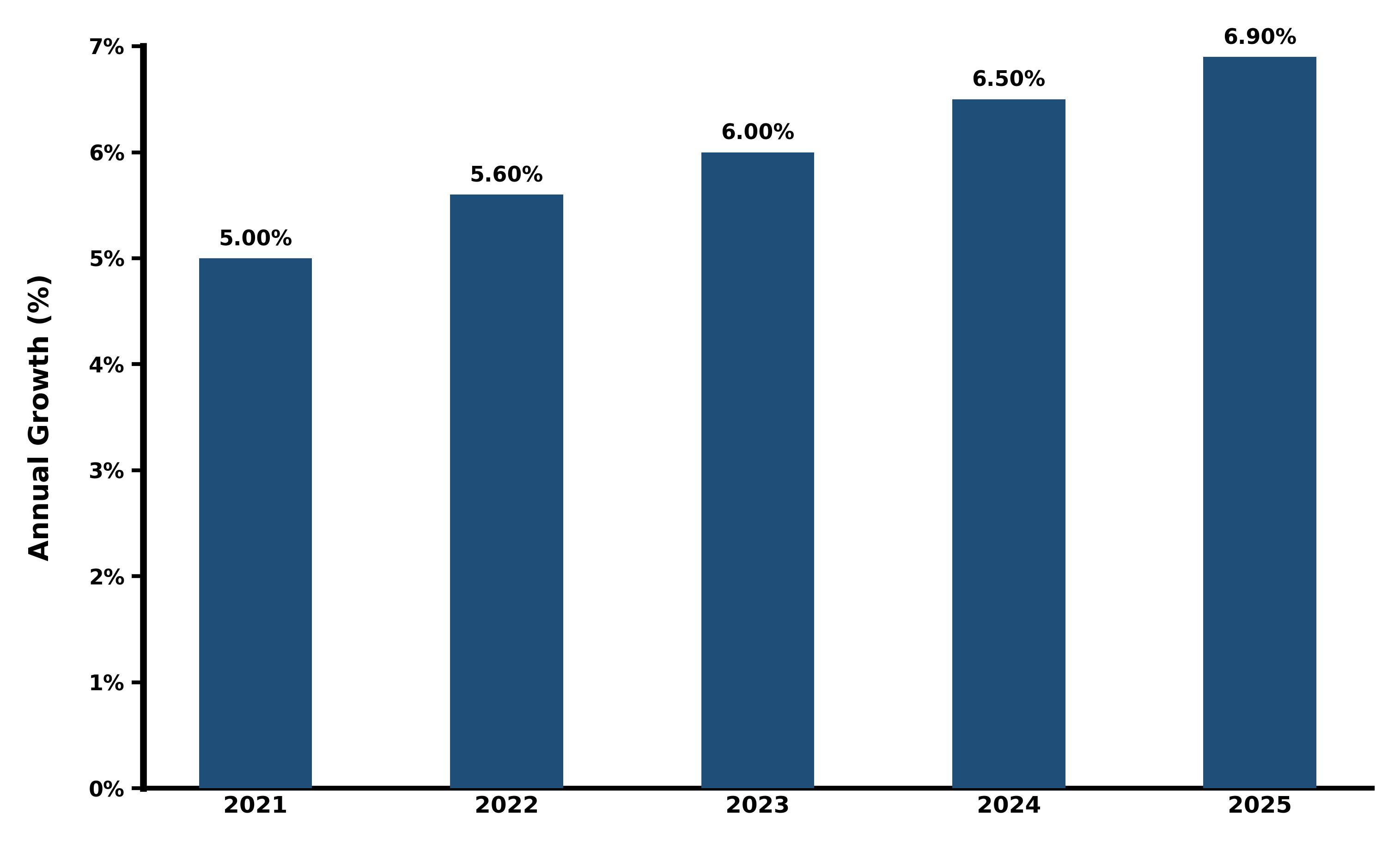
The table below presents the year‑wise growth rates along with the key drivers influencing the market
| Year | Est. Annual Growth | Growth Drivers |
| 2021 | 5% | Government push towards renewable energy and reducing dependence on imported fuel. |
| 2022 | 5.6% | Expansion of solar power generation under government programs. |
| 2023 | 6% | Investment in wind and hydro projects. |
| 2024 | 6.5% | Increased demand for clean energy due to rising power consumption. |
| 2025 | 6.9% | Implementation of renewable energy policies and incentives by the government. |
Topics Covered in the Philippines Renewable Energy Market Report
Philippines Renewable Energy Market report thoroughly covers the market by technology, and end-user. The market report provides an unbiased and detailed analysis of ongoing market trends, opportunities/high growth areas, and market drivers, which would help stakeholders devise and align their market strategies according to the current and future market dynamics.
Philippines Renewable Energy Market Highlights
| Report Name | Philippines Renewable Energy Market |
| Forecast period | 2026-2032 |
| CAGR | 8.3% |
| Growing Sector | Energy & Power |
Philippines Renewable Energy Market Synopsis
The Philippines Renewable Energy Market is expected to see strong growth primarily due to the country's commitment to clean energy and carbon emissions reductions. The combination of government policies to support renewable energy as well as continued investments in solar, wind, and hydro technologies correspond with the increasing demand for power that will inevitably fuel market growth. Additionally, the construction of utility scale solar and wind facilities will increase as government incentives to develop these technologies continue and will promote the utilization of renewable energy solutions to many more customers and thereby hasten the transition to more sustainable energy solutions throughout the country.
Evaluation of Growth Drivers in the Philippines Renewable Energy Market
Below mentioned are some growth drivers and their impact on market dynamics:
| Drivers | Primary Segments Affected | Why It Matters |
| Government Policies & Incentives | Solar, Wind, Utilities | Supports investment in renewable energy and drives adoption of green technologies. |
| Energy Demand & Electrification | Solar, Wind, Residential | Creates a need for sustainable and diversified power sources to meet growing energy demand. |
| Technological Advancements | Solar, Wind, Commercial | Reduces the cost of production and enhances efficiency of renewable energy systems. |
| Foreign Investment & Partnerships | Wind, Solar, Utilities | Brings in capital, expertise, and global technology to accelerate renewable energy adoption. |
| Environmental Impact & Sustainability | Solar, Wind, Residential | Encourages the adoption of cleaner energy solutions to meet environmental goals. |
Philippines Renewable Energy Market is expected to grow significantly, with a CAGR of 8.3% during the forecast period of 2026-2032. The market primarily steers by surging government support, rising environmental worries, and the necessity for energy diversification. Furthermore, one of the significant factors that contribute to the Philippines Renewable Energy Market Growth is the renewable energy foreign investments, which are now more than ever coming in because of the government's incentives for clean energy development, and the technological advancements in solar and wind capabilities. The solar rooftop systems and big wind plants will not stop leading the market.
Evaluation of Restraints in the Philippines Renewable Energy Market
Below mentioned are some major restraints and their influence on market dynamics:
| Restraints | Primary Segments Affected | What This Means |
| High Initial Capital Cost | Solar, Wind, Residential | Limits affordability, particularly for residential and small businesses. |
| Intermittency of Renewable Energy | Solar, Wind, Utilities | Affects power generation stability, requiring backup systems and energy storage solutions. |
| Regulatory & Policy Barriers | Solar, Wind, Commercial | Slows investment and project development due to unclear or lengthy approval processes. |
| Limited Skilled Workforce | Wind, Solar, Commercial | Hampers project execution, maintenance, and scalability. |
| Infrastructure Gaps | Solar, Wind, Residential | Restricts the integration of renewable energy into rural and off-grid areas. |
Philippines Renewable Energy Market Challenges
Philippines Renewable Energy Market Trends
Some major trends contributing to the development of the Philippines Renewable Energy Market
- Solar Power Dominance: The dominance of solar energy will continue as utility-scale projects rapidly expand, more and more government incentives are also driving the market.
- Wind Power Investment: Wind power is being recognized as one of the most important sources of energy, especially in regions with strong winds, thus making the construction of offshore wind farms a new trend.
- Rising Adoption of Energy Storage Solutions: Intermittent power generation will always be a challenge, but the rising use of energy storage systems (batteries) will not only increase grid stability but also make more of renewable energy.
- Smart Grids & Microgrids: Implementation of advanced and intelligent power grid systems to renewables' quicker integration and electricity distribution management.
- Sustainable Urban Development: Urban areas as part of the green building movement will increasingly need renewable energy technologies.
Investment Opportunities in the Philippines Renewable Energy Market
Here are some investment opportunities in the Philippines Renewable Energy Market
- Solar Power Projects: Investment in large-scale solar farms and residential rooftop solar projects.
- Wind Power Development: Opportunities for investment in both onshore and offshore wind energy projects in the Philippines.
- Energy Storage & Grid Solutions: Investment in energy storage technologies such as batteries to ensure a steady energy supply.
- Energy Efficiency Projects: Promoting energy efficiency in industrial, commercial, and residential sectors.
- Hybrid Systems: Development of hybrid power systems (solar + wind + storage) to ensure reliable energy access in remote and off-grid areas.
Top 5 Leading Players in the Philippines Renewable Energy Market
Here are some top companies contributing to Philippines Renewable Energy Market Share:
1. First Gen Corporation
| Company Name | First Gen Corporation |
| Established Year | 1998 |
| Headquarters | Quezon City, Philippines |
| Official Website | Click Here |
2. AC Energy
| Company Name | AC Energy |
| Established Year | 2009 |
| Headquarters | Makati, Philippines |
| Official Website | Click Here |
A subsidiary of Ayala Corporation, investing heavily in renewable energy projects including wind, solar, and hydroelectric power.
3. San Miguel Corporation
| Company Name | San Miguel Corporation |
| Established Year | 1890 |
| Headquarters | Mandaluyong City, Philippines |
| Official Website | Click Here |
Diversified energy company involved in power generation, including renewable energy such as solar and wind.
4. Suzlon Energy
| Company Name | Suzlon Energy |
| Established Year | 1995 |
| Headquarters | Pune, India (Operations in Philippines) |
| Official Website | Click Here |
A global wind energy provider, involved in providing turbines and services for wind energy projects in the Philippines.
5. Enfinity Global
| Company Name | Enfinity Global |
| Established Year | 2008 |
| Headquarters | Manila, Philippines |
| Official Website | Click Here |
Government Regulations Introduced in the Philippines Renewable Energy Market
According to Filipino Government data, The Philippines government has implemented several regulations to support renewable energy growth. The Renewable Energy Act of 2008 provides incentives for renewable energy developers, including feed-in-tariffs and tax exemptions. The National Renewable Energy Program (NREP) aims to increase the share of renewables in the energy mix. Additionally, the Department of Energy (DOE) promotes renewable energy through regulatory frameworks and guidelines for energy producers, while Philippine Energy Plan focuses on accelerating the growth of clean energy sources.
Future Insights of the Philippines Renewable Energy Market
Despite the uncertain times, the Philippines Renewable Energy Market will still experience good growth during the predicted period. The government initiative to cut down on carbon emissions, boost the power output from renewables, and improve energy self-reliance will be the main factors for the surge in the market. The progress in technology, specifically in solar and wind power, will continue to lower prices and raise the efficiency levels. The joining of renewable energy with the national grid, along with the private sector's participation, will be the backbone of market growth.
Market Segmentation Analysis
The report offers a comprehensive study of the subsequent market segments and their leading categories.
Solar to Dominate the Market – By Technology
According to Ritika Kalra, Senior Research Analyst, 6Wresearch, The solar energy segment leads the market due to the abundant sunlight in the Philippines, combined with government incentives and decreasing costs of solar panels. It is a widely adopted source of renewable energy in residential, commercial, and utility sectors.
Utilities to Dominate the Market – By End-User
The utilities segment dominates due to large-scale investments in solar and wind energy projects aimed at diversifying the country’s energy mix. The Philippines government’s push towards clean energy for national grid stability drives growth in this segment.
Key attractiveness of the report
- 10 Years Market Numbers.
- Historical Data Starting from 2022 to 2025.
- Base Year: 2025
- Forecast Data until 2032
- Key Performance Indicators Impacting the Market.
- Major Upcoming Developments and Projects.
Key Highlights of the Report:
- Philippines Renewable Energy Market Outlook
- Market Size of Philippines Renewable Energy Market, 2025
- Forecast of Philippines Renewable Energy Market, 2032
- Historical Data and Forecast of Philippines Renewable Energy Revenues & Volume for the Period 2022-2032
- Philippines Renewable Energy Market Trend Evolution
- Philippines Renewable Energy Market Drivers and Challenges
- Philippines Renewable Energy Price Trends
- Philippines Renewable Energy Porter's Five Forces
- Philippines Renewable Energy Industry Life Cycle
- Historical Data and Forecast of Philippines Renewable Energy Market Revenues & Volume By Technology for the Period 2022-2032
- Historical Data and Forecast of Philippines Renewable Energy Market Revenues & Volume By Wind for the Period 2022-2032
- Historical Data and Forecast of Philippines Renewable Energy Market Revenues & Volume By Solar for the Period 2022-2032
- Historical Data and Forecast of Philippines Renewable Energy Market Revenues & Volume By End-User for the Period 2022-2032
- Historical Data and Forecast of Philippines Renewable Energy Market Revenues & Volume By Utilities for the Period 2022-2032
- Historical Data and Forecast of Philippines Renewable Energy Market Revenues & Volume By Captive Industrial for the Period 2022-2032
- Historical Data and Forecast of Philippines Renewable Energy Market Revenues & Volume By Commercial for the Period 2022-2032
- Historical Data and Forecast of Philippines Renewable Energy Market Revenues & Volume By Residential for the Period 2022-2032
- Philippines Renewable Energy Import Export Trade Statistics
- Market Opportunity Assessment By Technology
- Market Opportunity Assessment By End-User
- Philippines Renewable Energy Top Companies Market Share
- Philippines Renewable Energy Competitive Benchmarking By Technical and Operational Parameters
- Philippines Renewable Energy Company Profiles
- Philippines Renewable Energy Key Strategic Recommendations
Market Covered
The report subsequently covers the market by following segments and subsegments:
By Technology
- Wind
- Solar
By End-User
- Utilities
- Captive Industrial
- Commercial
- Residential






































