Philippines Residential Boiler Market Top 5 Importing Countries and Market Competition (HHI) Analysis
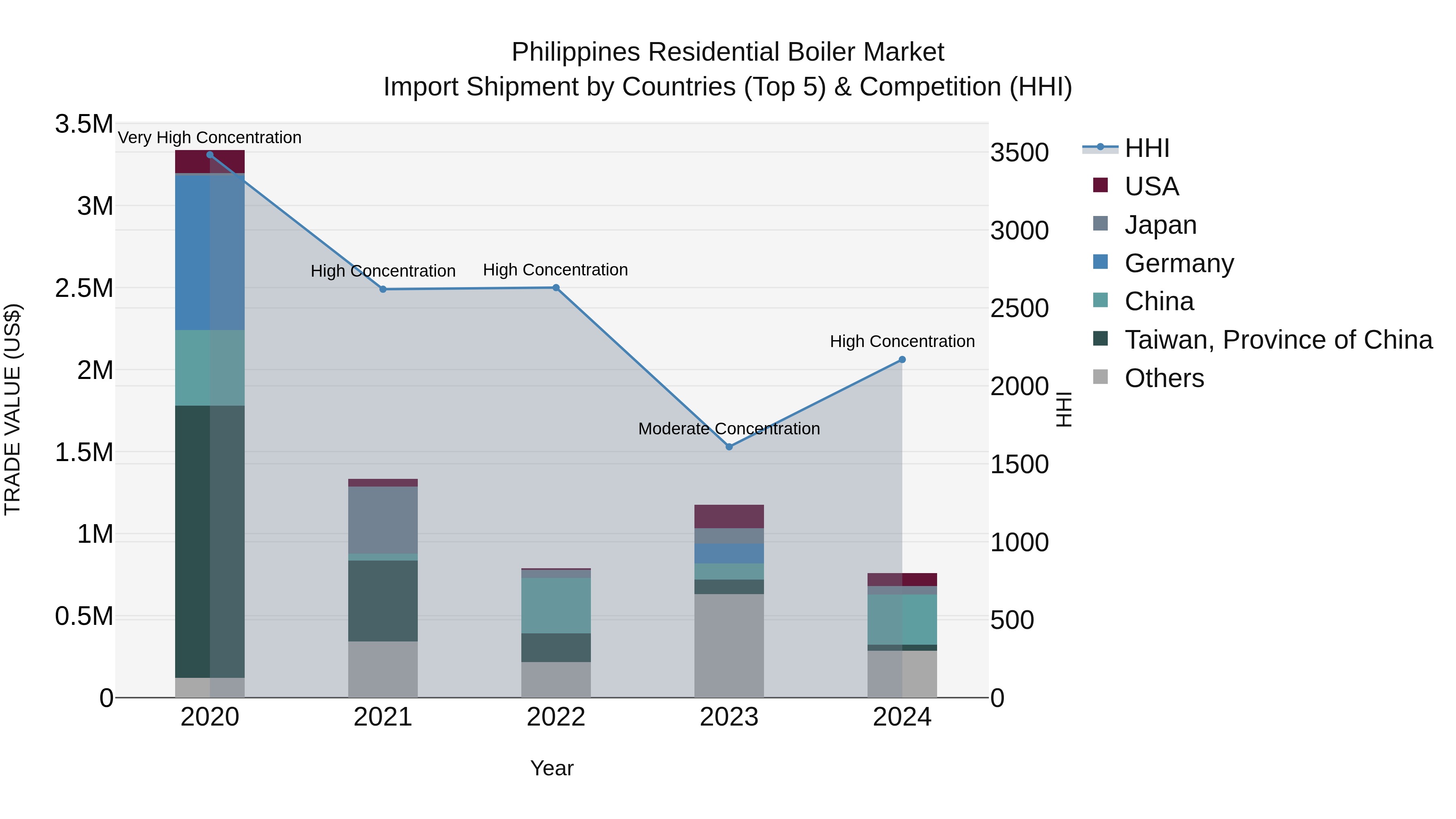
Philippines residential boiler import shipments in 2024 saw a shift in concentration levels, moving from moderate to high concentration. The top exporting countries to the Philippines were China, Australia, USA, Malaysia, and Japan. Despite a challenging CAGR of -30.91% from 2020 to 2024, there was a steeper decline in growth rate in 2024 with a -35.3% decrease compared to the previous year. This data suggests a complex market environment for residential boilers in the Philippines, with potential implications for industry players and stakeholders.
philippines residential boiler market Synopsis
The residential boiler market in Philippines was valued at USD 2 million in 2025 and is projected to grow annually by 5. 1% during the forecast period due to increasing construction activities across residential projects throughout the country coupled with rising energy costs that foster demand for energy efficient heating systems such as boilers among consumers. By technology, condensing boilers have seen highest adoption owing to their high efficiency ratings. Increasing awareness about green building initiatives are driving demand for ecofriendly solutions further bolstering this segment?s dominance. Further, increasing installation base will create opportunities for aftermarket service providers leading to increased associated revenues over forecast period.
Drivers of the Market
The residential boiler market in the Philippines is related to the housing sector and heating requirements. The outlook for residential boilers depends on factors like population growth, urbanization, and changing consumer preferences for heating solutions. As more people move into urban areas and seek comfortable living spaces, the demand for residential boilers might see an uptick, particularly in urban residential developments.
Challenges of the Market
The country`s warm climate makes the adoption of residential heating systems less common, limiting the overall demand for boilers. In some areas, especially rural ones, the lack of proper infrastructure could impede the installation and maintenance of heating systems, including boilers. Many consumers might not be aware of the benefits of residential boilers or how they work. Educating the market about the advantages of such systems could be a challenge.
COVID-19 Impact on the Market
The lockdowns and economic uncertainties resulting from COVID-19 might have affected consumer spending and housing projects, thereby impacting the residential boiler market. Understanding the extent of these effects and gauging the recovery in the housing and construction sectors is crucial to forecasting the future of the residential boiler market.
Key Players in the Market
Key players in the Philippines residential boiler market might include manufacturers such as Bosch Thermotechnology and Radiant Heat Exchanger Private Limited.
Key Highlights of the Report:
- Philippines Residential Boiler Market Outlook
- Market Size of Philippines Residential Boiler Market, 2024
- Forecast of Philippines Residential Boiler Market, 2031
- Historical Data and Forecast of Philippines Residential Boiler Revenues & Volume for the Period 2021-2031
- Philippines Residential Boiler Market Trend Evolution
- Philippines Residential Boiler Market Drivers and Challenges
- Philippines Residential Boiler Price Trends
- Philippines Residential Boiler Porter's Five Forces
- Philippines Residential Boiler Industry Life Cycle
- Historical Data and Forecast of Philippines Residential Boiler Market Revenues & Volume By Type for the Period 2021-2031
- Historical Data and Forecast of Philippines Residential Boiler Market Revenues & Volume By Water Tube Boiler for the Period 2021-2031
- Historical Data and Forecast of Philippines Residential Boiler Market Revenues & Volume By Fire Tube Boiler for the Period 2021-2031
- Historical Data and Forecast of Philippines Residential Boiler Market Revenues & Volume By Electric Boiler for the Period 2021-2031
- Historical Data and Forecast of Philippines Residential Boiler Market Revenues & Volume By Fuel Type for the Period 2021-2031
- Historical Data and Forecast of Philippines Residential Boiler Market Revenues & Volume By Coal Fired for the Period 2021-2031
- Historical Data and Forecast of Philippines Residential Boiler Market Revenues & Volume By Oil Fired for the Period 2021-2031
- Historical Data and Forecast of Philippines Residential Boiler Market Revenues & Volume By Gas Fired for the Period 2021-2031
- Historical Data and Forecast of Philippines Residential Boiler Market Revenues & Volume By Others for the Period 2021-2031
- Historical Data and Forecast of Philippines Residential Boiler Market Revenues & Volume By Technology for the Period 2021-2031
- Historical Data and Forecast of Philippines Residential Boiler Market Revenues & Volume By Condensing for the Period 2021-2031
- Historical Data and Forecast of Philippines Residential Boiler Market Revenues & Volume By Non-condensing for the Period 2021-2031
- Philippines Residential Boiler Import Export Trade Statistics
- Market Opportunity Assessment By Type
- Market Opportunity Assessment By Fuel Type
- Market Opportunity Assessment By Technology
- Philippines Residential Boiler Top Companies Market Share
- Philippines Residential Boiler Competitive Benchmarking By Technical and Operational Parameters
- Philippines Residential Boiler Company Profiles
- Philippines Residential Boiler Key Strategic Recommendations






































