Philippines Retail And Wholesale Market Top 5 Importing Countries and Market Competition (HHI) Analysis
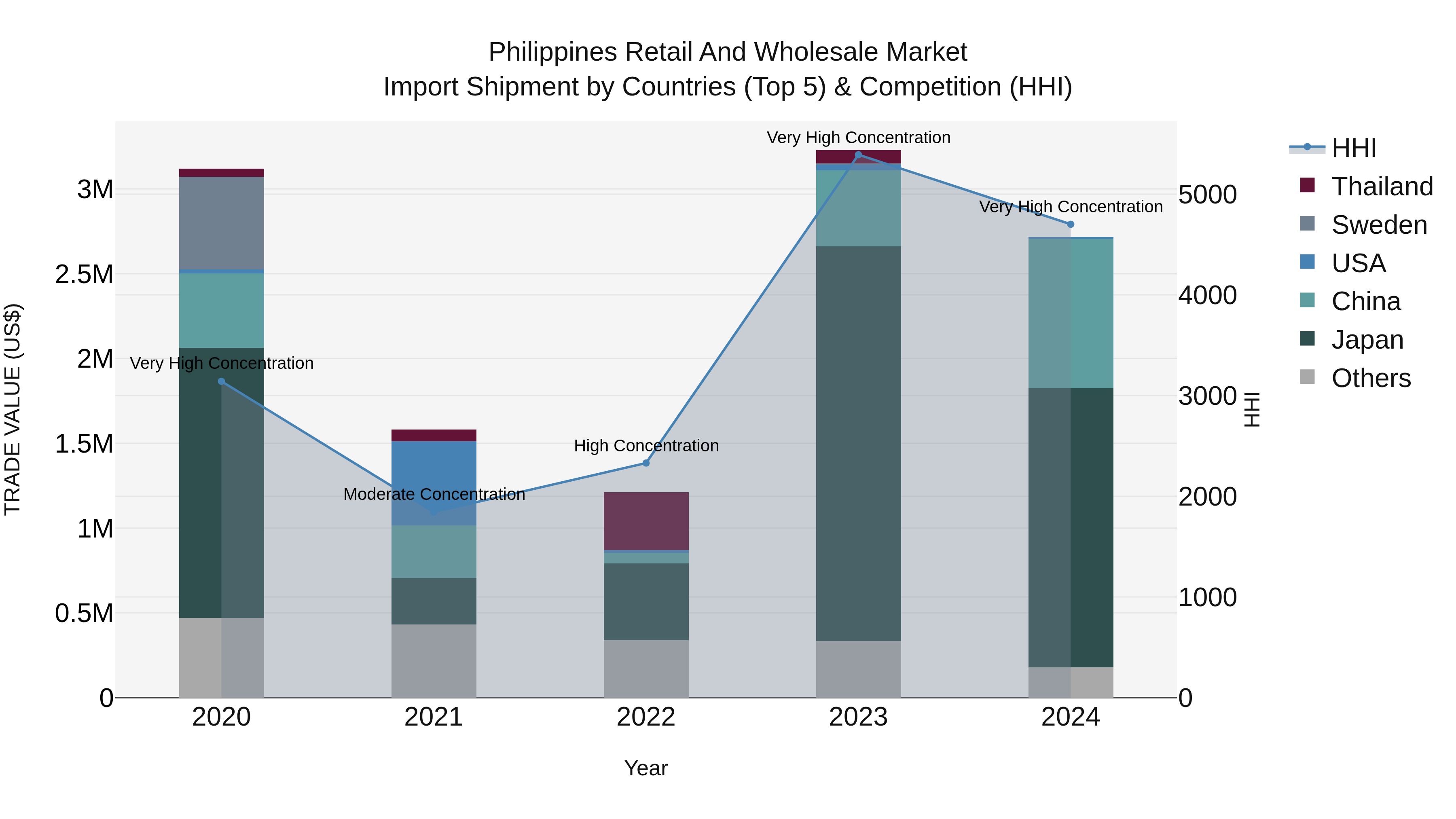
Despite a high Herfindahl-Hirschman Index (HHI) indicating market concentration, Philippines` retail and wholesale import shipments in 2024 saw significant contributions from top exporters like Japan, China, Malaysia, Mexico, and New Zealand. However, the industry experienced a decline with a Compound Annual Growth Rate (CAGR) of -3.39% from 2020 to 2024. The growth rate from 2023 to 2024 further declined by -15.84%, presenting challenges and opportunities for stakeholders to navigate the evolving market dynamics.
philippines retail and wholesale market Synopsis
The Philippines retail and wholesale market is a dynamic and vibrant sector that plays a crucial role in the country`s economy. With a growing middle class and increasing consumer spending, the market offers a wide range of products and services, both locally produced and imported. From traditional brick-and-mortar stores to modern shopping centers and e-commerce platforms, consumers have diverse options for their shopping needs. The retail and wholesale industry is characterized by its adaptability to changing consumer preferences and the adoption of digital technologies to enhance customer experience.
Drivers of the Market
The growth of the retail and wholesale market in the Philippines is propelled by several significant drivers. The country`s increasing population, rising disposable income, and urbanization have led to a greater demand for diverse products and services. Technological advancements, such as e-commerce and digital payment systems, have transformed the way consumers shop and interact with businesses. Additionally, tourism and the growth of the middle class contribute to the expansion of retail and wholesale activities.
Challenges of the Market
While the Philippines retail and wholesale market thrives, it faces specific challenges. Adapting to changing consumer preferences, ensuring efficient supply chain management, and providing a seamless omnichannel shopping experience are ongoing considerations. Balancing traditional brick-and-mortar retail with the digital landscape, addressing competition from international and online retailers, and meeting stringent regulatory requirements are challenges that businesses must navigate. Additionally, ensuring fair pricing and offering high-quality products remain important factors in maintaining consumer trust.
COVID-19 Impact on the Market
The Covid-19 pandemic has significantly impacted the Philippines retail and wholesale market. Lockdowns, mobility restrictions, and changes in consumer behavior disrupted business operations and supply chains. However, the pandemic accelerated the adoption of digital platforms and e-commerce solutions, highlighting the adaptability of the retail and wholesale sector to changing circumstances. As businesses pivot and consumers embrace online shopping, the demand for flexible and convenient retail options remains resilient.
Key Players in the Market
Several key players have emerged as influential contributors to the Philippines retail and wholesale market. Companies such as SM Retail, Robinsons Retail Holdings, and Puregold Price Club have played pivotal roles in shaping the retail landscape and providing a wide range of products and services to consumers.
Key Highlights of the Report:
- Philippines Retail And Wholesale Market Outlook
- Market Size of Philippines Retail And Wholesale Market, 2024
- Forecast of Philippines Retail And Wholesale Market, 2031
- Historical Data and Forecast of Philippines Retail And Wholesale Revenues & Volume for the Period 2021-2031
- Philippines Retail And Wholesale Market Trend Evolution
- Philippines Retail And Wholesale Market Drivers and Challenges
- Philippines Retail And Wholesale Price Trends
- Philippines Retail And Wholesale Porter's Five Forces
- Philippines Retail And Wholesale Industry Life Cycle
- Historical Data and Forecast of Philippines Retail And Wholesale Market Revenues & Volume By Type for the Period 2021-2031
- Historical Data and Forecast of Philippines Retail And Wholesale Market Revenues & Volume By Retail for the Period 2021-2031
- Historical Data and Forecast of Philippines Retail And Wholesale Market Revenues & Volume By Wholesale for the Period 2021-2031
- Historical Data and Forecast of Philippines Retail And Wholesale Market Revenues & Volume By Ownership for the Period 2021-2031
- Historical Data and Forecast of Philippines Retail And Wholesale Market Revenues & Volume By Retail Chain/Wholesale Chain for the Period 2021-2031
- Historical Data and Forecast of Philippines Retail And Wholesale Market Revenues & Volume By Independent Retailer/Independent Wholesalers for the Period 2021-2031
- Historical Data and Forecast of Philippines Retail And Wholesale Market Revenues & Volume By Price Range for the Period 2021-2031
- Historical Data and Forecast of Philippines Retail And Wholesale Market Revenues & Volume By Premium for the Period 2021-2031
- Historical Data and Forecast of Philippines Retail And Wholesale Market Revenues & Volume By Mid-Range for the Period 2021-2031
- Historical Data and Forecast of Philippines Retail And Wholesale Market Revenues & Volume By Economy for the Period 2021-2031
- Historical Data and Forecast of Philippines Retail And Wholesale Market Revenues & Volume By Distribution Channel for the Period 2021-2031
- Historical Data and Forecast of Philippines Retail And Wholesale Market Revenues & Volume By Supermarkets/Hypermarkets for the Period 2021-2031
- Historical Data and Forecast of Philippines Retail And Wholesale Market Revenues & Volume By Convenience Stores for the Period 2021-2031
- Historical Data and Forecast of Philippines Retail And Wholesale Market Revenues & Volume By Department Stores for the Period 2021-2031
- Historical Data and Forecast of Philippines Retail And Wholesale Market Revenues & Volume By Specialty Stores for the Period 2021-2031
- Philippines Retail And Wholesale Import Export Trade Statistics
- Market Opportunity Assessment By Type
- Market Opportunity Assessment By Ownership
- Market Opportunity Assessment By Price Range
- Market Opportunity Assessment By Distribution Channel
- Philippines Retail And Wholesale Top Companies Market Share
- Philippines Retail And Wholesale Competitive Benchmarking By Technical and Operational Parameters
- Philippines Retail And Wholesale Company Profiles
- Philippines Retail And Wholesale Key Strategic Recommendations






































