Philippines Revolvers Market Size, Share & Growth Rate
The Philippines Revolvers Market was estimated at USD 465 Million in 2025 and is projected to reach USD 851 Million by 2032, growing at a CAGR of 9.0% from 2026 to 2032. This impressive growth trajectory is driven by a combination of rising consumer interest in personal defense, coupled with the strengthening of local firearm manufacturing capabilities. Additionally, the ongoing evolution of regulatory frameworks is facilitating access to revolvers for various segments of the population, further bolstering market dynamics.
Philippines Revolvers Market Year-wise Growth Rate and Key Drivers
This graph highlights how the Philippines Revolvers Market has steadily grown over the years, supported by major growth factors.
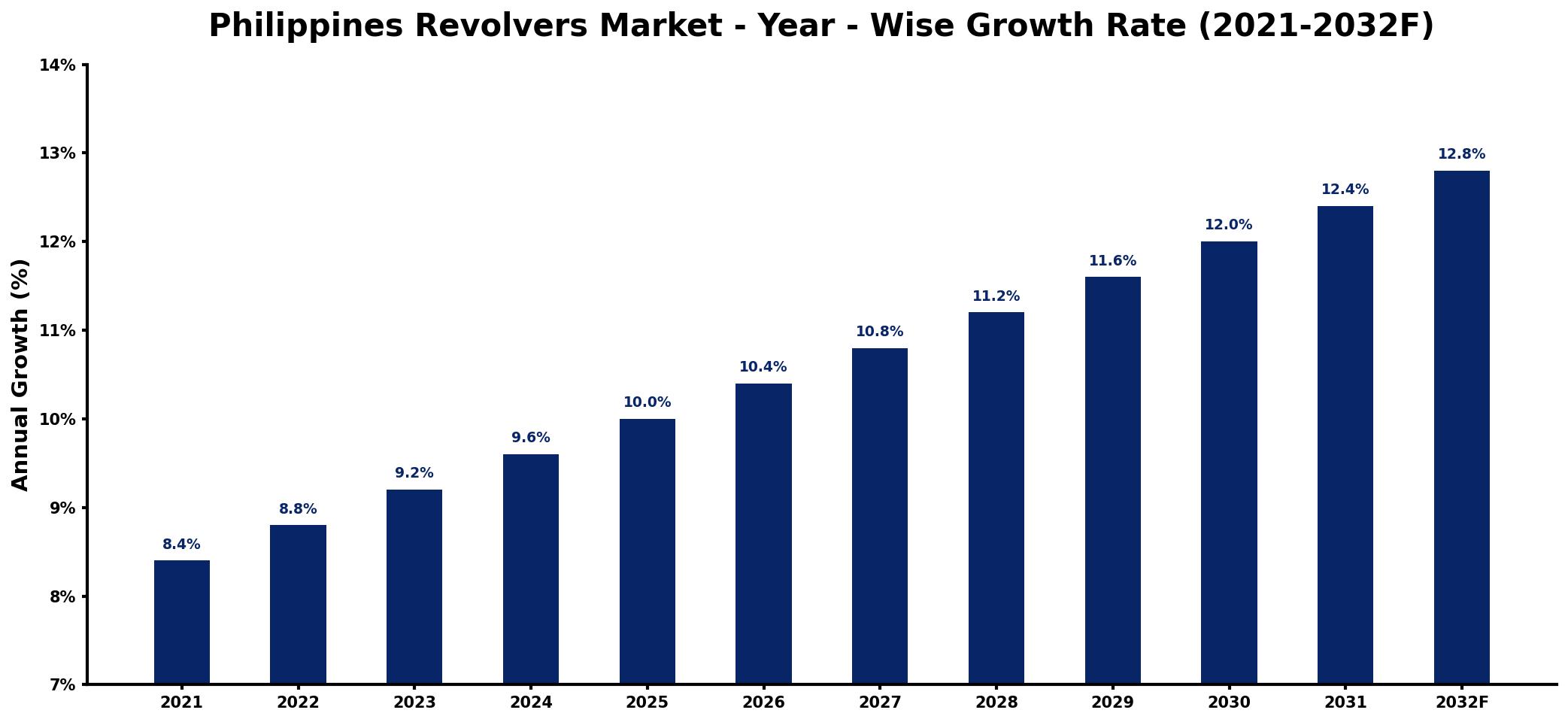
The table below presents the year‑wise growth rates along with the key drivers influencing the market
| Year | Growth Rate | Major Drivers |
| 2021 | 8.4% | Rising consumer interest firearms |
| 2022 | 8.8% | Increased recreational shooting activities |
| 2023 | 9.2% | Growing demand self-defense products |
| 2024 | 9.6% | Expansion of shooting ranges |
| 2025 | 10.0% | Surge in hunting participation rates |
| 2026 | 10.4% | Higher investments firearm accessories |
| 2027 | 10.8% | Emergence new shooting sports |
| 2028 | 11.2% | Enhanced firearm safety education programs |
| 2029 | 11.6% | Development advanced training facilities |
| 2030 | 12.0% | Strengthened community defense initiatives |
| 2031 | 12.4% | Increase in firearm ownership awareness |
| 2032 | 12.8% | Growing popularity outdoor adventures |
Note: Market size estimations and growth projections presented in this report are based on 6Wresearch's proprietary forecasting methodology, utilizing the latest available industry data, government publications, and primary research inputs.
Philippines Revolvers Market Synopsis
In recent years, the Philippines revolvers market has experienced notable momentum, reflecting a growing acceptance of firearms for personal safety and sporting purposes. As consumers become increasingly aware of their rights and responsibilities regarding gun ownership, the market is expected to evolve dramatically, driven by innovations and expanded product lines.
Looking ahead, the market is positioned for continued expansion. The interplay of local manufacturing growth, increased defense awareness among civilians, and proactive government initiatives is expected to significantly influence market dynamics. As urbanization continues, the demand for personal protection solutions will further catalyze the evolution of the revolvers market in the Philippines.
Philippines Revolvers Market Key Takeaways
- The market is set to grow significantly, with increasing interest in personal and home defense contributing to a favorable environment.
- Local manufacturing capabilities are expanding, promoting innovation and accessibility in the revolver segment.
- Regulatory developments are becoming more consumer-friendly, thereby enhancing legal access to revolvers.
- Urbanization trends are creating heightened demand for personal protection solutions among the population.
- Investment in education around responsible gun ownership is fostering a more informed consumer base.
Evaluation of Restraints in Philippines Revolvers Market
Despite the promising growth of the revolvers market in the Philippines, several constraints may hinder its potential. The regulatory landscape can be complex, with varying interpretations affecting consumer confidence. Moreover, economic factors such as inflation may impact disposable income, influencing purchase behavior. Additionally, there can be societal resistance to gun ownership, often rooted in historical context, which could limit market penetration. Addressing these challenges will require a collaborative effort among stakeholders to promote responsible ownership and further enhance regulatory clarity.
Philippines Revolvers Market Trends
The revolvers market is currently shaped by several emerging trends. An increase in tactical and personal defense training programs is heightening the demand for revolvers as individuals seek proficiency in firearm use. Furthermore, technology integration, such as smart revolvers with safety features, is capturing the attention of tech-savvy consumers. The trend toward customization and personal branding is also evident, with consumers increasingly looking for revolvers that reflect their personal style and preferences.
Philippines Revolvers Market Opportunities
Significant growth opportunities lie in niche markets, such as self-defense training for women and youth engagement in responsible firearm ownership. Leveraging e-commerce platforms for distribution can tap into a broader audience, particularly in urban areas. Additionally, fostering partnerships with safety training organizations can enhance product visibility and consumer trust, further opening avenues for market expansion. The growing trend of lifestyle branding in firearms can also create opportunities for new entrants focused on unique selling propositions.
Government Initiatives in the Philippines Revolvers Market
The Philippine government is gradually implementing initiatives aimed at enhancing the regulatory framework surrounding firearm ownership. Programs promoting responsible gun ownership and safety training are being established to educate citizens about safe practices. Furthermore, the government is exploring partnerships with private entities to bolster local manufacturing of firearms, thus supporting economic development while ensuring that safety standards are met. These initiatives reflect a commitment to balancing individual rights with public safety concerns.
Future Insights of the Philippines Revolvers Market
From 2026 to 2032, the Philippines revolvers market is likely to witness transformative changes driven by evolving consumer attitudes and enhanced product offerings. The expansion of local manufacturing capabilities will enable more rapid innovation and competitive pricing, making revolvers more accessible. Moreover, as social acceptance of responsible firearm ownership continues to grow, there will be a stronger emphasis on training and education, positioning the market for sustained growth and alignment with global best practices.
Philippines Revolvers Market Latest Developments (2025 - 2026)
Recent developments in the Philippines revolvers market indicate a shift towards modernization and increased safety standards. The introduction of new products featuring advanced safety mechanisms and consumer-driven designs is becoming more prevalent. Furthermore, collaborative efforts between government agencies and private manufacturers are underway to enhance the local production capabilities, ensuring compliance with international standards while catering to local demands.
Philippines Revolvers Market - Key Attractiveness of the Report
- 10 Years of Market Numbers
- Historical Data Starting from 2022 to 2025
- Base Year: 2025
- Forecast Data until 2032
- Key Performance Indicators Impacting the Market
- Major Upcoming Developments and Projects
Key Highlights of the Report:
- Philippines Revolvers Market Outlook
- Market Size of Philippines Revolvers Market, 2025
- Forecast of Philippines Revolvers Market, 2032
- Historical Data and Forecast of Philippines Revolvers Revenues & Volume for the Period 2022-2032F
- Philippines Revolvers Market Trend Evolution
- Philippines Revolvers Market Drivers and Challenges
- Philippines Revolvers Price Trends
- Philippines Revolvers Porter's Five Forces
- Philippines Revolvers Industry Life Cycle
- Historical Data and Forecast of Philippines Revolvers Market Revenues & Volume By Product Type for the Period 2022-2032F
- Historical Data and Forecast of Philippines Revolvers Market Revenues & Volume By Semi Automatic Revolvers for the Period 2022-2032F
- Historical Data and Forecast of Philippines Revolvers Market Revenues & Volume By Single and Double Action Revolvers for the Period 2022-2032F
- Historical Data and Forecast of Philippines Revolvers Market Revenues & Volume By Applications for the Period 2022-2032F
- Historical Data and Forecast of Philippines Revolvers Market Revenues & Volume By Civil for the Period 2022-2032F
- Historical Data and Forecast of Philippines Revolvers Market Revenues & Volume By Military for the Period 2022-2032F
- Philippines Revolvers Import Export Trade Statistics
- Market Opportunity Assessment By Product Type
- Market Opportunity Assessment By Applications
- Philippines Revolvers Top Companies Market Share
- Philippines Revolvers Competitive Benchmarking By Technical and Operational Parameters
- Philippines Revolvers Company Profiles
- Philippines Revolvers Key Strategic Recommendations






































