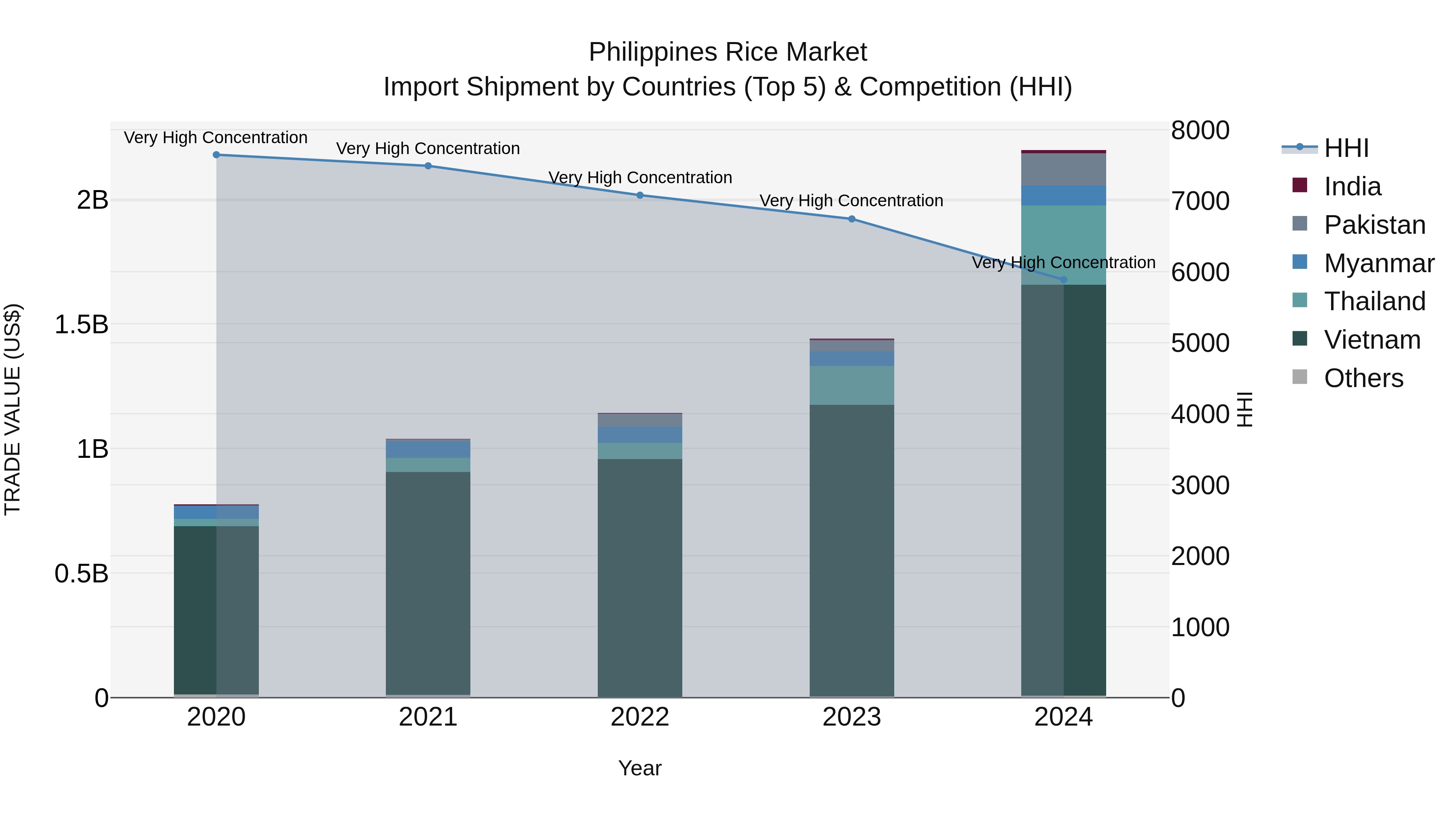
Philippines Rice Market Top 5 Importing Countries and Market Competition (HHI) Analysis
The Philippines continued to rely on rice imports in 2024, with Vietnam, Thailand, Pakistan, Myanmar, and India being the top exporting countries. The high Herfindahl-Hirschman Index (HHI) indicates a concentrated market. The impressive Compound Annual Growth Rate (CAGR) of 29.7% from 2020-2024 highlights the increasing demand for rice imports. Furthermore, the significant growth rate of 52.46% from 2023-2024 suggests a rapid expansion in the rice import market, reflecting evolving consumer preferences and economic factors.
Rice Market: Philippines vs Top 5 Major Economies in 2027 (Asia)
The Rice market in Philippines is projected to grow at a growing growth rate of 5.59% by 2027, within the Asia region led by China, along with other countries like India, Japan, Australia and South Korea, collectively shaping a dynamic and evolving market environment driven by innovation and increasing adoption of emerging technologies.

Philippines Rice Market Growth Rate
According to 6Wresearch internal database and industry insights, the Philippines Rice Market is projected to grow at a compound annual growth rate (CAGR) of 5.5% during the forecast period 2026–2032.
Topics Covered in the Philippines Rice Market Report
The Philippines Rice Market report thoroughly covers the market by rice length, type, product type, application, and distribution channel. The report provides a detailed analysis of ongoing market trends, opportunities/high-growth areas, and market drivers, helping stakeholders devise and align their market strategies according to current and future market dynamics.
Philippines Rice Market Highlights
| Report Name | Philippines Rice Market |
| Forecast Period | 2026–2032 |
| CAGR | 5.50% |
| Growing Sector | Agriculture and Food Processing |
Philippines Rice Market Synopsis
Due to rising demand for rise as a staple food, the Philippines rice industry is poised for firm growth. Furthermore, the market is bolstered through government measures aiding domestic production of rice. Along with this, the technology in farming practices is also enhancing. The rice processing industries are growing, with company growing focus on agricultural sustainability. Rising demand for specialized rice varieties, including aromatic and organic rice, further fuels the market's development.
Evaluation of Growth Drivers in the Philippines Rice Market
Below are some prominent drivers and their influence on the market dynamics:
| Drivers | Primary Segments Affected | Why It Matters |
| Government Initiatives | By Product Type (Regular, Aromatic) | Government policies supporting rice production and sustainability boost the market. |
| Population Growth | By Application (Food, Industry) | Increased population drives demand for rice as a primary food source. |
| Technological Advancements | By Rice Length (Long Grain, Medium Grain, Short Grain) | Improvements in agricultural technology improve yields and rice quality. |
| Export Opportunities | By Distribution Channel (Supermarket, E-commerce) | Expanding export market for rice promotes growth in production and processing. |
| Consumer Preferences | By Type (Red Rice, Black Rice) | Rising preference for organic and specialized rice varieties supports market expansion. |
The Philippines Rice Market Size is projected to grow at a CAGR of 5.5% during the forecast period 2026–2032. There are various factors supporting the growth of this industry. Increasing population and rising demand for rice as a staple food is a major factor in facilitating market growth. In addition to this, the technology in rice cultivation is also improving, which enhance yield efficiency. The demand for specialized rice varieties, such as organic, aromatic, and black rice, is rising among consumers, thus providing better market opportunities. In addition to this, the export market and need for processed rice products is also increasing. Therefore, considering all these factors, Philippines Rice Market Growth is anticipated.
Evaluation of Restraints in the Philippines Rice Market
Below are some prominent restraints and their influence on the market dynamics:
| Restraints | Primary Segments Affected | What This Means |
| High Cost of Production | By Product Type (Regular, Aromatic) | High production costs may limit profitability for small farmers. |
| Limited Storage Infrastructure | By Rice Length (Long Grain, Medium Grain, Short Grain) | Insufficient storage facilities may lead to post-harvest losses. |
| Dependence on Importation | By Distribution Channel (Supermarket, E-commerce) | Market volatility is a result of heavy import dependency for rice. |
| Environmental Factors | By Type (Red Rice, Black Rice) | The rice production is affected due to Climate change and adverse weather conditions. |
Philippines Rice Market Challenges
The Philippines rice market faces challenges through three main factors which include high production costs, insufficient storage capacity and its reliance on rice imports. Environmental factors which include climate change and unpredictable weather patterns directly impact rice production. Government support and agricultural technological progress will help to reduce existing challenges and create opportunities for the local rice industry to expand its operations.
Philippines Rice Market Trends
Some major trends contributing to the Philippines Rice Market growth are:
- Rise of Organic Rice: The market for organic products has expanded as consumers now prefer organic rice and other organic products due to their increased health awareness and environmental sustainability knowledge.
- E-commerce for Rice Sales: E-commerce platforms are making it easier to purchase rice for urban consumers which has led to market growth.
- Technological Advancements in Rice Production: The launch of genetically enhanced seeds and automated harvesting systems for rice farming has resulted in higher yields and better-quality products which benefit domestic markets and export needs.
- Sustainability Initiatives: The market appeal for sustainable rice production methods grows through government and industry support which promotes reduced pesticide usage and water conservation techniques.
Investment Opportunities in the Philippines Rice Market
Some investment opportunities that will shape the dynamics of the Philippines Rice Market include:
- Expansion of Rice Processing Facilities: The existing rice milling and processing facilities require expansion as here is an increasing demand from both domestic markets and export markets for processed rice products.
- Development of Storage Infrastructure: Companies are working on developing advanced storage solutions to reduce post-harvest losses and improve their supply chain efficiency.
- E-commerce Platforms for Rice: The expansion of e-commerce platforms dedicated to rice sales will provide rice suppliers with an effective method to distribute their products to both urban and remote customers.
- Agricultural Technology Innovations: Investing in cutting-edge agricultural technologies such as automated harvesting systems and improved irrigation techniques will increase rice productivity and market supply.
Top 5 Leading Players in the Philippines Rice Market
Below is the list of prominent companies leading the Philippines Rice Market Share:
1. Philippine Rice Research Institute (PhilRice)
| Company Name | Philippine Rice Research Institute (PhilRice) |
| Established Year | 1985 |
| Headquarters | Nueva Ecija, Philippines |
| Official Website | Click Here |
PhilRice is a government agency focused on rice research, with contributions to improving rice yield, pest resistance, and sustainability practices in the Philippines rice industry.
2. National Food Authority (NFA)
| Company Name | National Food Authority (NFA) |
| Established Year | 1972 |
| Headquarters | Quezon City, Philippines |
| Official Website | Click Here |
The NFA plays a key role in regulating and distributing rice in the Philippines, ensuring food security and a stable supply of rice for consumers across the country.
3. Santo Tomas Trading Corporation
| Company Name | Santo Tomas Trading Corporation |
| Established Year | 1979 |
| Headquarters | Manila, Philippines |
| Official Website | Click Here |
Santo Tomas is one of the leading rice suppliers in the Philippines, offering a wide variety of rice products to meet both domestic and international demands.
4. Rice Terraces Foods Corporation
| Company Name | Rice Terraces Foods Corporation |
| Established Year | 1995 |
| Headquarters | Baguio City, Philippines |
| Official Website | - |
Known for producing high-quality organic rice varieties, Rice Terraces Foods focuses on the premium segment and caters to health-conscious consumers.
5. San Miguel Corporation
| Company Name | San Miguel Corporation |
| Established Year | 1890 |
| Headquarters | Mandaluyong, Philippines |
| Official Website | Click Here |
San Miguel Corporation, a leading diversified conglomerate, operates in the rice production and processing sector through its various subsidiaries, ensuring a steady supply of rice to the market.
Government Regulations in the Philippines Rice Market
According to Philippine government data, the rice industry is managed by the National Food Authority (NFA) and the Philippine Rice Research Institute (PhilRice). The government has formed guidelines for rice importation, quality control, pricing, and distribution to ensure a stable supply of rice. In addition, the Department of Agriculture (DA) encourages sustainable rice farming practices and the adoption of innovative agricultural technologies.
Future Insights of the Philippines Rice Market
The Philippines Rice Market is forecasted to witness firm growth, driven by the surging need for rice as a staple food, government initiatives to promote agricultural sustainability, and technological advancements in rice production. The rising requirement for specialized rice types, such as organic and aromatic varieties, alongside the expansion of rice processing and export opportunities, will continue to drive market growth.
Market Segmentation Analysis
The report offers a comprehensive study of the following market segments and their leading categories:
By Rice Length – Long Grain to Lead the Market
According to Rashika, Senior Research Analyst, 6Wresearch, Long grain rice is expected to lead the Philippines rice market, due to its popularity for cooking and preference among Filipino consumers for everyday meals.
By Type – Regular Rice to Lead the Market
Regular rice will continue to dominate the market due to its high use in Filipino households for daily consumption, offering affordability and accessibility for the majority.
By Product Type – Aromatic Rice to Gain Popularity
Aromatic rice, including varieties like Jasmine and Basmati, is gaining popularity for its delightful fragrance and premium quality, attracting affluent consumers seeking distinctive flavors.
By Application – Food to Lead the Market
Food-grade rice will always constitute the largest market segment, simply since rice constitutes the staple diet of the Philippine population, being served up at everyday meals and constituting the main component of nutrition to Filipino diets.
By Distribution Channel – Supermarket to Lead the Market
Supermarkets and hypermarkets will maintain its position as leading distribution channels as they provide customers with easy access to numerous rice brands and types through their wide distribution network.
Key Attractiveness of the Report
- 10 Years of Market Numbers
- Historical Data Starting from 2022 to 2025
- Base Year: 2025
- Forecast Data until 2032
- Key Performance Indicators Impacting the Market
- Major Upcoming Developments and Projects
Key Highlights of the Report:
- Philippines Rice Market Outlook
- Market Size of Philippines Rice Market, 2025
- Forecast of Philippines Rice Market, 2032
- Historical Data and Forecast of Philippines Rice Revenues & Volume for the Period 2022-2032F
- Philippines Rice Market Trend Evolution
- Philippines Rice Market Drivers and Challenges
- Philippines Rice Price Trends
- Philippines Rice Porter's Five Forces
- Philippines Rice Industry Life Cycle
- Historical Data and Forecast of Philippines Rice Market Revenues & Volume By Rice Length for the Period 2022-2032F
- Historical Data and Forecast of Philippines Rice Market Revenues & Volume By Long Grain for the Period 2022-2032F
- Historical Data and Forecast of Philippines Rice Market Revenues & Volume By Medium Grain for the Period 2022-2032F
- Historical Data and Forecast of Philippines Rice Market Revenues & Volume By Short Grain for the Period 2022-2032F
- Historical Data and Forecast of Philippines Rice Market Revenues & Volume By Type for the Period 2022-2032F
- Historical Data and Forecast of Philippines Rice Market Revenues & Volume By Red Rice for the Period 2022-2032F
- Historical Data and Forecast of Philippines Rice Market Revenues & Volume By Arborio Rice for the Period 2022-2032F
- Historical Data and Forecast of Philippines Rice Market Revenues & Volume By Black Rice for the Period 2022-2032F
- Historical Data and Forecast of Philippines Rice Market Revenues & Volume By Grain Fragrance Rice for the Period 2022-2032F
- Historical Data and Forecast of Philippines Rice Market Revenues & Volume By Brown Rice for the Period 2022-2032F
- Historical Data and Forecast of Philippines Rice Market Revenues & Volume By Rosematta Rice for the Period 2022-2032F
- Historical Data and Forecast of Philippines Rice Market Revenues & Volume By Grain Parboiled Rice for the Period 2022-2032F
- Historical Data and Forecast of Philippines Rice Market Revenues & Volume By Others for the Period 2022-2032F
- Historical Data and Forecast of Philippines Rice Market Revenues & Volume By Product Type for the Period 2022-2032F
- Historical Data and Forecast of Philippines Rice Market Revenues & Volume By Regular for the Period 2022-2032F
- Historical Data and Forecast of Philippines Rice Market Revenues & Volume By Aromatic for the Period 2022-2032F
- Historical Data and Forecast of Philippines Rice Market Revenues & Volume By Application for the Period 2022-2032F
- Historical Data and Forecast of Philippines Rice Market Revenues & Volume By Food for the Period 2022-2032F
- Historical Data and Forecast of Philippines Rice Market Revenues & Volume By Industry for the Period 2022-2032F
- Historical Data and Forecast of Philippines Rice Market Revenues & Volume By Others for the Period 2022-2032F
- Historical Data and Forecast of Philippines Rice Market Revenues & Volume By Distribution Channel for the Period 2022-2032F
- Historical Data and Forecast of Philippines Rice Market Revenues & Volume By Roadside Stores for the Period 2022-2032F
- Historical Data and Forecast of Philippines Rice Market Revenues & Volume By Municipal Corporation Markets for the Period 2022-2032F
- Historical Data and Forecast of Philippines Rice Market Revenues & Volume By Convenience Stores for the Period 2022-2032F
- Historical Data and Forecast of Philippines Rice Market Revenues & Volume By Specialty Store for the Period 2022-2032F
- Historical Data and Forecast of Philippines Rice Market Revenues & Volume By Department Store for the Period 2022-2032F
- Historical Data and Forecast of Philippines Rice Market Revenues & Volume By Supermarket for the Period 2022-2032F
- Historical Data and Forecast of Philippines Rice Market Revenues & Volume By Hypermarket for the Period 2022-2032F
- Historical Data and Forecast of Philippines Rice Market Revenues & Volume By E-commerce for the Period 2022-2032F
- Philippines Rice Import Export Trade Statistics
- Market Opportunity Assessment By Rice Length
- Market Opportunity Assessment By Type
- Market Opportunity Assessment By Product Type
- Market Opportunity Assessment By Application
- Market Opportunity Assessment By Distribution Channel
- Philippines Rice Top Companies Market Share
- Philippines Rice Competitive Benchmarking By Technical and Operational Parameters
- Philippines Rice Company Profiles
- Philippines Rice Key Strategic Recommendations
Market Covered
The report provides a detailed analysis of the following market segments and subsegments:
By Rice Length
- Long Grain
- Medium Grain
- Short Grain
By Type
- Red Rice
- Arborio Rice
- Black Rice
- Grain Fragrance Rice
- Brown Rice
- Rosematta Rice
- Grain Parboiled Rice
- Others
By Product Type
- Regular
- Aromatic
By Application
- Food
- Industry
- Others
By Distribution Channel:
- Roadside Stores
- Municipal Corporation Markets
- Convenience Stores
- Specialty Store
- Department Store
- Supermarket
- Hypermarket
- E-commerce






































