Philippines Roofing Underlay Market Top 5 Importing Countries and Market Competition (HHI) Analysis
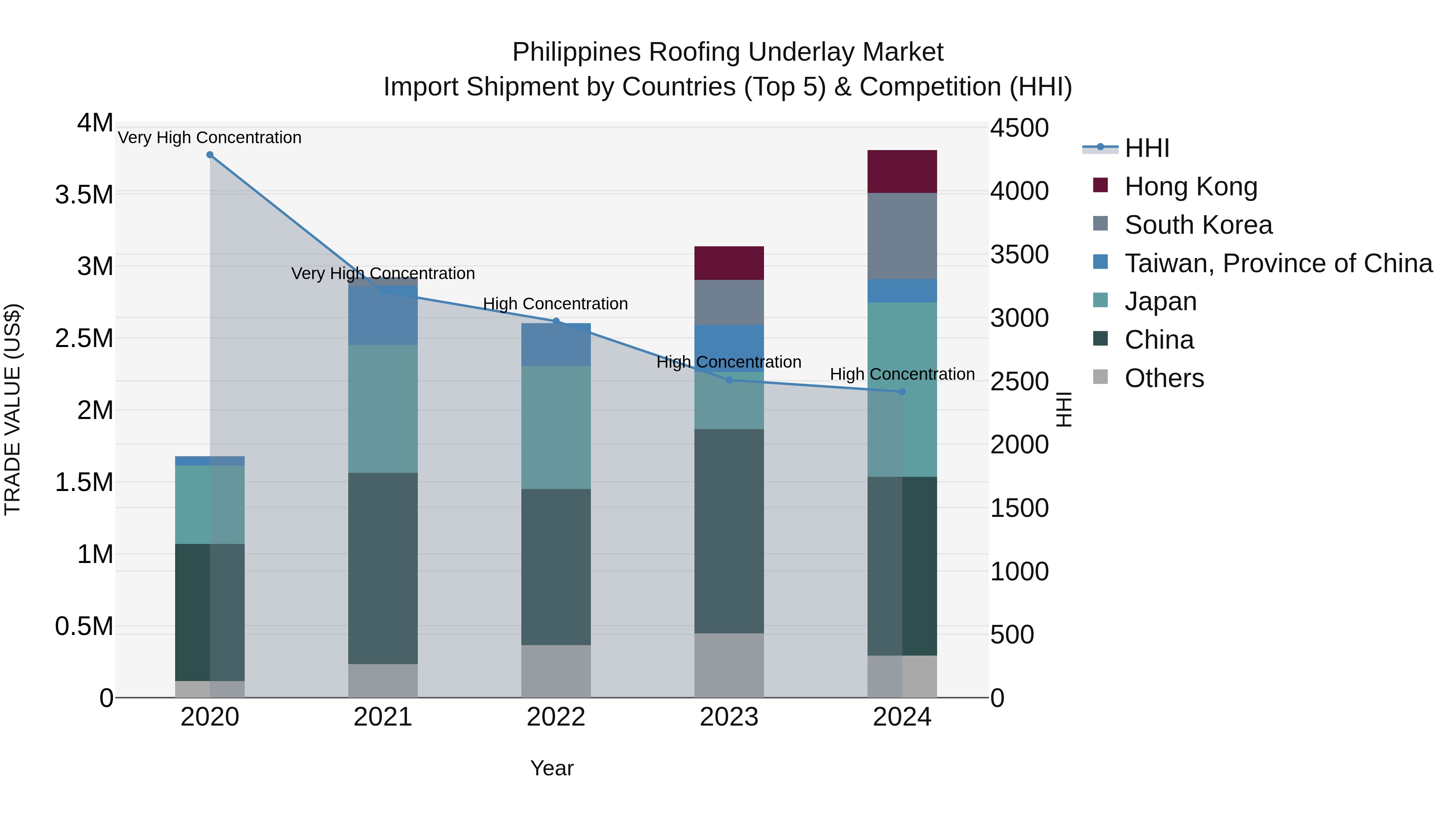
In 2024, the Philippines saw a significant increase in roofing underlay import shipments, with top exporting countries including China, Japan, South Korea, Hong Kong, and Taiwan. The market remained highly concentrated, with a high Herfindahl-Hirschman Index (HHI). The compound annual growth rate (CAGR) from 2020 to 2024 was an impressive 22.7%, demonstrating strong market demand. Additionally, the growth rate from 2023 to 2024 stood at 21.26%, indicating continued expansion in the roofing underlay segment. Overall, these trends suggest a thriving market for roofing underlay imports in the Philippines.
philippines roofing underlay market Synopsis
The roofing underlay market in Philippines is expected to register a CAGR of 7. 5% over the forecast period and reach USD $193 million by 2025. Polypropylene nonwovens are expected to be one of major materials used for manufacturing these underlays due to their better air permeability and high water resistance properties compared with other alternatives available on the market such as polyethylene or felt paper options. Moreover, rising popularity among customers due its higher durability will further drive product demand in near future.
Drivers of the Market
The Philippines roofing underlay market is closely linked to the construction and real estate sectors. Roofing underlay materials provide protection against weather elements and moisture. As construction standards evolve and building codes emphasize durability and moisture management, the demand for quality roofing underlay materials is expected to rise.
Challenges of the Market
Challenges for the roofing underlay market in the Philippines include competition from traditional roofing materials and the need to emphasize the benefits of underlay in terms of moisture protection, ventilation, and prolonged roof life. Building awareness among builders, contractors, and homeowners about the advantages of using roofing underlay will be crucial. Addressing concerns related to installation techniques and compatibility with different roofing systems will also play a significant role in market penetration.
COVID-19 Impact on the Market
The roofing underlay market could have experienced similar challenges to the roof insulation market. Disruptions in construction and renovation activities could have affected demand for roofing underlay materials. Additionally, economic uncertainties might have led to some consumers postponing or reconsidering their roofing projects. The pandemic could have also impacted the supply chain, including the availability of raw materials and transportation. However, like other construction-related markets, there might have been a rebound as restrictions eased and construction activities resumed.
Key Players in the Market
The roofing underlay market covers materials placed beneath roofing materials to provide additional protection and insulation. The outlook could be shaped by construction activities, weather conditions, and roofing technology advancements. Key players might include companies like GCP Applied Technologies and Owens Corning.
Key Highlights of the Report:
- Philippines Roofing Underlay Market Outlook
- Market Size of Philippines Roofing Underlay Market, 2024
- Forecast of Philippines Roofing Underlay Market, 2031
- Historical Data and Forecast of Philippines Roofing Underlay Revenues & Volume for the Period 2021-2031
- Philippines Roofing Underlay Market Trend Evolution
- Philippines Roofing Underlay Market Drivers and Challenges
- Philippines Roofing Underlay Price Trends
- Philippines Roofing Underlay Porter's Five Forces
- Philippines Roofing Underlay Industry Life Cycle
- Historical Data and Forecast of Philippines Roofing Underlay Market Revenues & Volume By Product for the Period 2021-2031
- Historical Data and Forecast of Philippines Roofing Underlay Market Revenues & Volume By Asphalt-saturated felt for the Period 2021-2031
- Historical Data and Forecast of Philippines Roofing Underlay Market Revenues & Volume By Rubberized asphalt for the Period 2021-2031
- Historical Data and Forecast of Philippines Roofing Underlay Market Revenues & Volume By Non-bitumen synthetic for the Period 2021-2031
- Historical Data and Forecast of Philippines Roofing Underlay Market Revenues & Volume By Application for the Period 2021-2031
- Historical Data and Forecast of Philippines Roofing Underlay Market Revenues & Volume By Residential construction for the Period 2021-2031
- Historical Data and Forecast of Philippines Roofing Underlay Market Revenues & Volume By Non-residential construction for the Period 2021-2031
- Philippines Roofing Underlay Import Export Trade Statistics
- Market Opportunity Assessment By Product
- Market Opportunity Assessment By Application
- Philippines Roofing Underlay Top Companies Market Share
- Philippines Roofing Underlay Competitive Benchmarking By Technical and Operational Parameters
- Philippines Roofing Underlay Company Profiles
- Philippines Roofing Underlay Key Strategic Recommendations






































