Philippines Safety and Relief Valves Market Summary
The philippines safety and relief valves market was estimated at USD 566 Million in 2025 and is projected to reach USD 809 Million by 2032, growing at a CAGR of 6.1% from 2026 to 2032.
Philippines Safety and Relief Valves Market Year-wise Growth Rate and Key Drivers
This graph highlights how the Philippines Safety and Relief Valves Market has steadily grown over the past five years, supported by major growth factors.
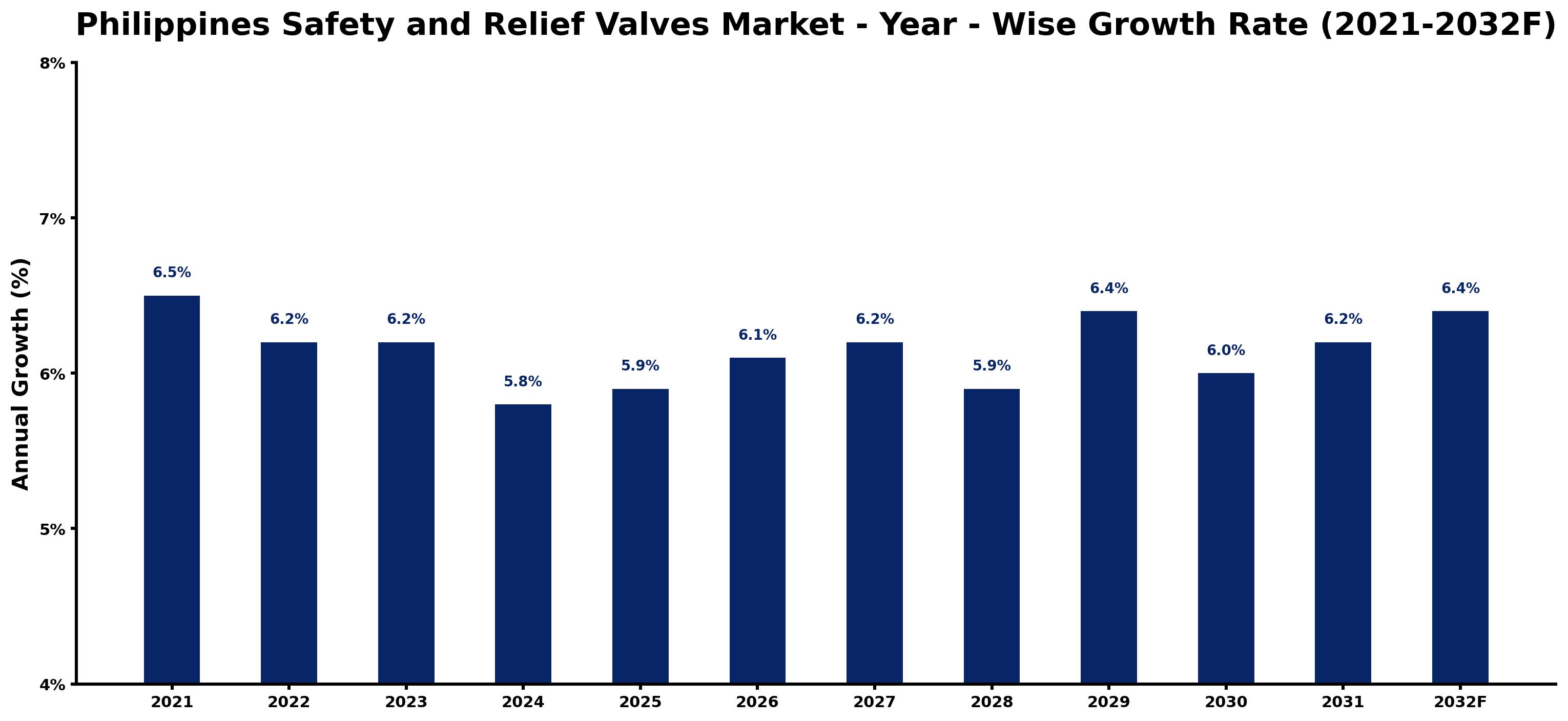
The table below presents the year wise growth rates along with the key drivers influencing the market
| Year | Growth Rate | Major Drivers |
| 2021 | 6.5% | Manufacturers are increasingly focusing on enhancing product safety to meet consumer expectations. |
| 2022 | 6.2% | Local industries are exploring advanced technologies to improve valve performance and reliability. |
| 2023 | 6.2% | Market players are investing heavily in R&D to innovate high-efficiency safety solutions. |
| 2024 | 5.8% | Infrastructure development in urban areas drives demand for reliable safety and relief valves. |
| 2025 | 5.9% | Emerging sectors, such as renewable energy, require specialized valves for operational safety. |
| 2026 | 6.1% | Increased manufacturing activities prompt a higher demand for safety mechanisms in production. |
| 2027 | 6.2% | Collaboration among industry leaders fosters standards that enhance valve performance nationally. |
| 2028 | 5.9% | Technological integration in monitoring systems promotes the need for advanced valve solutions. |
| 2029 | 6.4% | Growing public awareness on workplace safety influences purchasing decisions across sectors. |
| 2030 | 6.0% | Evolving climate conditions necessitate more robust valve systems for extreme environments. |
| 2031 | 6.2% | Investment in smart technology enhances predictive maintenance, leading to valve efficiency improvements. |
| 2032 | 6.4% | The expansion of logistics networks amplifies the need for reliable safety components in transit. |
Note - Market size estimations and growth projections presented in this report are based on 6Wresearch's advanced forecasting approach, validated with industry datasets as of June 2026.
Philippines Safety and Relief Valves Market Synopsis
The Philippines Safety and Relief Valves Market is projected to reach 6.1% and witness significant growth during the forecast period (2026-2032). This growth can be attributed to the increasing demand for safety systems across various industrial applications, including power generation, oil and gas, and chemical processing. The emphasis on safe operations by regulatory bodies is further driving market expansion as industries seek to comply with stringent safety standards.
Philippines Safety and Relief Valves Market Growth Drivers
Several factors are contributing to the growth of the Philippines Safety and Relief Valves Market. Key drivers include:
- The rising demand for efficient safety systems in critical industrial sectors ensures that safety and relief valves are integral to operational protocols.
- Technological advancements are leading to the development of high-performance valves that enhance reliability and operational efficiency, making them preferable choices for industries.
- Regulatory frameworks have become increasingly stringent, pushing industries to invest in safety systems that comply with updated standards and requirements.
- Increased investments in industrial automation are promoting the integration of advanced safety systems, thereby boosting the demand for safety and relief valves.
- Urbanization and corresponding construction activities are expanding the market for safety systems, with safety and relief valves being vital components in new installations.
Philippines Safety and Relief Valves Market Trends and Opportunities
The Philippines Safety and Relief Valves Market is witnessing several transformative trends that create new opportunities for growth:
- The integration of IoT and smart technologies into safety valves is enabling real-time monitoring and predictive maintenance, thereby enhancing operational safety.
- There is a notable shift towards more cost-effective solutions among end-users, prompting manufacturers to innovate and offer competitively priced products.
- Manufacturers are focusing on product longevity and durability, leading to the development of advanced materials that withstand extreme conditions.
- Increased collaboration between public and private sectors is expected to enhance safety standards and promotional initiatives, further stimulating market demand.
- Sustainability trends are encouraging companies to adopt environmentally friendly production practices, which are becoming a significant selling point in the competitive landscape.
Philippines Safety and Relief Valves Market Challenges and Restraints
Despite the promising growth prospects, the Philippines Safety and Relief Valves Market faces several challenges:
- Fluctuating raw material prices can impact production costs, making it challenging for manufacturers to maintain competitive pricing.
- Exchange rate volatility can complicate market dynamics, particularly for companies relying on imported materials and components.
- The COVID-19 pandemic has disrupted supply chains, leading to production halts and increased operational costs, affecting overall market revenues.
- Competition from alternative safety solutions can limit market access for traditional safety and relief valves.
- Limited awareness regarding the importance of safety systems in smaller industrial operations can hinder broader market adoption.
Philippines Safety and Relief Valves Market Government Investment and Initiatives
The Philippine government plays a crucial role in fostering the growth of the safety and relief valves market through various initiatives:
- Public investment in infrastructure development has increased, creating demand for safety valves in construction projects and industrial applications.
- Government policies are focused on enhancing workplace safety, leading to increased regulations that promote the use of safety systems.
- Incentives for companies investing in technology upgrades aim to bolster the adoption of advanced safety solutions in industrial operations.
- Collaborative efforts between government agencies and industry stakeholders are driving awareness about the importance of compliance with safety standards.
- Investment in training programs for industry personnel enhances knowledge about safety systems, contributing to overall market growth.
Philippines Safety and Relief Valves Market Latest Developments (May 2025 - June 2026)
The period from May 2025 to June 2026 has witnessed significant developments in the Philippines Safety and Relief Valves Market:
- Increased focus on digital transformation in manufacturing processes has prompted industries to adopt smart safety valves equipped with monitoring technologies.
- Collaboration between companies in the safety sector has led to joint ventures aimed at innovating advanced safety systems.
- Regulatory bodies have intensified enforcement of safety compliance measures, resulting in a surge in demand for upgraded safety systems.
- Emergent technologies such as artificial intelligence are being incorporated into safety valve operation, improving predictive maintenance capabilities.
- Investment in research and development by companies is yielding advancements in materials used for safety valves, promoting durability and resistance to corrosive environments.
Philippines Safety and Relief Valves Market - Key Attractiveness of the Report
- 10 Years of Market Numbers
- Historical Data Starting from 2022 to 2025
- Base Year: 2025
- Forecast Data until 2032
- Key Performance Indicators Impacting the Market
- Major Upcoming Developments and Projects
Key Highlights of the Report:
- Philippines Safety and Relief Valves Market Outlook
- Market Size of Philippines Safety and Relief Valves Market, 2025
- Forecast of Philippines Safety and Relief Valves Market, 2032F
- Historical Data and Forecast of Philippines Safety and Relief Valves Revenues & Volume for the Period 2022-2032F
- Philippines Safety and Relief Valves Market Trend Evolution
- Philippines Safety and Relief Valves Market Drivers and Challenges
- Philippines Safety and Relief Valves Price Trends
- Philippines Safety and Relief Valves Porter's Five Forces
- Philippines Safety and Relief Valves Industry Life Cycle
- Historical Data and Forecast of Philippines Safety and Relief Valves Market Revenues & Volume By Material for the Period 2022-2032F
- Historical Data and Forecast of Philippines Safety and Relief Valves Market Revenues & Volume By Steel for the Period 2022-2032F
- Historical Data and Forecast of Philippines Safety and Relief Valves Market Revenues & Volume By Cast Iron for the Period 2022-2032F
- Historical Data and Forecast of Philippines Safety and Relief Valves Market Revenues & Volume By Alloy for the Period 2022-2032F
- Historical Data and Forecast of Philippines Safety and Relief Valves Market Revenues & Volume By Cryogenic for the Period 2022-2032F
- Historical Data and Forecast of Philippines Safety and Relief Valves Market Revenues & Volume By Others for the Period 2022-2032F
- Historical Data and Forecast of Philippines Safety and Relief Valves Market Revenues & Volume By Size for the Period 2022-2032F
- Historical Data and Forecast of Philippines Safety and Relief Valves Market Revenues & Volume By Up To 1? for the Period 2022-2032F
- Historical Data and Forecast of Philippines Safety and Relief Valves Market Revenues & Volume By 1? to 6? for the Period 2022-2032F
- Historical Data and Forecast of Philippines Safety and Relief Valves Market Revenues & Volume By 6? to 25? for the Period 2022-2032F
- Historical Data and Forecast of Philippines Safety and Relief Valves Market Revenues & Volume By 25? to 50? for the Period 2022-2032F
- Historical Data and Forecast of Philippines Safety and Relief Valves Market Revenues & Volume By 50? and Larger for the Period 2022-2032F
- Historical Data and Forecast of Philippines Safety and Relief Valves Market Revenues & Volume By Industry for the Period 2022-2032F
- Historical Data and Forecast of Philippines Safety and Relief Valves Market Revenues & Volume By Oil & Gas for the Period 2022-2032F
- Historical Data and Forecast of Philippines Safety and Relief Valves Market Revenues & Volume By Energy & Power for the Period 2022-2032F
- Historical Data and Forecast of Philippines Safety and Relief Valves Market Revenues & Volume By Chemicals for the Period 2022-2032F
- Historical Data and Forecast of Philippines Safety and Relief Valves Market Revenues & Volume By Water & Wastewater for the Period 2022-2032F
- Historical Data and Forecast of Philippines Safety and Relief Valves Market Revenues & Volume By Building & Construction for the Period 2022-2032F
- Historical Data and Forecast of Philippines Safety and Relief Valves Market Revenues & Volume By Pharmaceuticals for the Period 2022-2032F
- Historical Data and Forecast of Philippines Safety and Relief Valves Market Revenues & Volume By Metal & Mining for the Period 2022-2032F
- Historical Data and Forecast of Philippines Safety and Relief Valves Market Revenues & Volume By Others for the Period 2022-2032F
- Philippines Safety and Relief Valves Import Export Trade Statistics
- Market Opportunity Assessment By Material
- Market Opportunity Assessment By Size
- Market Opportunity Assessment By Industry
- Philippines Safety and Relief Valves Top Companies Market Share
- Philippines Safety and Relief Valves Competitive Benchmarking By Technical and Operational Parameters
- Philippines Safety and Relief Valves Company Profiles
- Philippines Safety and Relief Valves Key Strategic Recommendations






































