Philippines Sanitary Paper Market Summary
The philippines sanitary paper market was estimated at USD 303 Million in 2025 and is projected to reach USD 435 Million by 2032, growing at a CAGR of 6.2% from 2026 to 2032.
Philippines Sanitary Paper Market Year-wise Growth Rate and Key Drivers
This graph highlights how the Philippines Sanitary Paper Market has steadily grown over the past five years, supported by major growth factors.
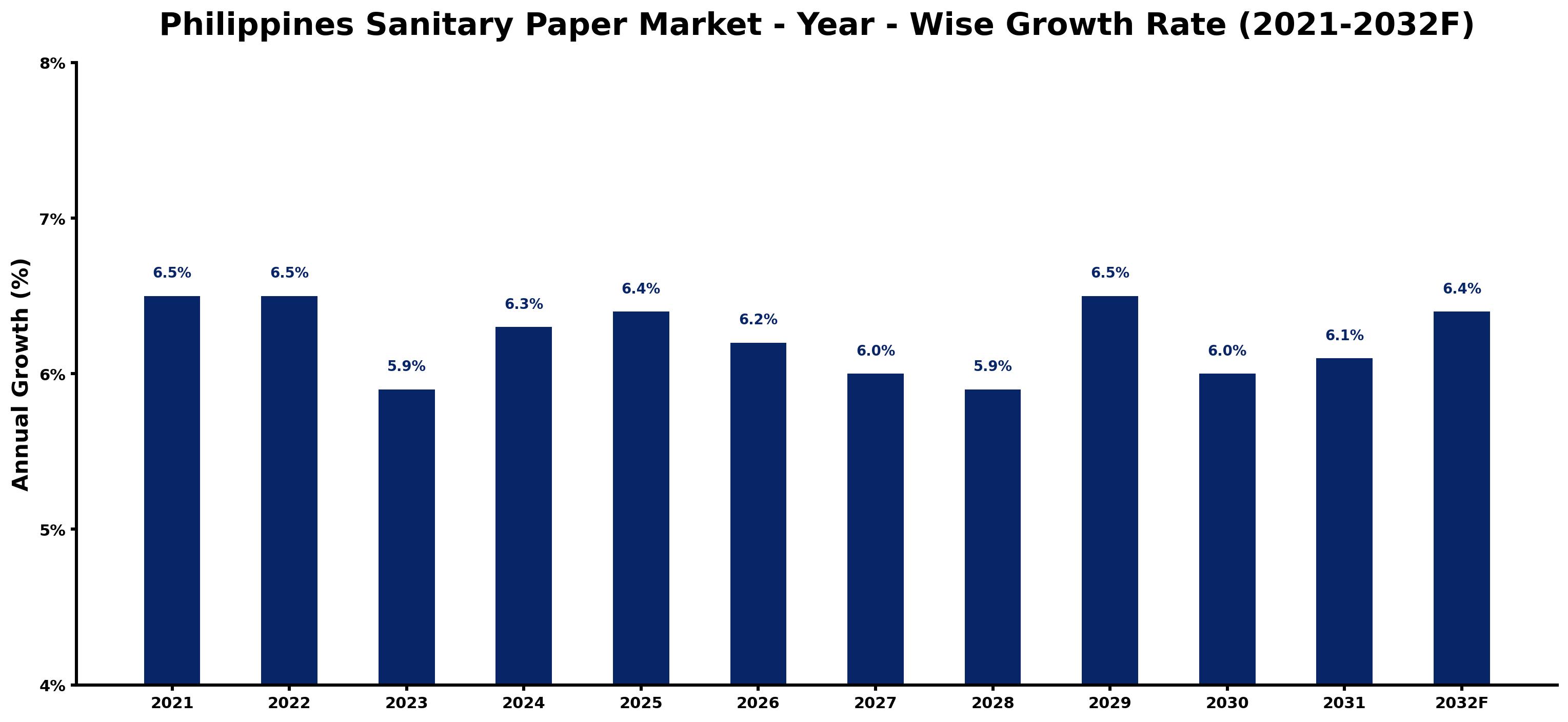
The table below presents the year wise growth rates along with the key drivers influencing the market
| Year | Growth Rate | Major Drivers |
| 2021 | 6.5% | Economic recovery post-pandemic boosts consumer purchasing power for sanitary products. |
| 2022 | 6.5% | Shift towards e-commerce platforms enhances accessibility of sanitary paper products. |
| 2023 | 5.9% | Increased awareness about hygiene leads to higher consumption of sanitary papers. |
| 2024 | 6.3% | Local manufacturers expand production capacity to meet rising market demands. |
| 2025 | 6.4% | Sustainability trends prompt more brands to offer eco-friendly sanitary paper options. |
| 2026 | 6.2% | Retail partnerships evolve, improving distribution networks for urban and rural areas. |
| 2027 | 6.0% | Innovations in product development enhance quality, attracting discerning consumers. |
| 2028 | 5.9% | Tourism sector recovery drives demand for sanitary products in hotels and restaurants. |
| 2029 | 6.5% | Cultural shifts towards health consciousness result in elevated sanitary paper usage. |
| 2030 | 6.0% | Investment in local manufacturing reduces import dependency, stabilizing market prices. |
| 2031 | 6.1% | Enhanced advertising strategies increase brand visibility and consumer engagement significantly. |
| 2032 | 6.4% | Technological advancements streamline production processes, reducing costs for manufacturers. |
Note - Market size estimations and growth projections presented in this report are based on 6Wresearch's advanced forecasting approach, validated with industry datasets as of June 2026.
Philippines Sanitary Paper Market Synopsis
The Philippines Sanitary Paper Market is projected to reach 6.2% and witness significant growth during the forecast period (2026-2032). Sanitary paper, encompassing products such as toilet tissue and facial tissues, serves an essential role in personal hygiene across the archipelago. The steady consumption of sanitary paper has been evident since the early 2000s, driven primarily by an increase in disposable income among Filipino consumers. This trend reflects changing consumer behaviors and heightened health awareness, establishing a solid foundation for market expansion.
Philippines Sanitary Paper Market Growth Drivers
The growth of the Philippines Sanitary Paper Market can be attributed to multiple converging factors that continuously shape consumer preferences. The foremost driver is the increase in purchasing power resulting from remittances sent back to the Philippines by overseas Filipino workers (OFWs). This influx of funds leads to greater expenditure on hygiene products as consumers increasingly seek quality alternatives. Furthermore, the rise of social media platforms such as Facebook and Twitter has played a pivotal role in disseminating global trends, piquing consumer interest in superior sanitary products that emphasize comfort and quality.
- Heightened health awareness has led consumers to prioritize hygiene, spurring demand for sanitary paper products.
- The introduction of diverse product lines featuring softer textures and fragrances caters to evolving consumer preferences.
- Increased competition in the market has incentivized local producers to innovate in product development.
- Government initiatives, including tax exemptions for certain exports, have facilitated expansion plans by local manufacturers.
- The growing urban population contributes to the rising demand for essential hygiene products in both urban and rural areas.
Philippines Sanitary Paper Market Challenges and Restraints
Despite the promising growth trajectory of the Philippines Sanitary Paper Market, several challenges loom that could hinder its potential. Protectionist policies in various countries have led to restrictions on foreign imports, affecting local manufacturers' access to raw materials and competitive pricing. Additionally, established international players with the capacity to absorb lower costs exert downward pressure on prices, creating a challenging environment for domestic producers. Smaller local companies may struggle to compete effectively, leading to potential disparities in market share.
- The competitive landscape dominated by larger international firms can limit opportunities for smaller domestic players.
- Government regulations may impose restrictions that complicate the importation of necessary raw materials.
- Fluctuations in currency exchange rates can adversely affect costs for firms reliant on international supplies.
- Environmental concerns regarding waste generation from sanitary paper products may lead to increased regulatory scrutiny.
- Consumer preference for eco-friendly alternatives could challenge traditional sanitary paper products if manufacturers do not adapt.
Philippines Sanitary Paper Market Government Investment and Initiatives
The Philippine government has demonstrated a proactive approach towards bolstering the sanitary paper sector through various initiatives aimed at promoting local production. Policies designed to provide economic incentives—such as tax exemptions for specific export commodities—have fostered a conducive environment for growth. Furthermore, the government's push for sustainable development has encouraged investments in eco-friendly manufacturing processes, aligning with global shifts towards sustainability. These initiatives aim to stimulate job creation, enhance production capabilities, and ultimately strengthen the overall economy.
Philippines Sanitary Paper Market Latest Developments (May 2025 - June 2026)
Between May 2025 and June 2026, the Philippines Sanitary Paper Market has been characterized by a series of advancements and strategic movements. As local manufacturers adapt to changing consumer behaviors, there has been an evident increase in product diversity, with companies introducing innovative features that cater to health-conscious consumers. Additionally, the period has witnessed a rise in collaborations between manufacturers and retailers, aimed at enhancing market penetration and product visibility. Moreover, companies have been increasingly investing in marketing campaigns to educate consumers about the benefits of using high-quality sanitary paper products. Overall, these developments reflect a growing resilience within the market, positioning it favorably for future growth.
Philippines Sanitary Paper Market - Key Attractiveness of the Report
- 10 Years of Market Numbers
- Historical Data Starting from 2022 to 2025
- Base Year: 2025
- Forecast Data until 2032
- Key Performance Indicators Impacting the Market
- Major Upcoming Developments and Projects
Key Highlights of the Report:
- Philippines Sanitary Paper Market Outlook
- Market Size of Philippines Sanitary Paper Market, 2025
- Forecast of Philippines Sanitary Paper Market, 2032
- Historical Data and Forecast of Philippines Sanitary Paper Revenues & Volume for the Period 2022-2032F
- Philippines Sanitary Paper Market Trend Evolution
- Philippines Sanitary Paper Market Drivers and Challenges
- Philippines Sanitary Paper Price Trends
- Philippines Sanitary Paper Porter's Five Forces
- Philippines Sanitary Paper Industry Life Cycle
- Historical Data and Forecast of Philippines Sanitary Paper Market Revenues & Volume By Product Types for the Period 2022-2032F
- Historical Data and Forecast of Philippines Sanitary Paper Market Revenues & Volume By Tissues And Handkerchiefs for the Period 2022-2032F
- Historical Data and Forecast of Philippines Sanitary Paper Market Revenues & Volume By Table Napkins for the Period 2022-2032F
- Historical Data and Forecast of Philippines Sanitary Paper Market Revenues & Volume By Toilet Paper for the Period 2022-2032F
- Historical Data and Forecast of Philippines Sanitary Paper Market Revenues & Volume By Towels for the Period 2022-2032F
- Historical Data and Forecast of Philippines Sanitary Paper Market Revenues & Volume By Sanitary Napkins And Tampons for the Period 2022-2032F
- Historical Data and Forecast of Philippines Sanitary Paper Market Revenues & Volume By Disposable Diapers for the Period 2022-2032F
- Historical Data and Forecast of Philippines Sanitary Paper Market Revenues & Volume By Application? for the Period 2022-2032F
- Historical Data and Forecast of Philippines Sanitary Paper Market Revenues & Volume By Residential for the Period 2022-2032F
- Historical Data and Forecast of Philippines Sanitary Paper Market Revenues & Volume By Commercial for the Period 2022-2032F
- Philippines Sanitary Paper Import Export Trade Statistics
- Market Opportunity Assessment By Product Types
- Market Opportunity Assessment By Application?
- Philippines Sanitary Paper Top Companies Market Share
- Philippines Sanitary Paper Competitive Benchmarking By Technical and Operational Parameters
- Philippines Sanitary Paper Company Profiles
- Philippines Sanitary Paper Key Strategic Recommendations






































