Philippines Satellite IoT Market Size, Share & Growth Rate
The Philippines Satellite IoT Market was estimated at USD 437 Million in 2025 and is projected to reach USD 617 Million by 2032, growing at a CAGR of 5.1% from 2026 to 2032. This growth trajectory is primarily fueled by increasing demand for reliable connectivity in agriculture, logistics, and environmental monitoring, particularly in the nations remote regions. The advancement of satellite technology is enabling real-time data transmission and improving operational efficiencies across various sectors.
Philippines Satellite IoT Market Year-wise Growth Rate and Key Drivers
This graph highlights how the Philippines Satellite IoT Market has steadily grown over the years, supported by major growth factors.
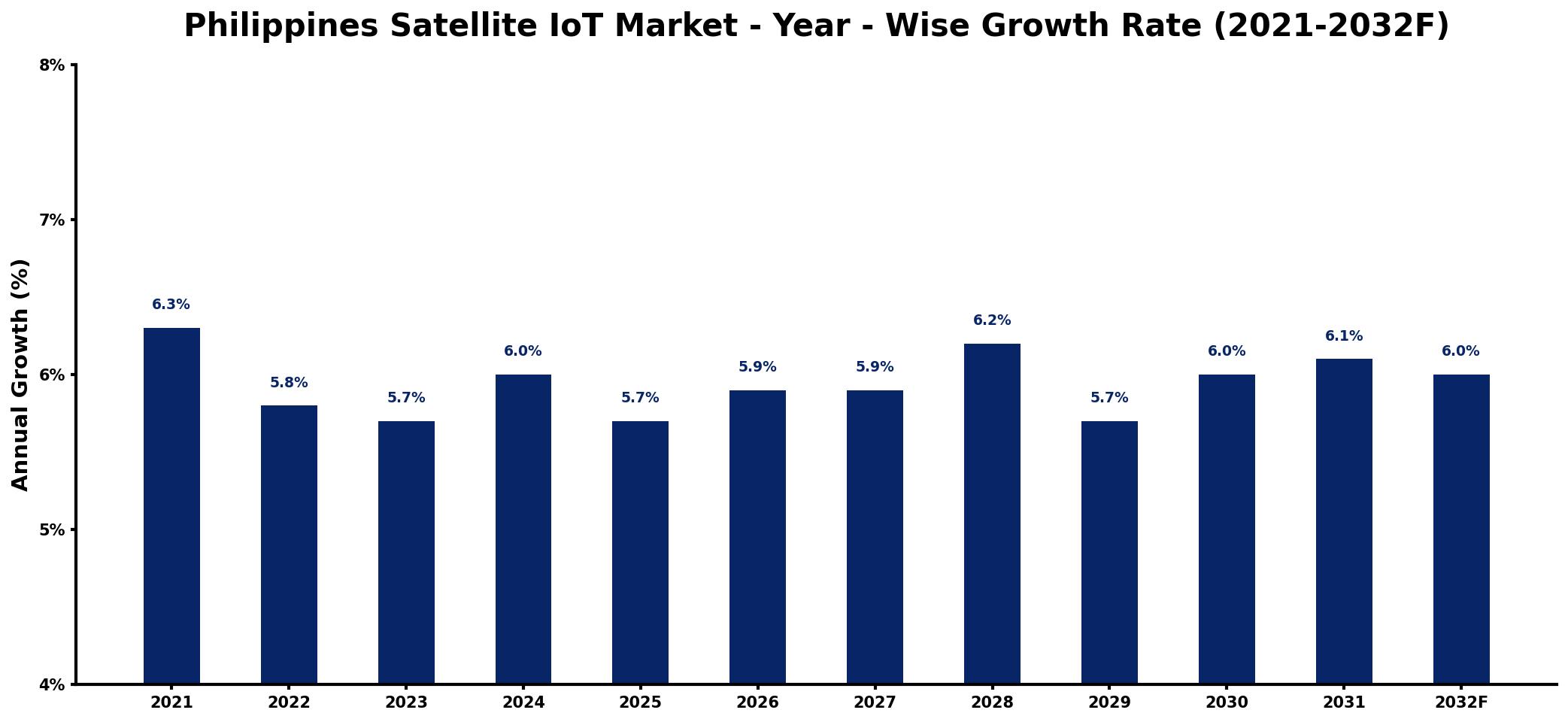
The table below presents the year‑wise growth rates along with the key drivers influencing the market
| Year | Growth Rate | Major Drivers |
| 2021 | 6.3% | Rising demand for connectivity solutions |
| 2022 | 5.8% | Increased investment in infrastructure development |
| 2023 | 5.7% | Growing adoption of smart technologies |
| 2024 | 6.0% | Expansion of agricultural monitoring systems |
| 2025 | 5.7% | Enhancement of logistics tracking services |
| 2026 | 5.9% | Surge in environmental monitoring initiatives |
| 2027 | 5.9% | Development of remote healthcare applications |
| 2028 | 6.2% | Boost in energy management systems |
| 2029 | 5.7% | Advancement in disaster response technologies |
| 2030 | 6.0% | Growth in urban planning projects |
| 2031 | 6.1% | Emergence of connected transportation networks |
| 2032 | 6.0% | Strengthening of maritime surveillance capabilities |
Note: Market size estimations and growth projections presented in this report are based on 6Wresearch's proprietary forecasting methodology, utilizing the latest available industry data, government publications, and primary research inputs.
Philippines Satellite IoT Market Synopsis
Recently, the Philippines satellite IoT market has gained significant momentum due to heightened awareness of the advantages of satellite connectivity. As industries adapt to more digitally integrated operations, the future points toward widespread adoption and innovative applications, enhancing connectivity even in the most challenging terrains.
Looking ahead, the market is poised for substantial growth as advancements in technology reduce costs and increase accessibility. The potential for integrating IoT devices into sectors such as disaster management, smart agriculture, and wildlife tracking is becoming increasingly appealing, making this a critical juncture for stakeholders seeking to capitalize on the burgeoning opportunities.
Philippines Satellite IoT Market Key Takeaways
- The market is witnessing robust growth, driven by the need for connectivity in rural and hard-to-reach areas.
- Advancements in satellite technology are paving the way for real-time monitoring and data analytics.
- Key sectors benefiting from this technology include agriculture, logistics, and environmental monitoring.
- Government initiatives are expected to bolster infrastructure and regulatory frameworks, enhancing market dynamics.
- The impact of COVID-19 has led to a renewed focus on IoT solutions for remote operations.
Evaluation of Restraints in Philippines Satellite IoT Market
Despite the potential for growth, the Philippines satellite IoT market faces significant constraints, particularly related to regulatory hurdles. Issues such as spectrum allocation and licensing can impede the deployment of satellite communication technologies. Additionally, the costs associated with these technologies can be prohibitive, especially for rural enterprises seeking to adopt IoT solutions. This results in a slower-than-anticipated uptake in satellite IoT applications, limiting the market's overall expansion.
Philippines Satellite IoT Market Trends
A notable trend shaping the market is the increasing integration of artificial intelligence (AI) and machine learning (ML) with satellite IoT systems. This integration enhances data analysis capabilities, allowing for smarter decision-making in various sectors. Moreover, the push for sustainability is prompting businesses to invest in satellite-based solutions that enable better resource management, tracking, and monitoring.
Philippines Satellite IoT Market Opportunities
The real growth opportunities lie in leveraging satellite IoT for smart agriculture and disaster management. As farmers seek ways to optimize yields and minimize waste, satellite IoT can provide critical insights and data. Similarly, as the country faces natural calamities, deploying these technologies for disaster response and management can significantly enhance preparedness and recovery efforts.
Government Initiatives in the Philippines Satellite IoT Market
The Philippine government has recognized the importance of satellite IoT technologies and is initiating policies aimed at enhancing infrastructure and connectivity. Public spending is increasingly directed toward projects that promote digital transformation across various sectors, fostering an environment conducive to innovation. Additionally, regulatory reforms are underway to streamline licensing processes and spectrum allocation, supporting the deployment of satellite technologies.
Future Insights of the Philippines Satellite IoT Market
From 2026 to 2032, the Philippines satellite IoT market is anticipated to witness significant transformation as technological advancements continue to emerge. Enhanced satellite systems will lead to improved data transmission speeds and reliability, making IoT solutions more accessible. Furthermore, as industries increasingly recognize the value of real-time data, the trend toward greater investment in satellite IoT will likely drive the development of new applications, establishing the Philippines as a leader in the region.
Philippines Satellite IoT Market Latest Developments (2025 - 2026)
Recent developments in the Philippines satellite IoT market reflect a growing commitment to enhancing connectivity solutions. The introduction of new satellite systems promises improved coverage and reduced latency, vital for industries reliant on real-time data. Additionally, partnerships between technology providers and local businesses are on the rise, fostering innovative applications tailored to the specific needs of the Philippine market.
Philippines Satellite IoT Market - Key Attractiveness of the Report
- 10 Years of Market Numbers
- Historical Data Starting from 2022 to 2025
- Base Year: 2025
- Forecast Data until 2032
- Key Performance Indicators Impacting the Market
- Major Upcoming Developments and Projects
Key Highlights of the Report:
- Philippines Satellite IoT Market Outlook
- Market Size of Philippines Satellite IoT Market, 2025
- Forecast of Philippines Satellite IoT Market, 2032
- Historical Data and Forecast of Philippines Satellite IoT Revenues & Volume for the Period 2022-2032F
- Philippines Satellite IoT Market Trend Evolution
- Philippines Satellite IoT Market Drivers and Challenges
- Philippines Satellite IoT Price Trends
- Philippines Satellite IoT Porter's Five Forces
- Philippines Satellite IoT Industry Life Cycle
- Historical Data and Forecast of Philippines Satellite IoT Market Revenues & Volume By Service Type for the Period 2022-2032F
- Historical Data and Forecast of Philippines Satellite IoT Market Revenues & Volume By Satellite IoT Backhaul for the Period 2022-2032F
- Historical Data and Forecast of Philippines Satellite IoT Market Revenues & Volume By Direct-to-satellite for the Period 2022-2032F
- Historical Data and Forecast of Philippines Satellite IoT Market Revenues & Volume By Frequency Band for the Period 2022-2032F
- Historical Data and Forecast of Philippines Satellite IoT Market Revenues & Volume By L-Band for the Period 2022-2032F
- Historical Data and Forecast of Philippines Satellite IoT Market Revenues & Volume By Ku-and Ka-Band for the Period 2022-2032F
- Historical Data and Forecast of Philippines Satellite IoT Market Revenues & Volume By S-Band for the Period 2022-2032F
- Historical Data and Forecast of Philippines Satellite IoT Market Revenues & Volume By Other Bands for the Period 2022-2032F
- Historical Data and Forecast of Philippines Satellite IoT Market Revenues & Volume By Organization Size for the Period 2022-2032F
- Historical Data and Forecast of Philippines Satellite IoT Market Revenues & Volume By Large Enterprises for the Period 2022-2032F
- Historical Data and Forecast of Philippines Satellite IoT Market Revenues & Volume By Small & Medium Sized Enterprises for the Period 2022-2032F
- Historical Data and Forecast of Philippines Satellite IoT Market Revenues & Volume By Vertical for the Period 2022-2032F
- Historical Data and Forecast of Philippines Satellite IoT Market Revenues & Volume By Maritime for the Period 2022-2032F
- Historical Data and Forecast of Philippines Satellite IoT Market Revenues & Volume By Oil & Gas for the Period 2022-2032F
- Historical Data and Forecast of Philippines Satellite IoT Market Revenues & Volume By Transportation & Logistics for the Period 2022-2032F
- Historical Data and Forecast of Philippines Satellite IoT Market Revenues & Volume By Energy & Utilities for the Period 2022-2032F
- Historical Data and Forecast of Philippines Satellite IoT Market Revenues & Volume By Agriculture for the Period 2022-2032F
- Historical Data and Forecast of Philippines Satellite IoT Market Revenues & Volume By Healthcare for the Period 2022-2032F
- Historical Data and Forecast of Philippines Satellite IoT Market Revenues & Volume By Military & Defense for the Period 2022-2032F
- Historical Data and Forecast of Philippines Satellite IoT Market Revenues & Volume By Other Verticals for the Period 2022-2032F
- Philippines Satellite IoT Import Export Trade Statistics
- Market Opportunity Assessment By Service Type
- Market Opportunity Assessment By Frequency Band
- Market Opportunity Assessment By Organization Size
- Market Opportunity Assessment By Vertical
- Philippines Satellite IoT Top Companies Market Share
- Philippines Satellite IoT Competitive Benchmarking By Technical and Operational Parameters
- Philippines Satellite IoT Company Profiles
- Philippines Satellite IoT Key Strategic Recommendations






































