Philippines Saw Blade Market Size, Share & Growth Rate
The Philippines Saw Blade Market was estimated at USD 703 Million in 2025 and is projected to reach USD 1009 Million by 2032, growing at a CAGR of 5.3% from 2026 to 2032. This growth trajectory is propelled by an increasing focus on infrastructure development and the proliferation of woodworking activities spurred by both professional and DIY enthusiasts. The shift towards precision cutting and automation in various sectors is expected to further drive the demand for high-quality saw blades.
Philippines Saw Blade Market Year-wise Growth Rate and Key Drivers
This graph highlights how the Philippines Saw Blade Market has steadily grown over the years, supported by major growth factors.
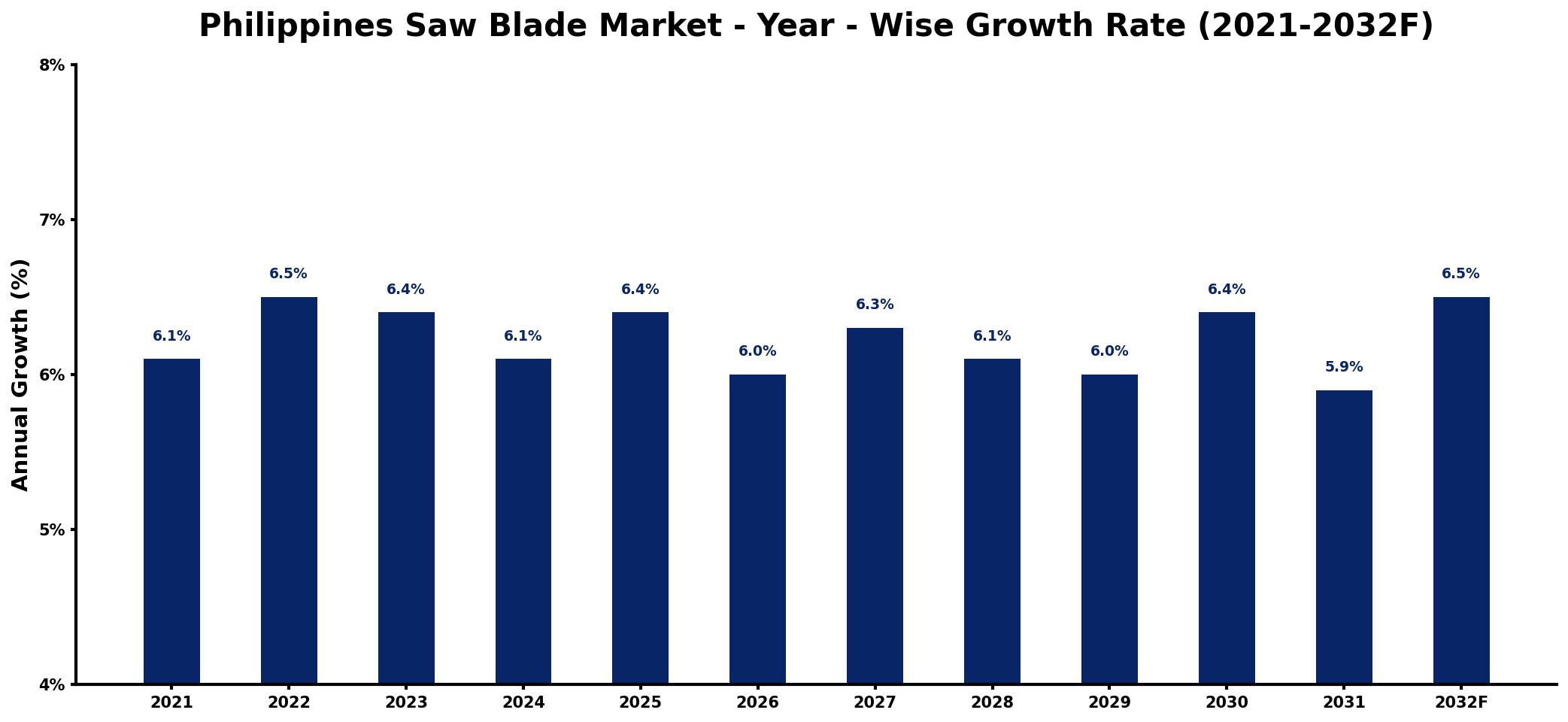
The table below presents the year‑wise growth rates along with the key drivers influencing the market
| Year | Growth Rate | Major Drivers |
| 2021 | 6.1% | Rising construction sector investments |
| 2022 | 6.5% | Growing demand from manufacturing industries |
| 2023 | 6.4% | Increased home renovation activities |
| 2024 | 6.1% | Expansion of furniture production facilities |
| 2025 | 6.4% | Strengthening logistics and distribution networks |
| 2026 | 6.0% | Surge in DIY project popularity |
| 2027 | 6.3% | Growing exports of wood products |
| 2028 | 6.1% | Enhanced technology in woodworking processes |
| 2029 | 6.0% | Increase in infrastructure development projects |
| 2030 | 6.4% | Boost in agricultural equipment manufacturing |
| 2031 | 5.9% | Growing interest in sustainable materials |
| 2032 | 6.5% | rising end-use demand growth |
Note: Market size estimations and growth projections presented in this report are based on 6Wresearch's proprietary forecasting methodology, utilizing the latest available industry data, government publications, and primary research inputs.
Philippines Saw Blade Market Synopsis
In recent years, the Philippines saw blade market has evolved significantly, responding to the dynamic demands of the construction and woodworking sectors. Local manufacturers are collaborating with international suppliers to provide a diverse range of saw blades that cater to specific needs, underscoring the blend of traditional craftsmanship and modern technology.
As consumer preferences shift toward higher quality and efficiency, the market has witnessed a corresponding rise in the adoption of advanced cutting technologies. The increase in DIY projects fueled by a growing home improvement culture has further enhanced the relevance of saw blades in everyday applications, marking a pivotal moment for industry stakeholders.
Philippines Saw Blade Market Key Takeaways
- The market is expected to flourish, with construction and woodworking leading the charge for growth.
- Automation and precision cutting technologies are becoming increasingly important in shaping demand.
- The surge in DIY culture presents new opportunities for saw blade manufacturers and suppliers.
- Local manufacturers face competition from imports, necessitating a focus on quality and innovation.
- Digitalization is transforming distribution channels, enhancing market accessibility.
Evaluation of Restraints in Philippines Saw Blade Market
Despite the promising growth prospects, the Philippines saw blade market faces significant challenges that could hinder its advancement. One notable constraint is the intense competition from imported products, which often offer lower prices. This pressure compels local manufacturers to not only maintain high product quality but also optimize their cost structures. Additionally, the diverse and evolving demands of customers in sectors like construction and woodworking require continuous innovation and adaptation, making it imperative for local players to stay ahead of market trends. Furthermore, raising awareness about the benefits of utilizing high-quality saw blades remains a challenge, particularly among smaller businesses and DIY enthusiasts, which can impact overall market expansion.
Philippines Saw Blade Market Trends
Several notable trends are shaping the Philippines saw blade market, reflecting broader shifts in consumer behavior and industry practices. The rise of automation in manufacturing processes and the construction sector is leading to increased demand for precision cutting tools that enhance efficiency. Moreover, sustainability is gaining traction, prompting manufacturers to explore eco-friendly materials and production methods. The influence of digital platforms is also evident as online sales channels gain popularity, allowing consumers easier access to a variety of saw blades. Additionally, the DIY trend is fostering innovation in product offerings, with a focus on user-friendly designs that cater to amateur craftsmen.
Philippines Saw Blade Market Opportunities
The Philippines saw blade market is rife with opportunities for growth and investment. As infrastructure projects expand, there is a robust demand for specialized saw blades designed for specific cutting applications. The increasing interest in DIY projects opens avenues for manufacturers to create products tailored for the home improvement segment, appealing to a wider consumer base. Moreover, there is potential for innovation in high-performance saw blades that utilize advanced materials and coatings, allowing for improved durability and efficiency. Companies can also leverage digital marketing strategies to reach more customers, creating a significant opportunity for expansion.
Government Initiatives in the Philippines Saw Blade Market
The Philippine government has implemented several initiatives aimed at boosting the manufacturing sector, which indirectly supports the saw blade market. Public spending on infrastructure development, including roads and buildings, provides a favorable environment for growth in the construction industry. Additionally, government programs focused on skills development and technology upgrades for local manufacturers promote competitiveness, enhancing product quality. These initiatives, coupled with incentives for innovation, lay a strong foundation for the saw blade market to thrive.
Future Insights of the Philippines Saw Blade Market
Looking ahead to 2026-2032, the Philippines saw blade market is set to embark on a promising trajectory. The expected recovery of the construction sector will play a pivotal role, supported by government investments and private sector initiatives. Moreover, the adoption of smarter manufacturing technologies and heightened consumer awareness regarding the benefits of quality tools will drive demand. The integration of e-commerce platforms is likely to revolutionize how saw blades are marketed and sold, making them more accessible to a diverse customer base. This confluence of factors indicates a vibrant and evolving market landscape in the years to come.
Philippines Saw Blade Market Latest Developments (2025 - 2026)
Recent developments in the Philippines saw blade market indicate a shift toward digital engagement, as suppliers increasingly embrace online platforms for sales and customer interaction. Manufacturers are also focusing on enhancing product lines with innovative features that cater to both professional and DIY users. Industry collaborations aimed at improving manufacturing efficiency and product quality have gained traction, reflecting a collective effort to address market demands. As the construction sector rebounds, a resurgence in demand for high-performance saw blades is anticipated, further propelling market growth.
Philippines Saw Blade Market - Key Attractiveness of the Report
- 10 Years of Market Numbers
- Historical Data Starting from 2022 to 2025
- Base Year: 2025
- Forecast Data until 2032
- Key Performance Indicators Impacting the Market
- Major Upcoming Developments and Projects
Key Highlights of the Report:
- Philippines Saw Blade Market Outlook
- Market Size of Philippines Saw Blade Market, 2025
- Forecast of Philippines Saw Blade Market, 2032
- Historical Data and Forecast of Philippines Saw Blade Revenues & Volume for the Period 2022-2032F
- Philippines Saw Blade Market Trend Evolution
- Philippines Saw Blade Market Drivers and Challenges
- Philippines Saw Blade Price Trends
- Philippines Saw Blade Porter's Five Forces
- Philippines Saw Blade Industry Life Cycle
- Historical Data and Forecast of Philippines Saw Blade Market Revenues & Volume By Product Type for the Period 2022-2032F
- Historical Data and Forecast of Philippines Saw Blade Market Revenues & Volume By Circular Saw for the Period 2022-2032F
- Historical Data and Forecast of Philippines Saw Blade Market Revenues & Volume By Band Saw for the Period 2022-2032F
- Historical Data and Forecast of Philippines Saw Blade Market Revenues & Volume By Chain Saw for the Period 2022-2032F
- Historical Data and Forecast of Philippines Saw Blade Market Revenues & Volume By Hand Saw for the Period 2022-2032F
- Historical Data and Forecast of Philippines Saw Blade Market Revenues & Volume By Others for the Period 2022-2032F
- Historical Data and Forecast of Philippines Saw Blade Market Revenues & Volume By Application for the Period 2022-2032F
- Historical Data and Forecast of Philippines Saw Blade Market Revenues & Volume By Wood Cutting for the Period 2022-2032F
- Historical Data and Forecast of Philippines Saw Blade Market Revenues & Volume By Metal Cutting for the Period 2022-2032F
- Historical Data and Forecast of Philippines Saw Blade Market Revenues & Volume By Stone Cutting for the Period 2022-2032F
- Historical Data and Forecast of Philippines Saw Blade Market Revenues & Volume By Others for the Period 2022-2032F
- Philippines Saw Blade Import Export Trade Statistics
- Market Opportunity Assessment By Product Type
- Market Opportunity Assessment By Application
- Philippines Saw Blade Top Companies Market Share
- Philippines Saw Blade Competitive Benchmarking By Technical and Operational Parameters
- Philippines Saw Blade Company Profiles
- Philippines Saw Blade Key Strategic Recommendations






































