Philippines Smart Kitchen Appliances Market Size, Share & Growth Rate
The Philippines Smart Kitchen Appliances Market was estimated at USD 540 Million in 2025 and is projected to reach USD 946 Million by 2032, growing at a CAGR of 8.3% from 2026 to 2032. This robust growth trajectory is primarily propelled by rapid urbanization trends and rising disposable incomes, particularly in metropolitan areas like Manila and Cebu City. The burgeoning middle-class demographic is increasingly inclined towards technology-driven kitchen solutions, finding value in the convenience and efficiency these smart appliances offer.
Philippines Smart Kitchen Appliances Market Year-wise Growth Rate and Key Drivers
This graph highlights how the Philippines Smart Kitchen Appliances Market has steadily grown over the years, supported by major growth factors.
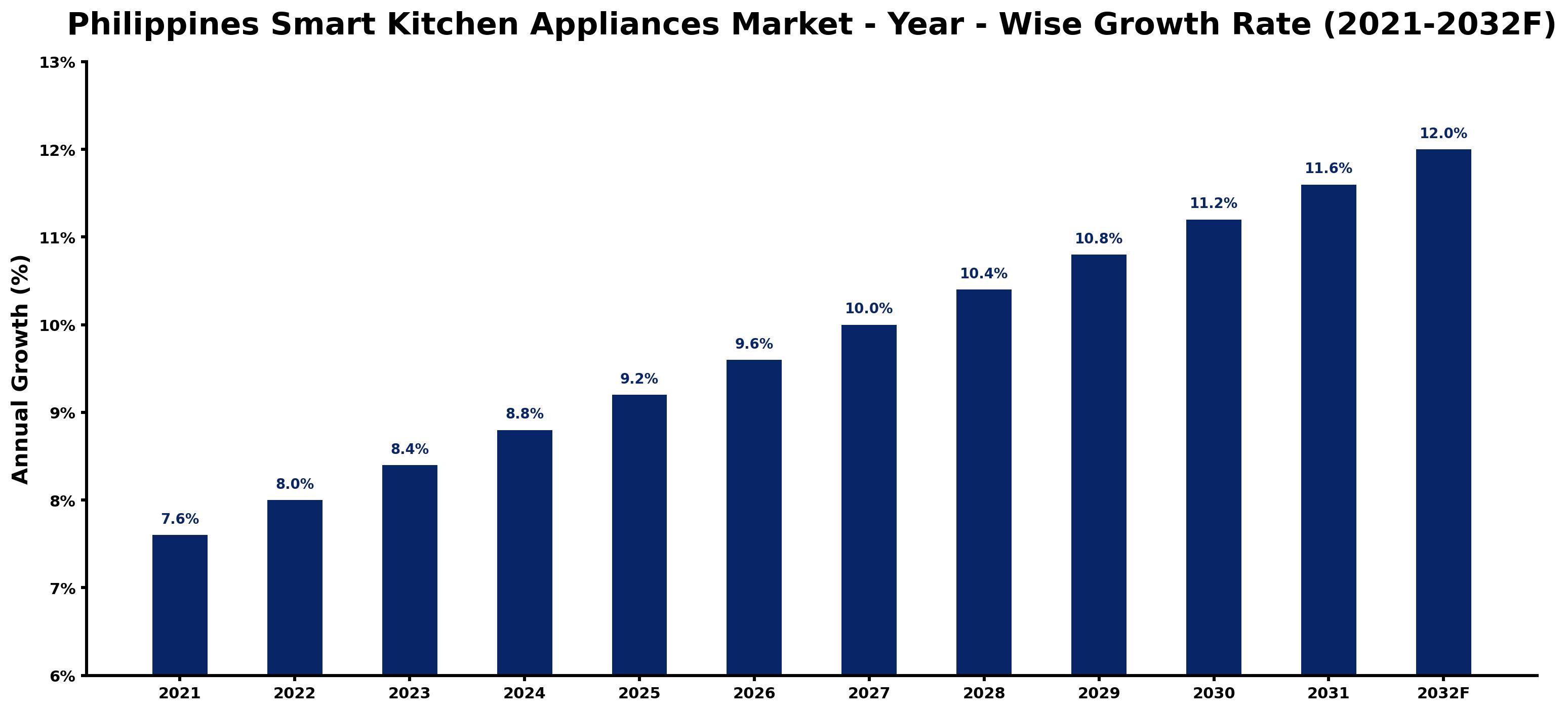
The table below presents the year‑wise growth rates along with the key drivers influencing the market
| Year | Growth Rate | Major Drivers |
| 2021 | 7.6% | Government infrastructure modernization initiatives |
| 2022 | 8.0% | Government infrastructure modernization initiatives |
| 2023 | 8.4% | Expansion of manufacturing activities |
| 2024 | 8.8% | Increasing industrial automation investments |
| 2025 | 9.2% | Increasing adoption of advanced technologies |
| 2026 | 9.6% | Increasing industrial automation investments |
| 2027 | 10.0% | Increasing adoption of advanced technologies |
| 2028 | 10.4% | Expansion of manufacturing activities |
| 2029 | 10.8% | Growing renewable energy integration projects |
| 2030 | 11.2% | Growing renewable energy integration projects |
| 2031 | 11.6% | Increasing industrial automation investments |
| 2032 | 12.0% | Growing urbanization and commercial development |
Note - Market size estimations and growth projections presented in this report are based on 6Wresearch’s advanced forecasting approach, validated with industry datasets as of June 2026.
Philippines Smart Kitchen Appliances Market Synopsis
As the Philippines continues to modernize, the demand for smart kitchen appliances is rising sharply, marking a pivotal shift in consumer behavior. With the integration of AI, IoT, and cloud computing technologies, households are discovering the benefits of connected kitchen environments that enhance both functionality and user experience.
Market players are keenly aware of the changing landscape, where consumer preference leans towards not just functionality but also seamless integration with lifestyle. The ongoing economic growth bolsters confidence, paving the way for higher spending on home appliances previously deemed luxury items.
Philippines Smart Kitchen Appliances Market Key Takeaways
- The market is characterized by a strong adoption of technology-enabled solutions to enhance kitchen efficiency.
- Urbanization and rising incomes create a fertile ground for the growth of smart kitchen appliances.
- Technological advancements in AI and IoT are central to product innovation and consumer engagement.
- Major players are actively diversifying their offerings to capture the tech-savvy, affluent consumer segment.
- There is a noticeable shift towards sustainable and energy-efficient appliances, resonating with eco-conscious consumers.
Evaluation of Restraints in Philippines Smart Kitchen Appliances Market
Despite its promising outlook, the Philippines Smart Kitchen Appliances Market faces several constraints that could impact growth. A significant barrier remains the high initial cost associated with smart appliances, which may deter budget-conscious consumers. Moreover, limited internet connectivity in rural areas can hinder the full utilization of IoT-enabled devices. The market is also grappling with a relatively low level of consumer awareness regarding the benefits of smart kitchen technologies, which could slow down adoption rates. Lastly, the competitive landscape is intensifying, making it crucial for companies to innovate continuously to maintain their market share.
Philippines Smart Kitchen Appliances Market Trends
The landscape of smart kitchen appliances is continuously evolving, influenced by several key trends. Notably, there is a rising focus on voice-activated technologies, allowing users to control their appliances hands-free, which aligns with the growing preference for convenience. The integration of smart home ecosystems also plays a vital role, enabling appliances to communicate with each other and enhancing overall user experience. Furthermore, the shift towards energy-efficient models reflects growing consumer awareness of sustainability, presenting a dual advantage of cost savings and environmental benefits.
Philippines Smart Kitchen Appliances Market Opportunities
With a significant growth trajectory ahead, the Philippines Smart Kitchen Appliances Market is ripe with opportunities. There is a notable demand for customized solutions tailored to the local culinary culture, which could be a critical factor for companies looking to differentiate themselves. Additionally, the surge in online shopping provides a unique channel for brands to reach tech-savvy consumers more effectively. Partnerships with local retailers and e-commerce platforms can further bolster market penetration. As the government increasingly supports technology adoption, investment in smart kitchen solutions is likely to gain traction in both urban and rural settings.
Government Initiatives in the Philippines Smart Kitchen Appliances Market
The Philippine government has recognized the role of technology in driving economic growth and improving quality of life. As part of its initiatives, there are ongoing programs aimed at promoting the use of smart technologies across various sectors, including home appliances. Public spending in infrastructure and connectivity is gradually enhancing internet access nationwide, crucial for the adoption of IoT-based solutions. Furthermore, the government is incentivizing businesses to innovate, creating a supportive environment for the development and integration of smart kitchen appliances.
Future Insights of the Philippines Smart Kitchen Appliances Market
Looking ahead to 2026-2032, the Philippines Smart Kitchen Appliances Market is set to flourish. Continued urbanization will drive demand as more consumers embrace smart technology for enhanced convenience and efficiency. As the middle class expands, the appetite for premium appliances will grow, pushing manufacturers to innovate and offer more diverse product lines. The focus on sustainability will also shape product offerings, with energy efficiency becoming a key consideration for consumers. Overall, the market is poised for robust growth as technological advancements and changing consumer preferences converge.
Philippines Smart Kitchen Appliances Market Latest Developments (May 2025 - June 2026)
In recent months, the smart kitchen appliances sector in the Philippines has witnessed a flurry of activity, including new product launches that emphasize connectivity and user-friendly features. Companies are increasingly partnering with tech firms to enhance their offerings, integrating AI capabilities into their appliances for better user interaction. Additionally, marketing campaigns are focusing on educating consumers about the benefits of smart kitchen technologies, aiming to drive adoption rates in both urban and rural markets. The response to these initiatives has been positive, signaling a growing acceptance of smart appliances among Filipino consumers.
Philippines Smart Kitchen Appliances Market - Key Attractiveness of the Report
- 10 Years of Market Numbers
- Historical Data Starting from 2022 to 2025
- Base Year: 2025
- Forecast Data until 2032
- Key Performance Indicators Impacting the Market
- Major Upcoming Developments and Projects
Key Highlights of the Report:
- Philippines Smart Kitchen Appliances Market Outlook
- Market Size of Philippines Smart Kitchen Appliances Market, 2025
- Forecast of Philippines Smart Kitchen Appliances Market, 2032
- Historical Data and Forecast of Philippines Smart Kitchen Appliances Revenues & Volume for the Period 2022-2032F
- Philippines Smart Kitchen Appliances Market Trend Evolution
- Philippines Smart Kitchen Appliances Market Drivers and Challenges
- Philippines Smart Kitchen Appliances Price Trends
- Philippines Smart Kitchen Appliances Porter's Five Forces
- Philippines Smart Kitchen Appliances Industry Life Cycle
- Historical Data and Forecast of Philippines Smart Kitchen Appliances Market Revenues & Volume By Products for the Period 2022-2032F
- Historical Data and Forecast of Philippines Smart Kitchen Appliances Market Revenues & Volume By Smart Refrigerators for the Period 2022-2032F
- Historical Data and Forecast of Philippines Smart Kitchen Appliances Market Revenues & Volume By Smart Cookware and Cooktops for the Period 2022-2032F
- Historical Data and Forecast of Philippines Smart Kitchen Appliances Market Revenues & Volume By Smart Ovens for the Period 2022-2032F
- Historical Data and Forecast of Philippines Smart Kitchen Appliances Market Revenues & Volume By Other for the Period 2022-2032F
- Historical Data and Forecast of Philippines Smart Kitchen Appliances Market Revenues & Volume By Applications for the Period 2022-2032F
- Historical Data and Forecast of Philippines Smart Kitchen Appliances Market Revenues & Volume By Residential for the Period 2022-2032F
- Historical Data and Forecast of Philippines Smart Kitchen Appliances Market Revenues & Volume By Commercial for the Period 2022-2032F
- Philippines Smart Kitchen Appliances Import Export Trade Statistics
- Market Opportunity Assessment By Products
- Market Opportunity Assessment By Applications
- Philippines Smart Kitchen Appliances Top Companies Market Share
- Philippines Smart Kitchen Appliances Competitive Benchmarking By Technical and Operational Parameters
- Philippines Smart Kitchen Appliances Company Profiles
- Philippines Smart Kitchen Appliances Key Strategic Recommendations






































