Philippines Smart Toilet Market Top 5 Importing Countries and Market Competition (HHI) Analysis
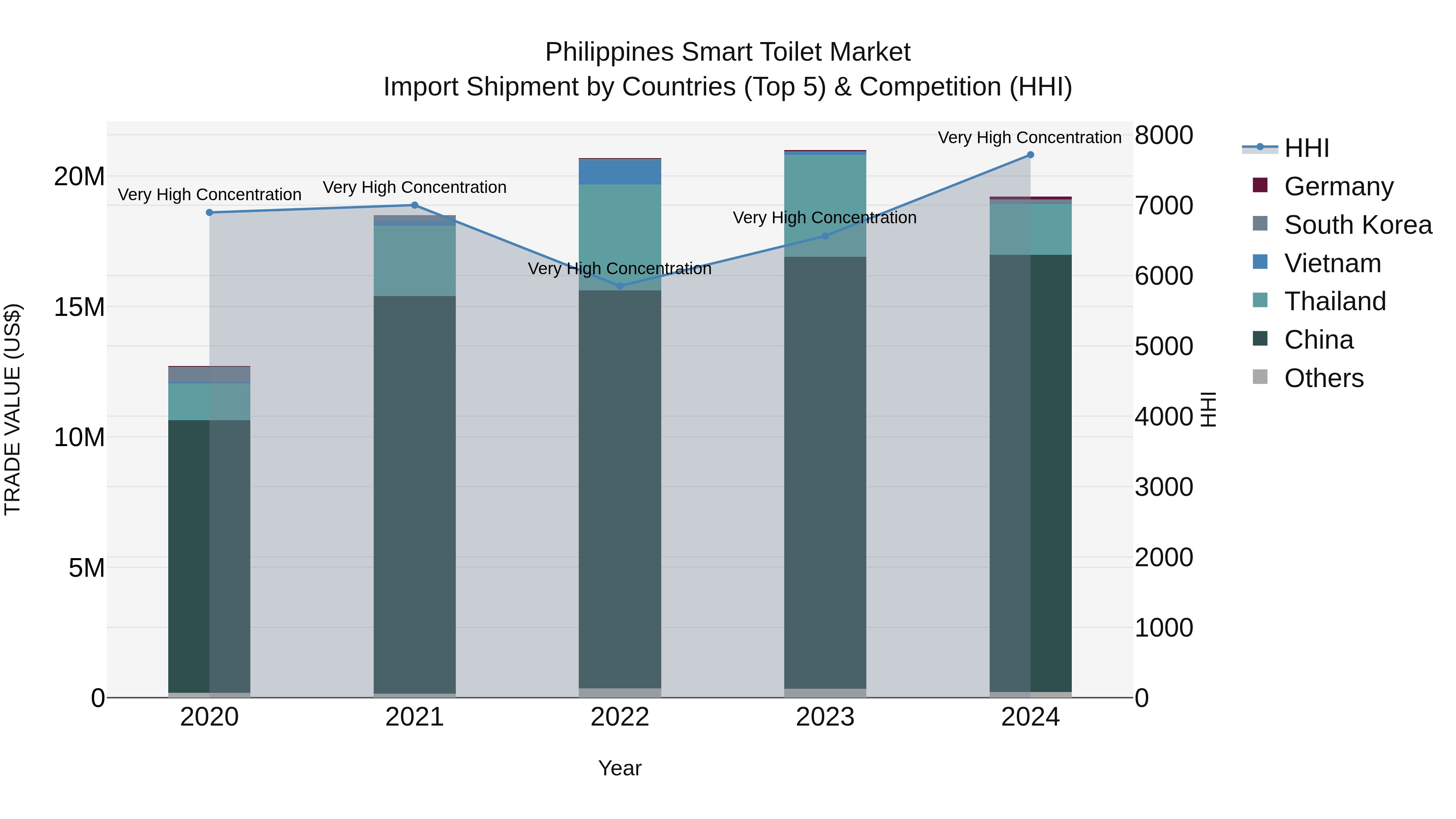
In 2024, the Philippines continued to see a high concentration of smart toilet imports from top countries such as China, Thailand, South Korea, Germany, and Malaysia. Despite a slight decline in growth rate from 2023 to 2024, the compound annual growth rate (CAGR) from 2020 to 2024 remained strong at 10.88%. This data suggests a sustained demand for smart toilets in the Philippines, with key players in the market maintaining their dominance and contributing to the overall import market dynamics.
philippines smart toilet market Synopsis
The smart toilet market in the Philippines is relatively small but growing. According to 6wresearch, it was worth an estimated USD 11 million in 2018 and is expected to grow at a CAGR of 15. 1% during the forecast period. It is mainly driven by increasing urbanization, rising disposable incomes, and growing health awareness among consumers.
Drivers of the Market
The smart toilet market is influenced by technology adoption and lifestyle changes. As consumers become more interested in smart home solutions, the demand for advanced bathroom fixtures like smart toilets could increase. The market`s outlook is driven by factors such as urbanization, technological innovations, and the desire for convenience and hygiene.
Challenges of the Market
The smart toilet market in the Philippines may encounter challenges associated with cultural preferences and economic considerations. The adoption of smart toilet technology could be influenced by cultural norms and preferences for traditional toilets. Moreover, the higher cost of smart toilets compared to conventional ones might limit their adoption, especially in price-sensitive segments of the population.
COVID-19 Impact on the Market
The smart toilet market could have experienced changes in consumer preferences during the pandemic. Increased awareness of hygiene and sanitation might have driven demand for smart toilets with advanced features. However, economic uncertainties and changes in purchasing priorities might also have influenced consumer spending in this market.
Key Players in the Market
The smart toilet market in the Philippines is relatively niche but has been growing as smart home technologies gain popularity. International brands like TOTO and Kohler have a presence in this market, offering smart toilets with features like heated seats, bidet functions, and automated flushing.
Key Highlights of the Report:
- Philippines Smart Toilet Market Outlook
- Market Size of Philippines Smart Toilet Market, 2024
- Forecast of Philippines Smart Toilet Market, 2031
- Historical Data and Forecast of Philippines Smart Toilet Revenues & Volume for the Period 2021-2031
- Philippines Smart Toilet Market Trend Evolution
- Philippines Smart Toilet Market Drivers and Challenges
- Philippines Smart Toilet Price Trends
- Philippines Smart Toilet Porter's Five Forces
- Philippines Smart Toilet Industry Life Cycle
- Historical Data and Forecast of Philippines Smart Toilet Market Revenues & Volume By Technology for the Period 2021-2031
- Historical Data and Forecast of Philippines Smart Toilet Market Revenues & Volume By Mobile Application for the Period 2021-2031
- Historical Data and Forecast of Philippines Smart Toilet Market Revenues & Volume By Non-Mobile Application for the Period 2021-2031
- Historical Data and Forecast of Philippines Smart Toilet Market Revenues & Volume By Type for the Period 2021-2031
- Historical Data and Forecast of Philippines Smart Toilet Market Revenues & Volume By Wall Hung Toilet for the Period 2021-2031
- Historical Data and Forecast of Philippines Smart Toilet Market Revenues & Volume By Close-Coupled for the Period 2021-2031
- Historical Data and Forecast of Philippines Smart Toilet Market Revenues & Volume By Single Floor Standing Toilet for the Period 2021-2031
- Historical Data and Forecast of Philippines Smart Toilet Market Revenues & Volume By One-Piece Toilet for the Period 2021-2031
- Historical Data and Forecast of Philippines Smart Toilet Market Revenues & Volume By Others for the Period 2021-2031
- Historical Data and Forecast of Philippines Smart Toilet Market Revenues & Volume By Usage for the Period 2021-2031
- Historical Data and Forecast of Philippines Smart Toilet Market Revenues & Volume By Residential for the Period 2021-2031
- Historical Data and Forecast of Philippines Smart Toilet Market Revenues & Volume By Commercial for the Period 2021-2031
- Historical Data and Forecast of Philippines Smart Toilet Market Revenues & Volume By Distribution Channel for the Period 2021-2031
- Historical Data and Forecast of Philippines Smart Toilet Market Revenues & Volume By Online Stores for the Period 2021-2031
- Historical Data and Forecast of Philippines Smart Toilet Market Revenues & Volume By Offline Stores for the Period 2021-2031
- Philippines Smart Toilet Import Export Trade Statistics
- Market Opportunity Assessment By Technology
- Market Opportunity Assessment By Type
- Market Opportunity Assessment By Usage
- Market Opportunity Assessment By Distribution Channel
- Philippines Smart Toilet Top Companies Market Share
- Philippines Smart Toilet Competitive Benchmarking By Technical and Operational Parameters
- Philippines Smart Toilet Company Profiles
- Philippines Smart Toilet Key Strategic Recommendations






































