Philippines Smartphone Market Summary
The philippines smartphone market was estimated at USD 1352 Million in 2025 and is projected to reach USD 2242 Million by 2032, growing at a CAGR of 8.6% from 2026 to 2032.
Philippines Smartphone Market Year-wise Growth Rate and Key Drivers
This graph highlights how the Philippines Smartphone Market has steadily grown over the past five years, supported by major growth factors.
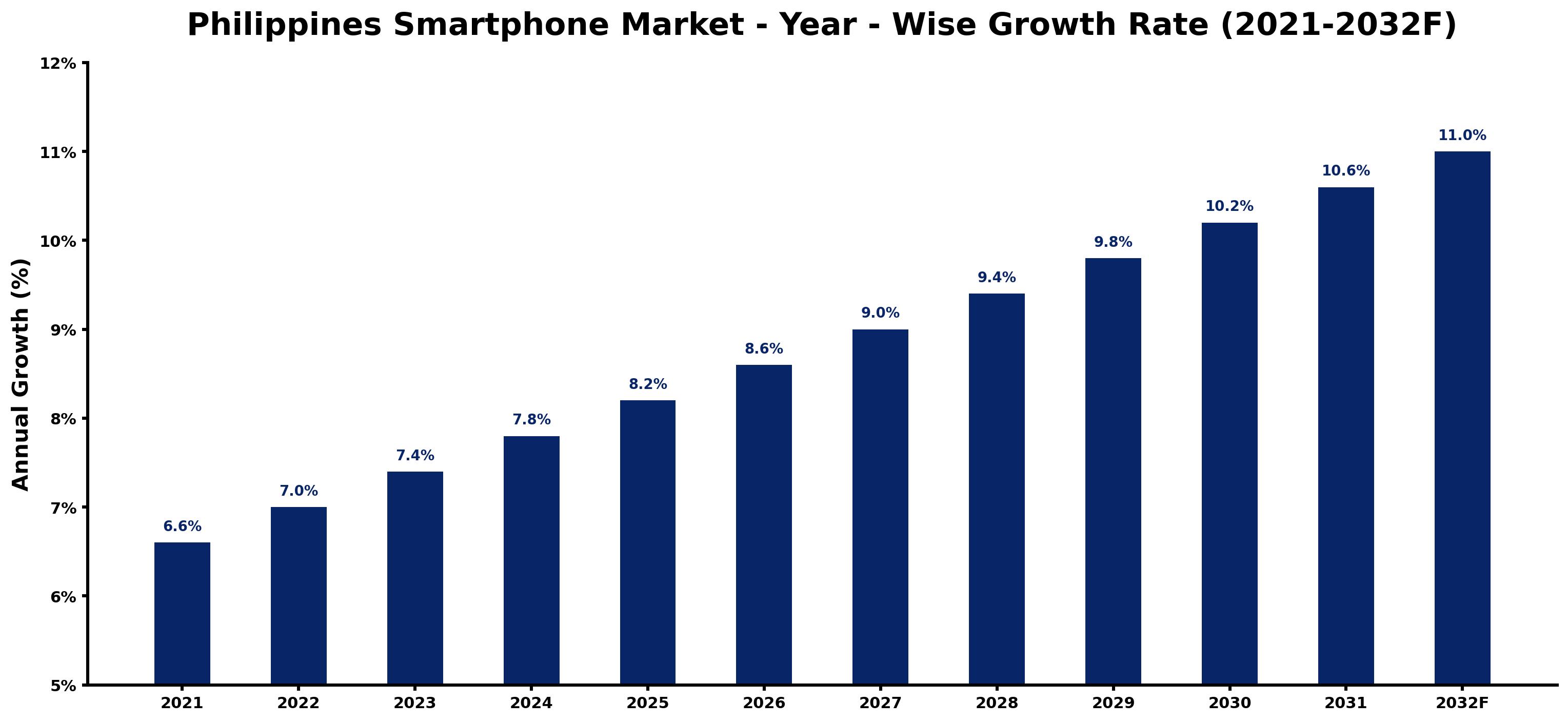
The table below presents the year wise growth rates along with the key drivers influencing the market
| Year | Growth Rate | Major Drivers |
| 2021 | 6.6% | Smartphone penetration in urban areas provides a solid foundation for future growth. |
| 2022 | 7.0% | Increased competition among brands encourages innovative features and affordability for consumers. |
| 2023 | 7.4% | Post-pandemic consumer behaviors highlight a shift toward e-commerce and mobile payments. |
| 2024 | 7.8% | 5G technology rollout opens new possibilities for high-speed mobile applications and services. |
| 2025 | 8.2% | Rural electrification efforts advance, enhancing smartphone accessibility in previously underserved areas. |
| 2026 | 8.6% | Local manufacturers gain traction, reducing costs and nurturing brand loyalty among consumers. |
| 2027 | 9.0% | Emerging middle class seeks premium devices, shifting market dynamics toward higher-end smartphones. |
| 2028 | 9.4% | Integration of AI capabilities in devices caters to evolving consumer preferences and needs. |
| 2029 | 9.8% | Environmental consciousness influences demand for sustainable and eco-friendly smartphone options. |
| 2030 | 10.2% | Enhanced mobile internet infrastructure supports streaming services, driving smartphone usage further. |
| 2031 | 10.6% | Growing interest in tech education encourages youth engagement in smartphone-related innovations. |
| 2032 | 11.0% | Smartphones evolve into essential tools for digital workspaces, reshaping market expectations. |
Note - Market size estimations and growth projections presented in this report are based on 6Wresearch's advanced forecasting approach, validated with industry datasets as of June 2026.
Philippines Smartphone Market Synopsis
The Philippines Smartphone Market is projected to reach 8.6% and witness significant growth during the forecast period (2026-2032). This dynamic market is characterized by a rapid increase in mobile subscribers, driven by both the growing accessibility of smartphones and improved data service availability. With an estimated 82 million active mobile subscribers in 2020, up from 68 million in 2019, the demand for smartphones has surged significantly. This growth trajectory is supported by a robust increase in 3G and 4G user adoption, prompting a greater interest in high-end smartphones featuring advanced technologies such as superior camera capabilities, larger display sizes, and enhanced battery life.
Philippines Smartphone Market Growth Drivers
Several key factors are driving growth in the Philippines Smartphone Market:
- Rising disposable incomes among Filipinos have led to increased consumer spending on technology, allowing more individuals to afford smartphones with advanced features.
- The ongoing rollout and expansion of 4G and 5G networks across the country have significantly enhanced mobile connectivity, fostering a greater demand for smartphones capable of supporting these technologies.
- The introduction of innovative product lines, including 5G-enabled devices, has attracted tech-savvy consumers looking for the latest technology in their smartphones.
- The increasing reliance on mobile applications and services underscores the importance of high-performance smartphones in facilitating daily activities, including online shopping, banking, and social media engagement.
- A significant shift towards online sales channels during the COVID-19 pandemic has established a strong foundation for future e-commerce growth, enabling consumers to purchase smartphones conveniently from home.
Philippines Smartphone Market Trends and Opportunities
The Philippines Smartphone Market presents numerous trends and opportunities that stakeholders should consider:
- The increasing acceptance of e-wallets and mobile payment systems reflects a burgeoning trend among consumers, highlighting the need for smartphones with secure and efficient payment capabilities.
- Consumers are increasingly prioritizing smartphones with longer battery life and efficient energy management systems, creating opportunities for manufacturers to innovate in this area.
- As more consumers engage with social media platforms, there is a growing demand for smartphones equipped with superior camera technology, pushing companies to enhance their image quality and video capabilities.
- The rise of mobile gaming represents a substantial opportunity, as consumers seek devices with high-performance graphics and processing power to enjoy immersive gaming experiences.
- There is a noticeable shift toward eco-friendly smartphones, prompting manufacturers to invest in sustainable practices and materials, resonating with environmentally conscious consumers.
Philippines Smartphone Market Challenges and Restraints
Despite its growth potential, the Philippines Smartphone Market faces several challenges:
- Intense competition among manufacturers creates pricing pressures, which can hinder profit margins and lead to unsustainable business practices.
- Infrastructure gaps in rural areas can limit access to modern data networks, potentially restricting adoption rates of advanced smartphone technologies.
- Economic fluctuations, particularly those induced by external factors such as global supply chain disruptions, may affect consumers' purchasing power and overall market growth.
- Cybersecurity concerns regarding the protection of personal data can deter consumers from fully embracing smartphones laden with features that require constant internet connectivity.
- The reliance on imports for high-end smartphone components exposes the market to volatility in pricing and availability, particularly during geopolitical tensions or logistical challenges.
Philippines Smartphone Market Government Investment and Initiatives
The Philippine government is actively promoting the smartphone market through various policies and initiatives aimed at enhancing digital connectivity and economic growth. Key government actions include:
- Investments in expanding network infrastructure through public-private partnerships, aimed at improving broadband access and mobile connectivity throughout the archipelago.
- Initiatives promoting digital literacy and access to technology in underserved communities, thus encouraging smartphone adoption among a broader population.
- Support for local technology startups and innovations that focus on smartphone application development, aligning with government objectives to boost digital economies.
- Regulatory frameworks that encourage fair competition in the telecommunications sector, ensuring that consumers benefit from a variety of devices and services.
- Programs aimed at enhancing cybersecurity measures are vital for fostering consumer trust in smartphone usage and online transactions.
Philippines Smartphone Market Latest Developments (May 2025 - June 2026)
The Philippines Smartphone Market has experienced several noteworthy developments from May 2025 to June 2026. Industry players have been notably active in launching new devices that cater to evolving consumer preferences, especially in the realm of 5G technology. There has been a marked increase in marketing efforts focusing on features such as improved camera systems and battery longevity, reflecting consumer demand for more technologically advanced smartphones. Furthermore, initiatives to bolster local manufacturing capabilities have gained momentum, aimed at reducing reliance on imports and enhancing supply chain resilience. Simultaneously, notable partnerships between telecommunications providers and smartphone manufacturers have emerged, focusing on bundled offers that further incentivize consumers to upgrade to newer models. Overall, these trends indicate a robust competitive landscape as stakeholders strive to capture a growing share of the burgeoning smartphone market.
Philippines Smartphone Market - Key Attractiveness of the Report
- 10 Years of Market Numbers
- Historical Data Starting from 2022 to 2025
- Base Year: 2025
- Forecast Data until 2032
- Key Performance Indicators Impacting the Market
- Major Upcoming Developments and Projects
Key Highlights of the Report:
- Philippines Smartphone Market Outlook
- Market Size of Philippines Smartphone Market, 2025
- Forecast of Philippines Smartphone Market, 2032F
- Historical Data and Forecast of Philippines Smartphone Revenues & Volume for the Period 2022-2032F
- Philippines Smartphone Market Trend Evolution
- Philippines Smartphone Market Drivers and Challenges
- Philippines Smartphone Price Trends
- Philippines Smartphone Porter's Five Forces
- Philippines Smartphone Industry Life Cycle
- Historical Data and Forecast of Philippines Smartphone Market Revenues & Volume By Product Type for the Period 2022-2032F
- Historical Data and Forecast of Philippines Smartphone Market Revenues & Volume By Android for the Period 2022-2032F
- Historical Data and Forecast of Philippines Smartphone Market Revenues & Volume By iOS for the Period 2022-2032F
- Historical Data and Forecast of Philippines Smartphone Market Revenues & Volume By Windows for the Period 2022-2032F
- Historical Data and Forecast of Philippines Smartphone Market Revenues & Volume By Blackberry Operating System for the Period 2022-2032F
- Historical Data and Forecast of Philippines Smartphone Market Revenues & Volume By Other for the Period 2022-2032F
- Historical Data and Forecast of Philippines Smartphone Market Revenues & Volume By Distribution Channel for the Period 2022-2032F
- Historical Data and Forecast of Philippines Smartphone Market Revenues & Volume By OEM for the Period 2022-2032F
- Historical Data and Forecast of Philippines Smartphone Market Revenues & Volume By Retailer for the Period 2022-2032F
- Historical Data and Forecast of Philippines Smartphone Market Revenues & Volume By e-Commerce for the Period 2022-2032F
- Philippines Smartphone Import Export Trade Statistics
- Market Opportunity Assessment By Product Type
- Market Opportunity Assessment By Distribution Channel
- Philippines Smartphone Top Companies Market Share
- Philippines Smartphone Competitive Benchmarking By Technical and Operational Parameters
- Philippines Smartphone Company Profiles
- Philippines Smartphone Key Strategic Recommendations






































