Philippines Sodium Hydride Market Size, Share & Growth Rate
The Philippines Sodium Hydride Market was estimated at USD 1373 Million in 2025 and is projected to reach USD 1961 Million by 2032, growing at a CAGR of 5.2% from 2026 to 2032. This remarkable growth trajectory can be attributed to the escalating demand from the pharmaceutical sector and advancements in material sciences, notably in electronics and green chemistry. As industries evolve and prioritize efficiency, the role of sodium hydride as a fundamental reducing agent becomes increasingly vital.
Philippines Sodium Hydride Market Year-wise Growth Rate and Key Drivers
This graph highlights how the Philippines Sodium Hydride Market has steadily grown over the years, supported by major growth factors.
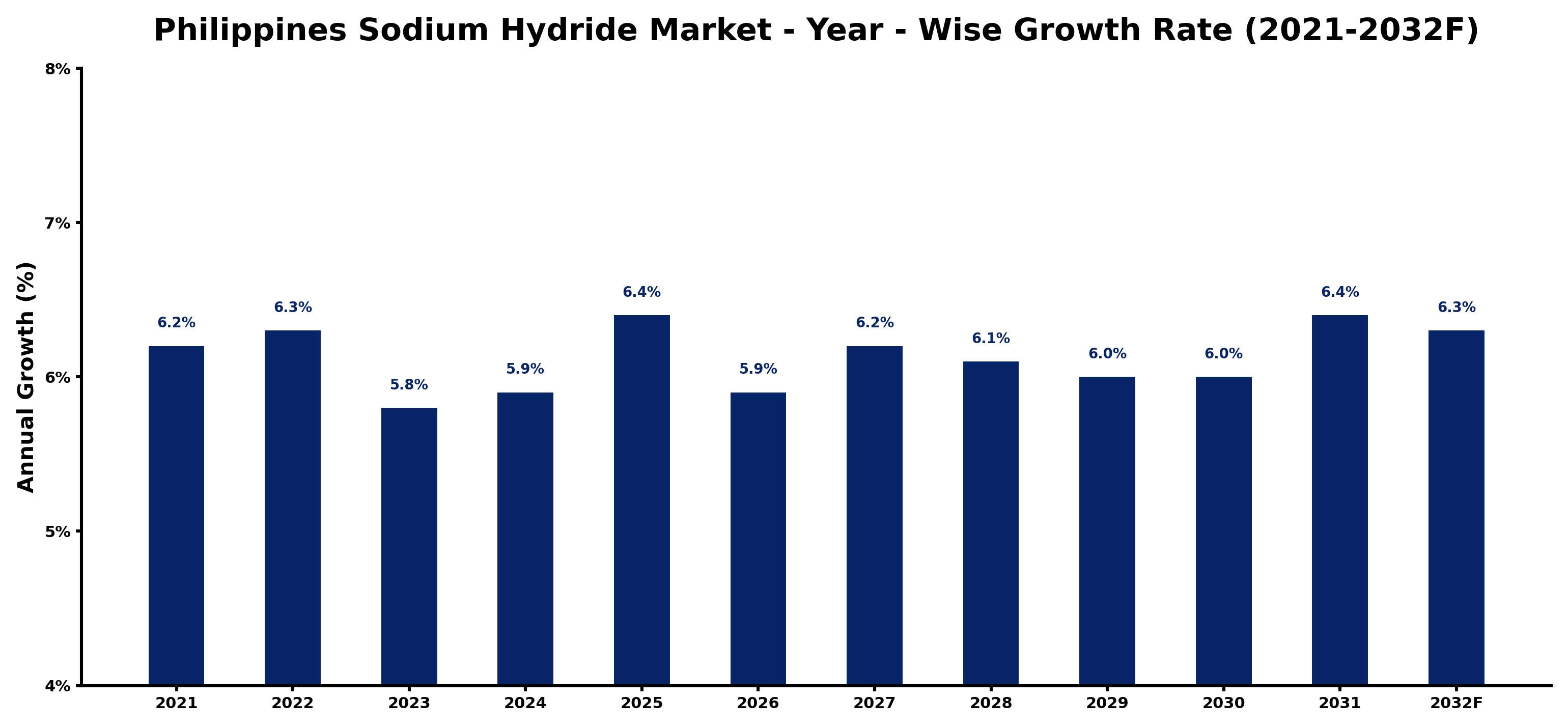
The table below presents the year‑wise growth rates along with the key drivers influencing the market
| Year | Growth Rate | Major Drivers |
| 2021 | 6.2% | Rising demand for specialty chemicals |
| 2022 | 6.3% | Increased production capacity enhancements |
| 2023 | 5.8% | Growing applications in pharmaceuticals |
| 2024 | 5.9% | Expansion in renewable energy sector |
| 2025 | 6.4% | Technological advancements in production |
| 2026 | 5.9% | Emerging markets driving consumption growth |
| 2027 | 6.2% | Strategic partnerships enhancing distribution |
| 2028 | 6.1% | Regulatory support for chemical innovations |
| 2029 | 6.0% | Sustainability trends boosting market interest |
| 2030 | 6.0% | Investment in research and development |
| 2031 | 6.4% | Global market expansion opportunities arise |
| 2032 | 6.3% | Increased focus on product quality |
Note - Market size estimations and growth projections presented in this report are based on 6Wresearch’s advanced forecasting approach, validated with industry datasets as of June 2026.
Philippines Sodium Hydride Market Synopsis
The sodium hydride market in the Philippines is witnessing a paradigm shift, characterized by robust growth fueled by diverse industrial applications. With its exceptional reactivity, sodium hydride serves as a cornerstone in various chemical synthesis processes, particularly in pharmaceuticals and advanced materials.
As a preferred reducing agent, sodium hydride is pivotal in the formulation of fine chemicals and aids significantly in the development of innovative products across sectors such as electronics. This growing utilization underscores the market's expanding horizons, poised for substantial growth as industries increasingly recognize the benefits of efficient chemical synthesis.
Philippines Sodium Hydride Market Key Takeaways
- The market is driven by the rising demand from pharmaceuticals and advanced material sectors.
- Significant growth opportunities exist due to the shift towards sustainable chemical practices.
- Safety protocols and regulations surrounding sodium hydride handling remain critical market considerations.
- The pandemic has reshaped supply chains, necessitating adaptability within the market.
- Innovative applications in green chemistry are emerging as a transformative force in the sector.
Evaluation of Restraints in Philippines Sodium Hydride Market
Despite its growth potential, the Philippines sodium hydride market faces notable constraints primarily centered on safety and regulatory compliance. The inherent reactivity of sodium hydride necessitates stringent safety measures during its handling and storage, which can complicate operations for manufacturers and suppliers. Additionally, the market must navigate complex regulatory frameworks that dictate safe usage practices, potentially hindering swift market expansion. Stakeholders must remain vigilant in addressing these challenges to maintain a secure operational environment while fulfilling industry demands.
Philippines Sodium Hydride Market Trends
Current trends in the Philippines sodium hydride market indicate a strong shift toward environmentally sustainable practices. Industries are increasingly adopting green chemistry methods that utilize sodium hydride for efficient, low-impact synthesis processes. Concurrently, the pharmaceutical sector is witnessing heightened innovation, with sodium hydride playing a key role in the development of new drugs and therapies.
Moreover, advancements in semiconductor technology are driving demand for high-quality materials, positioning sodium hydride as a crucial component in the production of specialized chemicals. This confluence of trends signifies a transformative period for the market, as it adapts to evolving industry standards and consumer expectations.
Philippines Sodium Hydride Market Opportunities
The Philippines sodium hydride market presents significant growth opportunities, particularly through investments in research and development. As industries seek to enhance chemical efficiency and sustainability, innovative applications of sodium hydride are expected to proliferate. Additionally, the ongoing expansion of the pharmaceutical sector, with its relentless demand for advanced synthesis methods, creates a fertile ground for sodium hydride manufacturers to thrive.
Moreover, partnerships with academic institutions focused on chemical research can yield breakthroughs in the utilization of sodium hydride, driving further demand. As environmental regulations tighten globally, the emphasis on cleaner chemical processes will only serve to elevate the position of sodium hydride within the marketplace.
Government Initiatives in the Philippines Sodium Hydride Market
The Philippine government is increasingly supportive of initiatives that encourage sustainable manufacturing practices, which can benefit the sodium hydride market. Regulatory frameworks are being updated to promote environmentally friendly chemical synthesis methods, which align with global sustainability goals. Additionally, public funding directed towards research in advanced materials and green chemistry offers substantial support for sodium hydride applications, thereby positioning the market for future growth.
Future Insights of the Philippines Sodium Hydride Market
Looking forward to the 2026-2032 period, the Philippines sodium hydride market is anticipated to undergo a transformational evolution. With the increasing demand for innovative pharmaceuticals and advanced electronic materials, manufacturers are likely to expand their operational capacities and enhance product offerings. The rise of green chemistry will serve as a catalyst for sodium hydride's adoption in various industries, potentially unlocking new market segments.
Furthermore, collaborative ventures between industry players and research institutions are expected to foster innovation, paving the way for enhanced applications. As the global chemical landscape continues to shift towards sustainability, the Philippines sodium hydride market is poised to capitalize on these trends, leading to robust market expansion.
Philippines Sodium Hydride Market Latest Developments (May 2025 - June 2026)
In recent months, the Philippines sodium hydride market has seen notable advancements. Key industry stakeholders are focusing on improving safety protocols and sustainable practices in response to increasing regulatory pressures. Additionally, companies are investing in technology that enhances the efficiency of sodium hydride production, aiming to meet rising demand across diverse applications. Collaborative projects are emerging between academia and industry, further driving innovation in the application of sodium hydride, particularly in pharmaceuticals and materials science.
Philippines Sodium Hydride Market - Key Attractiveness of the Report
- 10 Years of Market Numbers
- Historical Data Starting from 2022 to 2025
- Base Year: 2025
- Forecast Data until 2032
- Key Performance Indicators Impacting the Market
- Major Upcoming Developments and Projects
Key Highlights of the Report:
- Philippines Sodium Hydride Market Outlook
- Market Size of Philippines Sodium Hydride Market, 2025
- Forecast of Philippines Sodium Hydride Market, 2032
- Historical Data and Forecast of Philippines Sodium Hydride Revenues & Volume for the Period 2022-2032F
- Philippines Sodium Hydride Market Trend Evolution
- Philippines Sodium Hydride Market Drivers and Challenges
- Philippines Sodium Hydride Price Trends
- Philippines Sodium Hydride Porter's Five Forces
- Philippines Sodium Hydride Industry Life Cycle
- Historical Data and Forecast of Philippines Sodium Hydride Market Revenues & Volume By Product Range for the Period 2022-2032F
- Historical Data and Forecast of Philippines Sodium Hydride Market Revenues & Volume By Sodium Hydride 60% for the Period 2022-2032F
- Historical Data and Forecast of Philippines Sodium Hydride Market Revenues & Volume By Sodium Hydride 55% for the Period 2022-2032F
- Historical Data and Forecast of Philippines Sodium Hydride Market Revenues & Volume By Sodium Hydride 45% for the Period 2022-2032F
- Historical Data and Forecast of Philippines Sodium Hydride Market Revenues & Volume By Other for the Period 2022-2032F
- Historical Data and Forecast of Philippines Sodium Hydride Market Revenues & Volume By Application for the Period 2022-2032F
- Historical Data and Forecast of Philippines Sodium Hydride Market Revenues & Volume By Chemical Industry for the Period 2022-2032F
- Historical Data and Forecast of Philippines Sodium Hydride Market Revenues & Volume By Pharmaceutical Industry for the Period 2022-2032F
- Historical Data and Forecast of Philippines Sodium Hydride Market Revenues & Volume By Pesticide Industry for the Period 2022-2032F
- Philippines Sodium Hydride Import Export Trade Statistics
- Market Opportunity Assessment By Product Range
- Market Opportunity Assessment By Application
- Philippines Sodium Hydride Top Companies Market Share
- Philippines Sodium Hydride Competitive Benchmarking By Technical and Operational Parameters
- Philippines Sodium Hydride Company Profiles
- Philippines Sodium Hydride Key Strategic Recommendations






































