Philippines Solvent Market Top 5 Importing Countries and Market Competition (HHI) Analysis
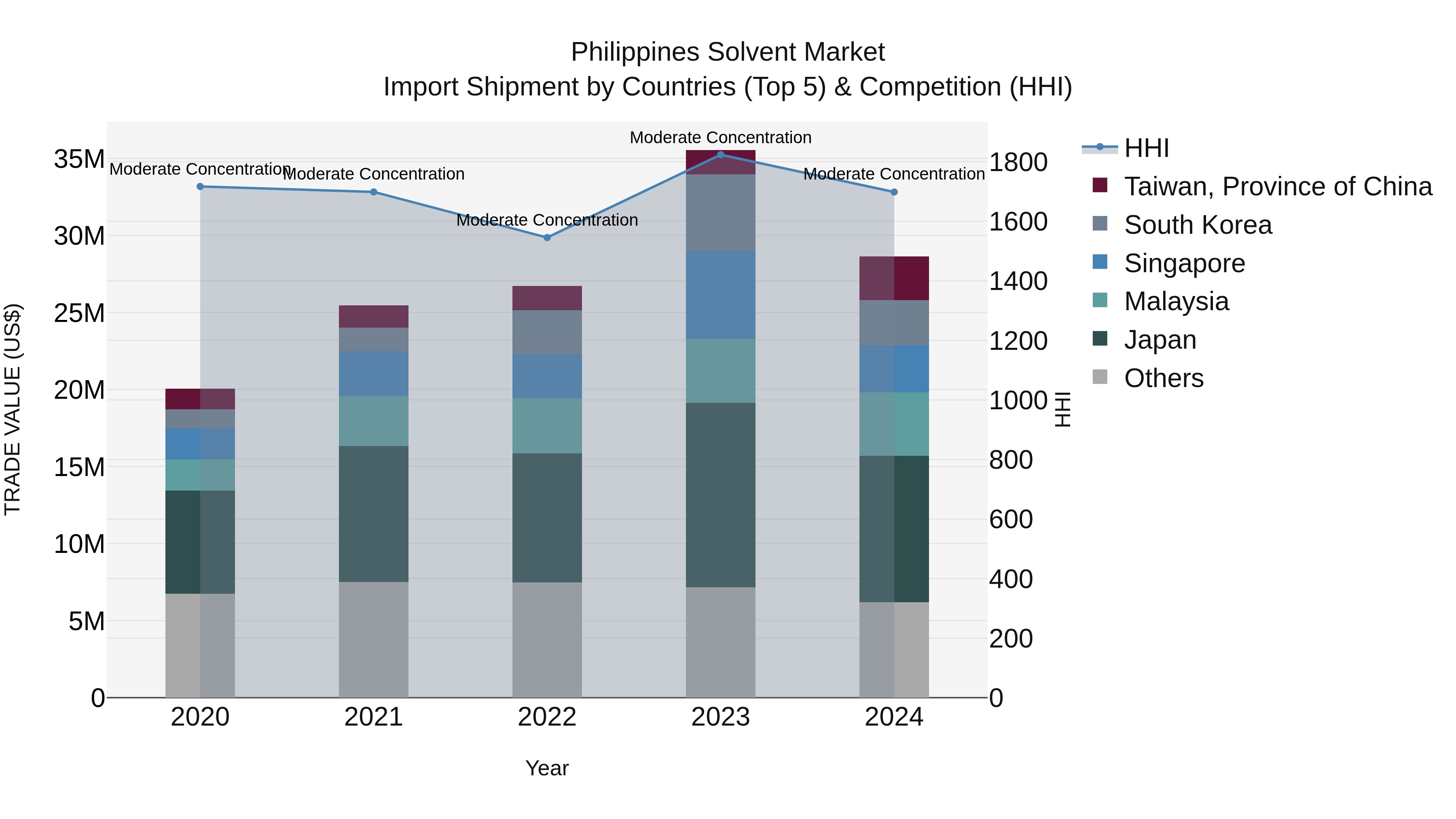
In 2024, Philippines saw a steady growth in solvent import shipments, with Japan, Malaysia, Singapore, South Korea, and Taiwan being the top exporting countries. Despite a slight decrease in growth rate from 2023, the market remained moderately concentrated with a healthy Compound Annual Growth Rate (CAGR) of 9.31% over the period of 2020-2024. This trend indicates a stable demand for solvents in the Philippines and a strong presence of key suppliers in the market.
Philippines Solvent Market Synopsis
The solvent market in the Philippines serves various industries including paints, pharmaceuticals, and agrochemicals. Demand for solvents is driven by industrialization and the increasing production of consumer goods. However, environmental concerns and regulatory constraints around volatile organic compounds (VOCs) are shaping the market towards greener and bio-based solvents.
Trends of the market
The solvent market in the Philippines is projected to expand, fueled by the increasing demand from various industries such as paints, coatings, chemicals, and pharmaceuticals. Solvents are crucial for a wide range of applications, including the formulation of paints, coatings, and cleaning agents. The market`s growth is influenced by industrial activities, construction, and the expanding manufacturing sector. Additionally, with rising awareness of environmental issues, there is a growing shift toward more eco-friendly and less toxic solvents, contributing to the market`s diversification and development.
Challenges of the market
The solvent market grapples with regulatory pressures due to the environmental and health risks associated with volatile organic compounds (VOCs). Many solvent products face restrictions under environmental laws, leading to increased costs for safer or alternative formulations. Furthermore, high import reliance and logistical inefficiencies contribute to supply chain instability.
Investment opportunities in the Market
The Solvent Market in the Philippines holds lucrative investment opportunities, driven by the expanding demand for solvents across various industries, including paints and coatings, pharmaceuticals, and chemicals. The country`s manufacturing and industrial sectors are growing, creating an increased need for solvents in processes such as cleaning, thinning, and extraction. Investors can benefit from the rise in consumer demand for eco-friendly and non-toxic solvents, as industries are shifting toward greener alternatives, which opens up niche markets for investment in environmentally friendly solutions.
Government Policy of the market
The Philippines Solvent Market is influenced by the demand from various industries, including manufacturing, pharmaceuticals, and chemicals. Government policies around solvents emphasize safety and environmental standards. The Philippine government has set regulations to control the use and disposal of hazardous solvents, aiming to reduce their negative impact on human health and the environment. There are also initiatives to encourage companies to adopt greener solvents and technologies through tax breaks and grants.
Key Highlights of the Report:
- Philippines Solvent Market Outlook
- Market Size of Philippines Solvent Market, 2024
- Forecast of Philippines Solvent Market, 2031
- Historical Data and Forecast of Philippines Solvent Revenues & Volume for the Period 2021- 2031
- Philippines Solvent Market Trend Evolution
- Philippines Solvent Market Drivers and Challenges
- Philippines Solvent Price Trends
- Philippines Solvent Porter's Five Forces
- Philippines Solvent Industry Life Cycle
- Historical Data and Forecast of Philippines Solvent Market Revenues & Volume By Product for the Period 2021- 2031
- Historical Data and Forecast of Philippines Solvent Market Revenues & Volume By Alcohols for the Period 2021- 2031
- Historical Data and Forecast of Philippines Solvent Market Revenues & Volume By Hydrocarbons for the Period 2021- 2031
- Historical Data and Forecast of Philippines Solvent Market Revenues & Volume By Ketones for the Period 2021- 2031
- Historical Data and Forecast of Philippines Solvent Market Revenues & Volume By Esters for the Period 2021- 2031
- Historical Data and Forecast of Philippines Solvent Market Revenues & Volume By Chlorinated for the Period 2021- 2031
- Historical Data and Forecast of Philippines Solvent Market Revenues & Volume By Others for the Period 2021- 2031
- Historical Data and Forecast of Philippines Solvent Market Revenues & Volume By Source for the Period 2021- 2031
- Historical Data and Forecast of Philippines Solvent Market Revenues & Volume By Petrochemical-based for the Period 2021- 2031
- Historical Data and Forecast of Philippines Solvent Market Revenues & Volume By Bio and Green for the Period 2021- 2031
- Historical Data and Forecast of Philippines Solvent Market Revenues & Volume By Application for the Period 2021- 2031
- Historical Data and Forecast of Philippines Solvent Market Revenues & Volume By Paints and Coatings for the Period 2021- 2031
- Historical Data and Forecast of Philippines Solvent Market Revenues & Volume By Printing Inks for the Period 2021- 2031
- Historical Data and Forecast of Philippines Solvent Market Revenues & Volume By Pharmaceuticals for the Period 2021- 2031
- Historical Data and Forecast of Philippines Solvent Market Revenues & Volume By Cosmetics and Adhesives for the Period 2021- 2031
- Historical Data and Forecast of Philippines Solvent Market Revenues & Volume By Others for the Period 2021- 2031
- Philippines Solvent Import Export Trade Statistics
- Market Opportunity Assessment By Product
- Market Opportunity Assessment By Source
- Market Opportunity Assessment By Application
- Philippines Solvent Top Companies Market Share
- Philippines Solvent Competitive Benchmarking By Technical and Operational Parameters
- Philippines Solvent Company Profiles
- Philippines Solvent Key Strategic Recommendations






































