Philippines Soup Market Top 5 Importing Countries and Market Competition (HHI) Analysis
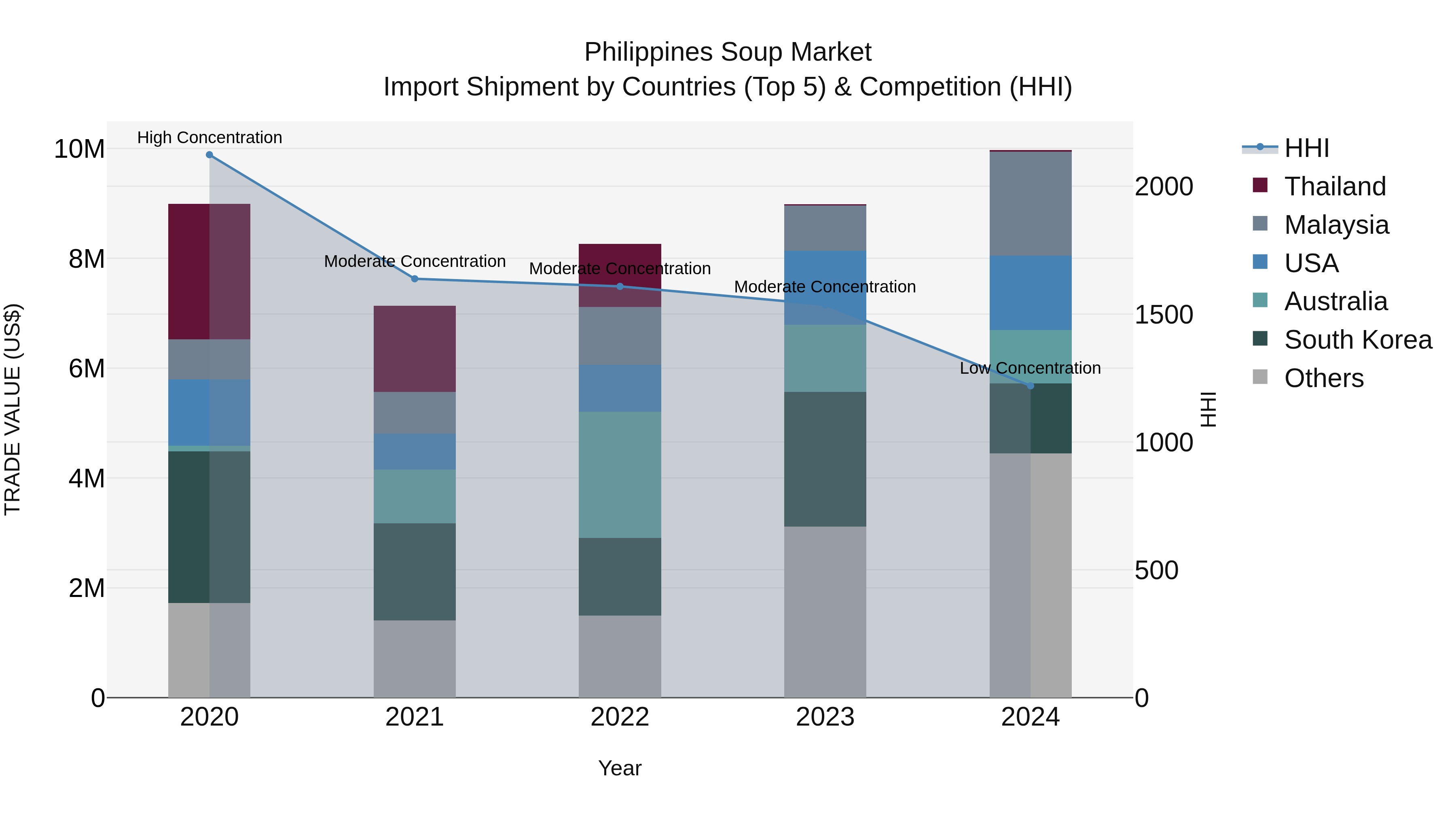
The Philippines soup import market saw steady growth from 2020 to 2024 with a Compound Annual Growth Rate (CAGR) of 2.62%. In 2024, the top countries exporting soup to the Philippines were Malaysia, China, USA, South Korea, and Egypt. The market concentration decreased from moderate to low in 2024, indicating a more diverse range of soup imports. The impressive growth rate of 10.93% in 2024 suggests a strong demand for imported soups in the Philippines, presenting opportunities for both domestic and international soup manufacturers.
Philippines Soup Market Overview
The soup market in the Philippines is growing, driven by changing lifestyles, increasing urbanization, and rising demand for convenient and nutritious meal options. The market includes a range of offerings from instant soups and ready-to-eat varieties to organic and health-focused options. Local and international brands are investing in new flavors, packaging innovation, and health-oriented formulations, targeting both the younger demographic and health-conscious consumers.
Trends of the market
The soup market in the Philippines is experiencing steady growth, driven by the increasing popularity of ready-to-eat meals and the convenience offered by packaged soups. With the busy lifestyles of many Filipinos, the demand for quick, nutritious, and flavorful meal options is on the rise. Additionally, the growing health consciousness among consumers has led to an increase in demand for soups made from natural ingredients and those offering functional benefits, such as low sodium or added vitamins. As a result, the market is witnessing an influx of diverse soup varieties, including instant, canned, and fresh options, catering to a broad consumer base.
Challenges of the market
The Soup Market in the Philippines contends with shifting consumer tastes and the dominance of traditional home-cooked meals. While instant and ready-to-eat soups are gaining popularity among urban populations, they face competition from local food options. Also, concerns about preservatives and artificial ingredients impact consumer perception and sales.
Investment opportunities in the Market
The soup market in the Philippines is expanding, driven by the increasing demand for convenience foods and ready-to-eat products. Consumers are looking for healthy, flavorful, and quick meal options, and soup fits well into this trend. Investment opportunities lie in developing innovative soup products that cater to local tastes and dietary preferences, such as organic, vegetarian, or low-sodium options. As the demand for convenient and nutritious meal solutions continues to grow, the soup market in the Philippines presents a promising opportunity for businesses in the food industry.
Government Policy of the market
The soup market in the Philippines is shaped by evolving consumer preferences toward ready-to-eat and nutritious food. The Department of Agriculture (DA) supports local ingredient sourcing, while the Food and Drug Administration (FDA) regulates food safety and labeling. Manufacturers and retailers benefit from DTI marketing assistance, especially for locally produced instant and canned soups. Health campaigns by the Department of Health (DOH) encourage the development of low-sodium and fortified varieties.
Key Highlights of the Report:
- Philippines Soup Market Outlook
- Market Size of Philippines Soup Market, 2024
- Forecast of Philippines Soup Market, 2031
- Historical Data and Forecast of Philippines Soup Revenues & Volume for the Period 2021- 2031
- Philippines Soup Market Trend Evolution
- Philippines Soup Market Drivers and Challenges
- Philippines Soup Price Trends
- Philippines Soup Porter's Five Forces
- Philippines Soup Industry Life Cycle
- Historical Data and Forecast of Philippines Soup Market Revenues & Volume By Category for the Period 2021- 2031
- Historical Data and Forecast of Philippines Soup Market Revenues & Volume By Vegetarian Soup for the Period 2021- 2031
- Historical Data and Forecast of Philippines Soup Market Revenues & Volume By Non-Vegetarian Soup for the Period 2021- 2031
- Historical Data and Forecast of Philippines Soup Market Revenues & Volume By Type for the Period 2021- 2031
- Historical Data and Forecast of Philippines Soup Market Revenues & Volume By Dehydrated for the Period 2021- 2031
- Historical Data and Forecast of Philippines Soup Market Revenues & Volume By Instant for the Period 2021- 2031
- Historical Data and Forecast of Philippines Soup Market Revenues & Volume By Canned/Preserved for the Period 2021- 2031
- Historical Data and Forecast of Philippines Soup Market Revenues & Volume By Chilled for the Period 2021- 2031
- Historical Data and Forecast of Philippines Soup Market Revenues & Volume By Frozen for the Period 2021- 2031
- Historical Data and Forecast of Philippines Soup Market Revenues & Volume By UHT for the Period 2021- 2031
- Historical Data and Forecast of Philippines Soup Market Revenues & Volume By Others for the Period 2021- 2031
- Historical Data and Forecast of Philippines Soup Market Revenues & Volume By Packaging for the Period 2021- 2031
- Historical Data and Forecast of Philippines Soup Market Revenues & Volume By Canned for the Period 2021- 2031
- Historical Data and Forecast of Philippines Soup Market Revenues & Volume By Pouch for the Period 2021- 2031
- Historical Data and Forecast of Philippines Soup Market Revenues & Volume By Other for the Period 2021- 2031
- Historical Data and Forecast of Philippines Soup Market Revenues & Volume By Distribution Channels for the Period 2021- 2031
- Historical Data and Forecast of Philippines Soup Market Revenues & Volume By Supermarket/Hypermarkets for the Period 2021- 2031
- Historical Data and Forecast of Philippines Soup Market Revenues & Volume By Convenience Stores for the Period 2021- 2031
- Historical Data and Forecast of Philippines Soup Market Revenues & Volume By Online Retail Stores for the Period 2021- 2031
- Historical Data and Forecast of Philippines Soup Market Revenues & Volume By Others for the Period 2021- 2031
- Philippines Soup Import Export Trade Statistics
- Market Opportunity Assessment By Category
- Market Opportunity Assessment By Type
- Market Opportunity Assessment By Packaging
- Market Opportunity Assessment By Distribution Channels
- Philippines Soup Top Companies Market Share
- Philippines Soup Competitive Benchmarking By Technical and Operational Parameters
- Philippines Soup Company Profiles
- Philippines Soup Key Strategic Recommendations






































