Philippines Sports Equipment Market Size, Share & Growth Rate
The Philippines Sports Equipment Market was estimated at USD 426 Million in 2025 and is projected to reach USD 590 Million by 2032, growing at a CAGR of 4.8% from 2026 to 2032. This growth trajectory is largely driven by an increasing participation in both recreational and competitive sports, as well as a rising awareness of health and fitness among the Filipino population. Urbanization, coupled with the expansion of sports facilities and government initiatives promoting physical activities, are key contributors to this flourishing market.
Philippines Sports Equipment Market Year-wise Growth Rate and Key Drivers
This graph highlights how the Philippines Sports Equipment Market has steadily grown over the years, supported by major growth factors.
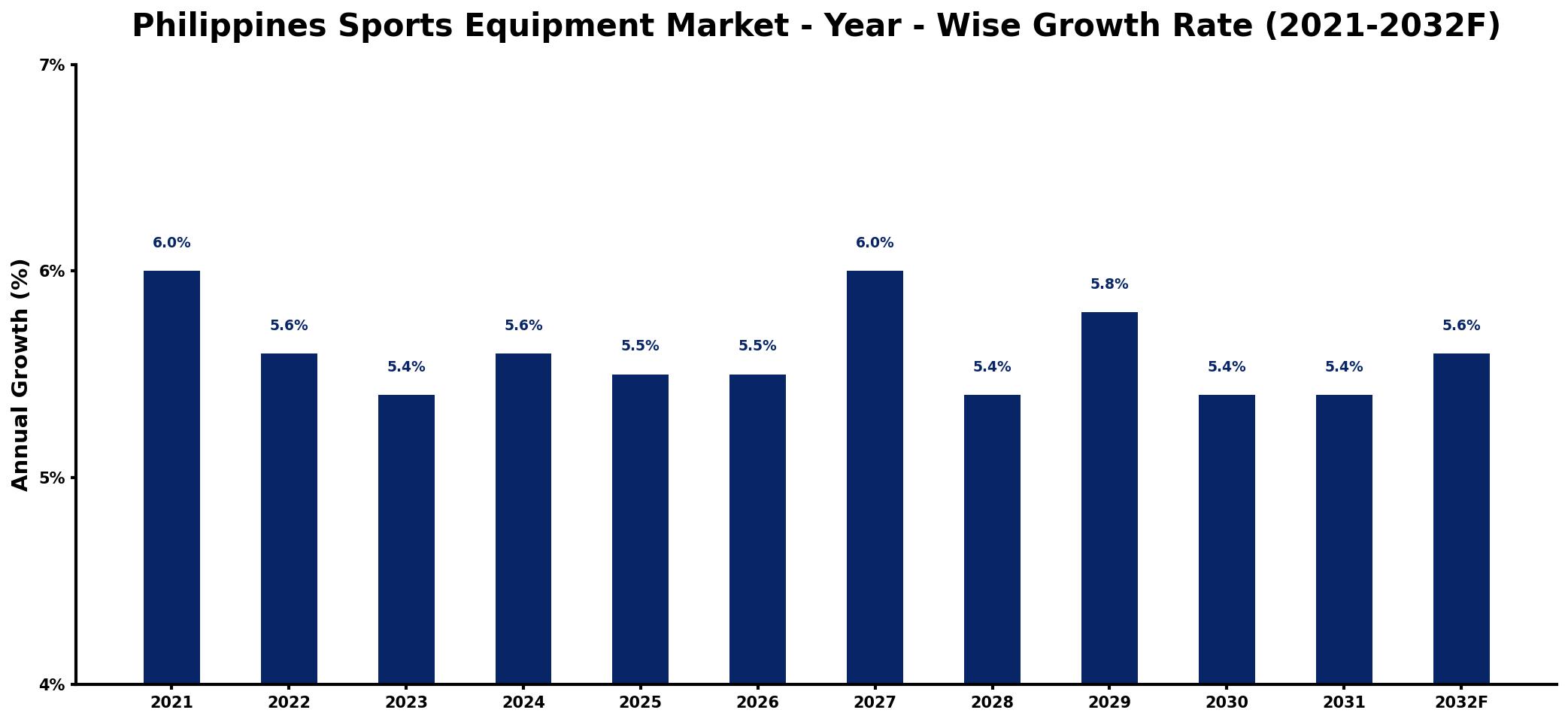
The table below presents the year‑wise growth rates along with the key drivers influencing the market
| Year | Growth Rate | Major Drivers |
| 2021 | 6.0% | Rising health consciousness among consumers |
| 2022 | 5.6% | Increase in recreational activities participation |
| 2023 | 5.4% | Growing youth engagement in fitness |
| 2024 | 5.6% | Expansion of fitness facilities nationwide |
| 2025 | 5.5% | Surge in online fitness communities |
| 2026 | 5.5% | Investment in local fitness initiatives |
| 2027 | 6.0% | Enhanced government support for health |
| 2028 | 5.4% | Popularity of active lifestyle trends |
| 2029 | 5.8% | Emergence of innovative fitness programs |
| 2030 | 5.4% | Collaborations with wellness influencers |
| 2031 | 5.4% | Growth in corporate wellness programs |
| 2032 | 5.6% | Development of eco-friendly fitness solutions |
Note: Market size estimations and growth projections presented in this report are based on 6Wresearch's proprietary forecasting methodology, utilizing the latest available industry data, government publications, and primary research inputs.
Philippines Sports Equipment Market Synopsis
The landscape of the Philippines Sports Equipment Market is evolving rapidly, reflecting a nation captivated by athletic pursuits. With a diverse range of sports gaining traction, from basketball and volleyball to emerging interests in individual sports like badminton and running, the demand for quality sports equipment is surging.
Recent trends indicate that the population's engagement in fitness activities is not just a passing phase; it's becoming a lifestyle choice. Schools, local communities, and private entities are increasingly investing in sports infrastructure, which further amplifies the need for advanced and accessible sports equipment throughout the archipelago.
Philippines Sports Equipment Market Key Takeaways
- Robust growth anticipated, with a market size projected to reach USD 590 Million by 2032.
- The increase in public awareness regarding health and fitness is significantly driving equipment demand.
- Urban development and enhanced sports infrastructure are pivotal to expanding market opportunities.
- Government initiatives are promoting sports participation, encouraging investments in sports facilities.
- Technological advancements are leading to innovative sports equipment tailored for local preferences.
Evaluation of Restraints in Philippines Sports Equipment Market
Despite the positive outlook, the Philippines Sports Equipment Market encounters several real restraints that can hamper its potential. Accessibility to quality sports equipment remains a challenge, particularly in rural areas where local supply chains are less developed. Furthermore, economic disparities mean that a segment of the population may prioritize essential needs over recreational expenditures. Awareness and education about the benefits of sports participation are still growing, which can limit immediate market expansion.
Philippines Sports Equipment Market Trends
The demand for eco-friendly and sustainable sports equipment is gaining traction in the Philippines, reflecting a global trend towards environmentally conscious products. Additionally, the rise of digital platforms for sports training and e-commerce is transforming how consumers shop for sports gear, offering convenience and variety. Wearable technology is also becoming more prevalent, with athletes seeking data-driven insights into performance and health.
Philippines Sports Equipment Market Opportunities
Genuine growth opportunities lie in the development of specialized products targeting emerging sports and leisure activities. Companies can leverage local athletes' rising profiles to market tailored equipment that enhances performance. Additionally, expanding distribution channels into underserved areas could unlock new customer segments, creating a more inclusive market landscape.
Government Initiatives in the Philippines Sports Equipment Market
The Philippine government is actively promoting sports development through various initiatives. Public spending on sports infrastructure, training programs, and community sports events has been on the rise. Additionally, partnerships with private sectors to sponsor local athletes and competitions are instrumental in fostering a culture of sportsmanship and physical fitness across the country. These efforts are not only encouraging grassroots sports development but also creating an environment conducive for market growth.
Future Insights of the Philippines Sports Equipment Market
Looking ahead to 2026-2032, the Philippines Sports Equipment Market is poised for significant growth as urban centers continue to evolve and more Filipinos adopt active lifestyles. As the population becomes increasingly health-conscious, the market will likely respond with innovative and diverse offerings. The collaboration between the public and private sectors will remain vital in enhancing sports facilities and promoting local talent, thereby further energizing demand for sports equipment.
Philippines Sports Equipment Market Latest Developments (2025 - 2026)
In recent months, the Philippines sports equipment sector has seen notable developments, with new partnerships between manufacturers and local athletes aimed at promoting brand visibility. Sports events have resumed post-pandemic, leading to a renewed interest in competitive and recreational sports. Additionally, local retailers are adapting to changing consumer preferences by expanding their online sales platforms, making it easier for customers to access a wider range of sports gear.
Philippines Sports Equipment Market - Key Attractiveness of the Report
- 10 Years of Market Numbers
- Historical Data Starting from 2022 to 2025
- Base Year: 2025
- Forecast Data until 2032
- Key Performance Indicators Impacting the Market
- Major Upcoming Developments and Projects
Key Highlights of the Report:
- Philippines Sports Equipment Market Outlook
- Market Size of Philippines Sports Equipment Market, 2025
- Forecast of Philippines Sports Equipment Market, 2032
- Historical Data and Forecast of Philippines Sports Equipment Revenues & Volume for the Period 2022-2032F
- Philippines Sports Equipment Market Trend Evolution
- Philippines Sports Equipment Market Drivers and Challenges
- Philippines Sports Equipment Price Trends
- Philippines Sports Equipment Porter's Five Forces
- Philippines Sports Equipment Industry Life Cycle
- Historical Data and Forecast of Philippines Sports Equipment Market Revenues & Volume By Product for the Period 2022-2032F
- Historical Data and Forecast of Philippines Sports Equipment Market Revenues & Volume By Ball over net games for the Period 2022-2032F
- Historical Data and Forecast of Philippines Sports Equipment Market Revenues & Volume By Ball games for the Period 2022-2032F
- Historical Data and Forecast of Philippines Sports Equipment Market Revenues & Volume By Fitness/Strength equipment for the Period 2022-2032F
- Historical Data and Forecast of Philippines Sports Equipment Market Revenues & Volume By Athletic training equipment for the Period 2022-2032F
- Historical Data and Forecast of Philippines Sports Equipment Market Revenues & Volume By Others for the Period 2022-2032F
- Historical Data and Forecast of Philippines Sports Equipment Market Revenues & Volume By Distribution Channel for the Period 2022-2032F
- Historical Data and Forecast of Philippines Sports Equipment Market Revenues & Volume By Online retail for the Period 2022-2032F
- Historical Data and Forecast of Philippines Sports Equipment Market Revenues & Volume By Specialty & sports shops for the Period 2022-2032F
- Historical Data and Forecast of Philippines Sports Equipment Market Revenues & Volume By Department & discount stores for the Period 2022-2032F
- Philippines Sports Equipment Import Export Trade Statistics
- Market Opportunity Assessment By Product
- Market Opportunity Assessment By Distribution Channel
- Philippines Sports Equipment Top Companies Market Share
- Philippines Sports Equipment Competitive Benchmarking By Technical and Operational Parameters
- Philippines Sports Equipment Company Profiles
- Philippines Sports Equipment Key Strategic Recommendations






































