Philippines Spun Yarn Market Size, Share & Growth Rate
The Philippines Spun Yarn Market was estimated at USD 415 Million in 2025 and is projected to reach USD 558 Million by 2032, growing at a CAGR of 4.3% from 2026 to 2032. This growth trajectory is underpinned by increased government investments in spinning mills and a shifting consumer preference towards spun yarn apparel, which is becoming increasingly popular compared to knitted fabrics and garments made from alternative materials. The strategic efforts by manufacturers to innovate and diversify product offerings are also pivotal in supporting this upward trend.
Philippines Spun Yarn Market Year-wise Growth Rate and Key Drivers
This graph highlights how the Philippines Spun Yarn Market has steadily grown over the years, supported by major growth factors.
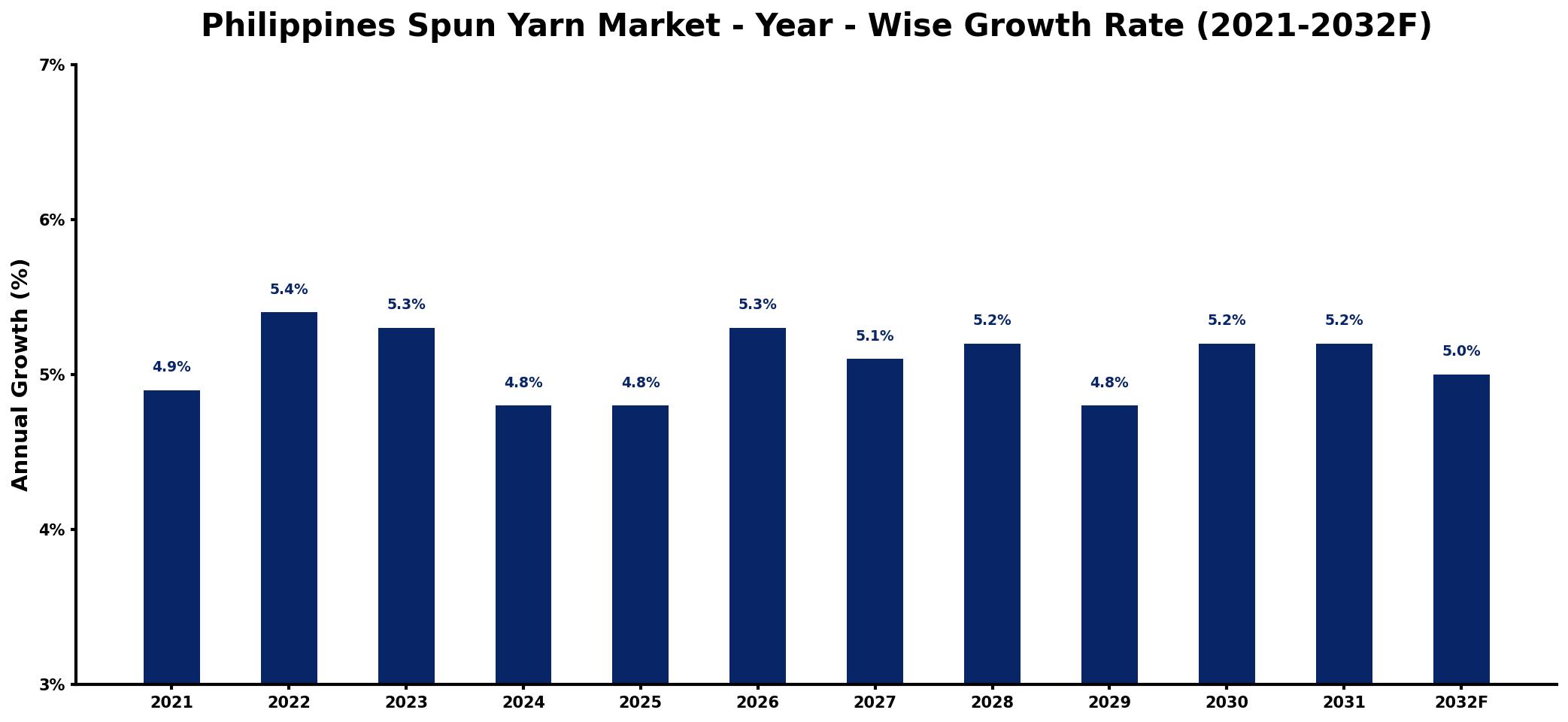
The table below presents the year‑wise growth rates along with the key drivers influencing the market
| Year | Growth Rate | Major Drivers |
| 2021 | 4.9% | Rising textile manufacturing investments |
| 2022 | 5.4% | Expansion of eco-friendly materials |
| 2023 | 5.3% | Increased global fashion demand |
| 2024 | 4.8% | Growth in local garment production |
| 2025 | 4.8% | Emergence of sustainable practices |
| 2026 | 5.3% | Boost in export opportunities |
| 2027 | 5.1% | Technological advancements in production |
| 2028 | 5.2% | Rising consumer preference for quality |
| 2029 | 4.8% | Strengthening domestic supply chains |
| 2030 | 5.2% | Increase in retail sector growth |
| 2031 | 5.2% | Diversification of product offerings |
| 2032 | 5.0% | Enhanced trade agreements benefits |
Note: Market size estimations and growth projections presented in this report are based on 6Wresearch's proprietary forecasting methodology, utilizing the latest available industry data, government publications, and primary research inputs.
Philippines Spun Yarn Market Synopsis
A significant force shaping the Philippines Spun Yarn Market is the surge in demand for spun yarn across various sectors, particularly in textiles and home furnishings. This growing consumer preference signals an evolving market landscape where traditional materials are being reevaluated in favor of spun yarn solutions.
Additionally, the competitive production landscape in the Philippines, driven by a skilled labor force and efficient manufacturing processes, is positioning the country as a formidable player in the global spun yarn market. This advantage is further augmented by the rising trend towards sustainability, leading manufacturers to explore eco-friendly spun yarn variants.
Philippines Spun Yarn Market Key Takeaways
- The market is projected to grow substantially, driven by increasing investments and consumer demand.
- A focus on innovation is leading to the development of spun yarn products with enhanced properties for diverse applications.
- Government initiatives are bolstering the growth of spinning mills, enhancing production capabilities.
- The local workforces skills contribute to cost-effective manufacturing and a competitive edge in exports.
- Challenges related to fluctuating raw material prices persist but are being addressed through strategic planning.
Evaluation of Restraints in Philippines Spun Yarn Market
The Philippines Spun Yarn Market faces certain constraints that may inhibit its potential growth. One of the primary challenges is the fluctuation of cotton prices, which can significantly impact production costs and margins. Maintaining product quality and consistency remains another critical area, as manufacturers strive to meet the diverse and evolving demands of various sectors. Additionally, the necessity to remain competitive in the global market compels local producers to innovate while facing challenges in sourcing skilled labor, which can become a bottleneck for growth. Strategic planning and adaptability will be essential in addressing these concerns.
Philippines Spun Yarn Market Trends
Current trends in the Philippines Spun Yarn Market indicate a growing inclination towards sustainability and eco-conscious consumerism. Manufacturers are increasingly focusing on developing spun yarns made from recycled materials and organic fibers to cater to environmentally aware consumers. Furthermore, the adoption of digital technologies in manufacturing and sales processes is reshaping how products are marketed and sold, allowing for greater engagement with end-users and streamlined operations.
Philippines Spun Yarn Market Opportunities
Opportunities for growth within the Philippines Spun Yarn Market are abundant, particularly in the export sector. As the global textile market expands, the demand for high-quality spun yarn presents an opening for Filipino manufacturers to capture a larger share of international markets. Additionally, diversifying product lines to include specialized yarns for sectors like automotive and home furnishings can further drive sales and market presence. Collaborative ventures with local designers to create unique, locally produced textile products could also enhance brand recognition and consumer loyalty.
Government Initiatives in the Philippines Spun Yarn Market
The Philippine government has taken significant steps to bolster the spinning sector, recognizing its potential contribution to economic growth. Initiatives include providing incentives for investments in textile machinery and technology, which are essential for modernizing spinning mills. Programs aimed at enhancing vocational training for the textile industry are also being implemented to ensure a steady supply of skilled labor, vital for maintaining competitiveness. Moreover, policies that promote export growth and international partnerships are being actively pursued, creating a conducive environment for market expansion.
Future Insights of the Philippines Spun Yarn Market
Looking ahead to 2026-2032, the Philippines Spun Yarn Market is set to undergo significant transformations driven by technological advancements and consumer trends towards sustainability. The integration of artificial intelligence and automation in production processes will likely enhance efficiency and reduce costs, enabling manufacturers to scale effectively. With increasing global attention on eco-friendly materials, the sector will likely pivot towards more sustainable practices, positioning itself favorably in the global market. This evolution will not only boost local production capabilities but also enhance export potential, propelling the market into a new era of growth.
Philippines Spun Yarn Market Latest Developments (2025 - 2026)
Recent developments within the Philippines Spun Yarn Market indicate a strategic pivot towards embracing sustainability. Numerous manufacturers have begun collaborating with environmental organizations to innovate in the production of eco-friendly yarns. Additionally, industry trade shows and exhibitions have increasingly showcased local spun yarn products, highlighting the growing emphasis on brand visibility and consumer engagement. The COVID-19 pandemics lingering effects are also prompting businesses to adapt their supply chains for resilience, paving the way for more robust operational frameworks.
Philippines Spun Yarn Market - Key Attractiveness of the Report
- 10 Years of Market Numbers
- Historical Data Starting from 2022 to 2025
- Base Year: 2025
- Forecast Data until 2032
- Key Performance Indicators Impacting the Market
- Major Upcoming Developments and Projects
Key Highlights of the Report:
- Philippines Spun Yarn Market Outlook
- Market Size of Philippines Spun Yarn Market, 2025
- Forecast of Philippines Spun Yarn Market, 2032
- Historical Data and Forecast of Philippines Spun Yarn Revenues & Volume for the Period 2022-2032F
- Philippines Spun Yarn Market Trend Evolution
- Philippines Spun Yarn Market Drivers and Challenges
- Philippines Spun Yarn Price Trends
- Philippines Spun Yarn Porter's Five Forces
- Philippines Spun Yarn Industry Life Cycle
- Historical Data and Forecast of Philippines Spun Yarn Market Revenues & Volume By Application for the Period 2022-2032F
- Historical Data and Forecast of Philippines Spun Yarn Market Revenues & Volume By Textile for the Period 2022-2032F
- Historical Data and Forecast of Philippines Spun Yarn Market Revenues & Volume By Healthcare for the Period 2022-2032F
- Historical Data and Forecast of Philippines Spun Yarn Market Revenues & Volume By Home Furnishing for the Period 2022-2032F
- Historical Data and Forecast of Philippines Spun Yarn Market Revenues & Volume By Others for the Period 2022-2032F
- Philippines Spun Yarn Import Export Trade Statistics
- Market Opportunity Assessment By Application
- Philippines Spun Yarn Top Companies Market Share
- Philippines Spun Yarn Competitive Benchmarking By Technical and Operational Parameters
- Philippines Spun Yarn Company Profiles
- Philippines Spun Yarn Key Strategic Recommendations






































