Philippines Structural Adhesives, Sealants, and Thermal Materials for EV Batteries Market Size, Share & Growth Rate
The Philippines Structural Adhesives, Sealants, and Thermal Materials for EV Batteries Market was estimated at USD 880 Million in 2025 and is projected to reach USD 1500 Million by 2032, growing at a CAGR of 7.9% from 2026 to 2032. This robust growth is fueled by rising consumer demand for electric vehicles, driven by increasing awareness of environmental issues and a shift towards sustainable transport options. Furthermore, enhanced governmental policies supporting EV adoption significantly bolster the materials market vital for battery construction.
Philippines Structural Adhesives, Sealants, and Thermal Materials for EV Batteries Market Year-wise Growth Rate and Key Drivers
This graph highlights how the Philippines Structural Adhesives, Sealants, and Thermal Materials for EV Batteries Market has steadily grown over the years, supported by major growth factors.
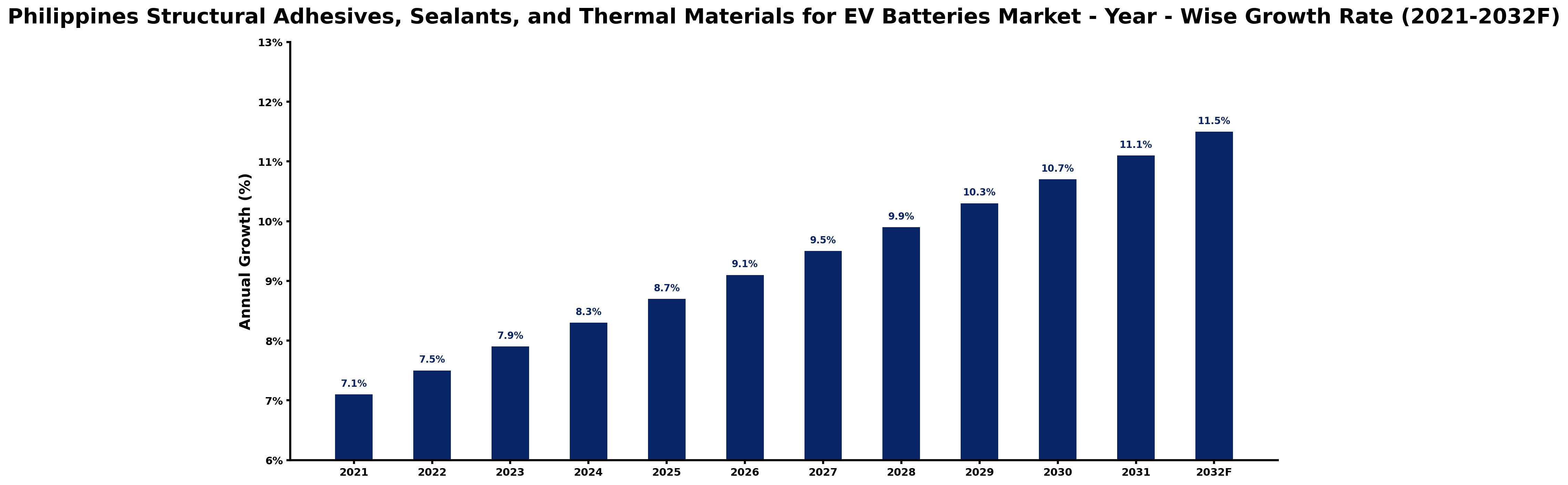
The table below presents the year‑wise growth rates along with the key drivers influencing the market
| Year | Growth Rate | Major Drivers |
| 2021 | 7.1% | Expansion of commercial construction activities |
| 2022 | 7.5% | Expansion of transportation and logistics networks |
| 2023 | 7.9% | Increasing adoption of advanced technologies |
| 2024 | 8.3% | Expansion of transportation and logistics networks |
| 2025 | 8.7% | Increasing industrial automation investments |
| 2026 | 9.1% | Increasing smart city development projects |
| 2027 | 9.5% | Increasing industrial infrastructure investments |
| 2028 | 9.9% | Growing urbanization and commercial development |
| 2029 | 10.3% | Increasing adoption of advanced technologies |
| 2030 | 10.7% | Rapid growth in telecom and data center sectors |
| 2031 | 11.1% | Growing urbanization and commercial development |
| 2032 | 11.5% | Government infrastructure modernization initiatives |
Note - Market size estimations and growth projections presented in this report are based on 6Wresearch's advanced forecasting approach, validated with industry datasets as of June 2026.
Philippines Structural Adhesives, Sealants, and Thermal Materials for EV Batteries Market Synopsis
The most impactful force shaping the Philippines market is the increasing adoption of electric vehicles amid stringent emission regulations. As consumers pivot towards cleaner alternatives due to environmental concerns, the need for high-performance structural adhesives, sealants, and thermal materials has escalated.
Additionally, the government's commitment to fostering the EV sector through infrastructure initiatives and fiscal incentives has strengthened the market landscape. Coupled with rising middle-class purchasing power, this environment creates an ideal scenario for sustained growth of battery-related materials.
Philippines Structural Adhesives, Sealants, and Thermal Materials for EV Batteries Market Key Takeaways
- The market is projected to grow significantly due to rising consumer preference for electric vehicles.
- Government initiatives are playing a crucial role in shaping the market dynamics and investment climate.
- The increasing disposable income among Filipinos allows for higher spending on electric vehicles.
- There is a growing need for advanced materials that enhance the efficiency and safety of EV batteries.
- High initial costs of EVs may limit broader adoption in lower-income demographics.
Evaluation of Restraints in Philippines Structural Adhesives, Sealants, and Thermal Materials for EV Batteries Market
Despite the promising outlook, the market faces certain restraints that could impede its growth trajectory. Primarily, the high price point associated with premium electric vehicle models may discourage consumers, particularly those in lower income brackets. Additionally, the lack of necessary infrastructure hampers the effective deployment of electric vehicles, thus limiting demand for related materials. Without significant advancements in these areas, the full potential of the market may remain unfulfilled.
Philippines Structural Adhesives, Sealants, and Thermal Materials for EV Batteries Market Trends
Several emerging trends are shaping the demand and technological landscape of the Philippines market. One notable trend is the shift towards innovative materials that offer enhanced thermal management properties, crucial for battery efficiency and safety. Furthermore, the demand for eco-friendly adhesive solutions is growing, with consumers and manufacturers alike prioritizing sustainability. Additionally, advancements in battery technology are driving the need for adhesives and sealants that can withstand higher temperatures and pressures.
Philippines Structural Adhesives, Sealants, and Thermal Materials for EV Batteries Market Opportunities
The market presents a plethora of opportunities for growth and investment. With the government actively promoting electric mobility, stakeholders can capitalize on the growing demand for high-performance battery components. Moreover, as consumer awareness of EV benefits increases, companies investing in R&D for advanced adhesive and thermal management solutions stand to gain a competitive edge. Expanding manufacturing capabilities and partnerships with automotive OEMs will further enhance market presence.
Government Initiatives in the Philippines Structural Adhesives, Sealants, and Thermal Materials for EV Batteries Market
The Philippine government is implementing various initiatives aimed at promoting electric vehicle adoption. These include incentives such as tax breaks for EV manufacturers, subsidies for consumers purchasing electric vehicles, and investments in charging infrastructure. The government's push to reduce dependency on fossil fuels and enhance local manufacturing capabilities is set to create a more conducive environment for the growth of the structural adhesives, sealants, and thermal materials sector.
Future Insights of the Philippines Structural Adhesives, Sealants, and Thermal Materials for EV Batteries Market
Looking ahead to 2026-2032, the Philippines Structural Adhesives, Sealants, and Thermal Materials for EV Batteries Market is poised for significant advancements. Innovations in material science and technological integration will likely lead to the development of more efficient and sustainable products. As the government continues to foster the electric vehicle ecosystem, a collaborative effort among stakeholders will be essential in driving growth. Overall, the future appears promising, with ample opportunities for those willing to adapt and innovate.
Philippines Structural Adhesives, Sealants, and Thermal Materials for EV Batteries Market Latest Developments (May 2025 - June 2026)
Recent developments in the market highlight a surge in investments towards research and development for next-generation battery materials. Manufacturers are increasingly focusing on eco-friendly formulations, aiming to meet rising consumer expectations regarding sustainability. Additionally, collaboration between industry players and government agencies is intensifying to bolster infrastructure and promote consumer adoption of electric vehicles, paving the way for enhanced market dynamics.
Philippines Structural Adhesives, Sealants, and Thermal Materials for EV Batteries Market - Key Attractiveness of the Report
- 10 Years of Market Numbers
- Historical Data Starting from 2022 to 2025
- Base Year: 2025
- Forecast Data until 2032
- Key Performance Indicators Impacting the Market
- Major Upcoming Developments and Projects
Key Highlights of the Report:
- Philippines Structural Adhesives, Sealants, and Thermal Materials for EV Batteries Market Outlook
- Market Size of Philippines Structural Adhesives, Sealants, and Thermal Materials for EV Batteries Market, 2025
- Forecast of Philippines Structural Adhesives, Sealants, and Thermal Materials for EV Batteries Market, 2032
- Historical Data and Forecast of Philippines Structural Adhesives, Sealants, and Thermal Materials for EV Batteries Revenues & Volume for the Period 2022-2032F
- Philippines Structural Adhesives, Sealants, and Thermal Materials for EV Batteries Market Trend Evolution
- Philippines Structural Adhesives, Sealants, and Thermal Materials for EV Batteries Market Drivers and Challenges
- Philippines Structural Adhesives, Sealants, and Thermal Materials for EV Batteries Price Trends
- Philippines Structural Adhesives, Sealants, and Thermal Materials for EV Batteries Porter's Five Forces
- Philippines Structural Adhesives, Sealants, and Thermal Materials for EV Batteries Industry Life Cycle
- Historical Data and Forecast of Philippines Structural Adhesives, Sealants, and Thermal Materials for EV Batteries Market Revenues & Volume By Type for the Period 2022-2032F
- Historical Data and Forecast of Philippines Structural Adhesives, Sealants, and Thermal Materials for EV Batteries Market Revenues & Volume By Structural Adhesives and Sealants for the Period 2022-2032F
- Historical Data and Forecast of Philippines Structural Adhesives, Sealants, and Thermal Materials for EV Batteries Market Revenues & Volume By Thermal materials for the Period 2022-2032F
- Historical Data and Forecast of Philippines Structural Adhesives, Sealants, and Thermal Materials for EV Batteries Market Revenues & Volume By Applications for the Period 2022-2032F
- Historical Data and Forecast of Philippines Structural Adhesives, Sealants, and Thermal Materials for EV Batteries Market Revenues & Volume By Hybrid Electric Vehicles for the Period 2022-2032F
- Historical Data and Forecast of Philippines Structural Adhesives, Sealants, and Thermal Materials for EV Batteries Market Revenues & Volume By Battery Electric Vehicles for the Period 2022-2032F
- Philippines Structural Adhesives, Sealants, and Thermal Materials for EV Batteries Import Export Trade Statistics
- Market Opportunity Assessment By Type
- Market Opportunity Assessment By Applications
- Philippines Structural Adhesives, Sealants, and Thermal Materials for EV Batteries Top Companies Market Share
- Philippines Structural Adhesives, Sealants, and Thermal Materials for EV Batteries Competitive Benchmarking By Technical and Operational Parameters
- Philippines Structural Adhesives, Sealants, and Thermal Materials for EV Batteries Company Profiles
- Philippines Structural Adhesives, Sealants, and Thermal Materials for EV Batteries Key Strategic Recommendations






































