Philippines Sugar Mill Machinery Market Size, Share & Growth Rate
The Philippines Sugar Mill Machinery Market was estimated at USD 369 Million in 2025 and is projected to reach USD 492 Million by 2032, growing at a CAGR of 4.2% from 2026 to 2032. This growth trajectory is primarily driven by the modernization efforts within the sugar industry as producers seek to enhance productivity and efficiency. The increasing demand for sugar, alongside a robust emphasis on energy-efficient machinery, presents substantial opportunities for growth in this vital sector.
Philippines Sugar Mill Machinery Market Year-wise Growth Rate and Key Drivers
This graph highlights how the Philippines Sugar Mill Machinery Market has steadily grown over the years, supported by major growth factors.
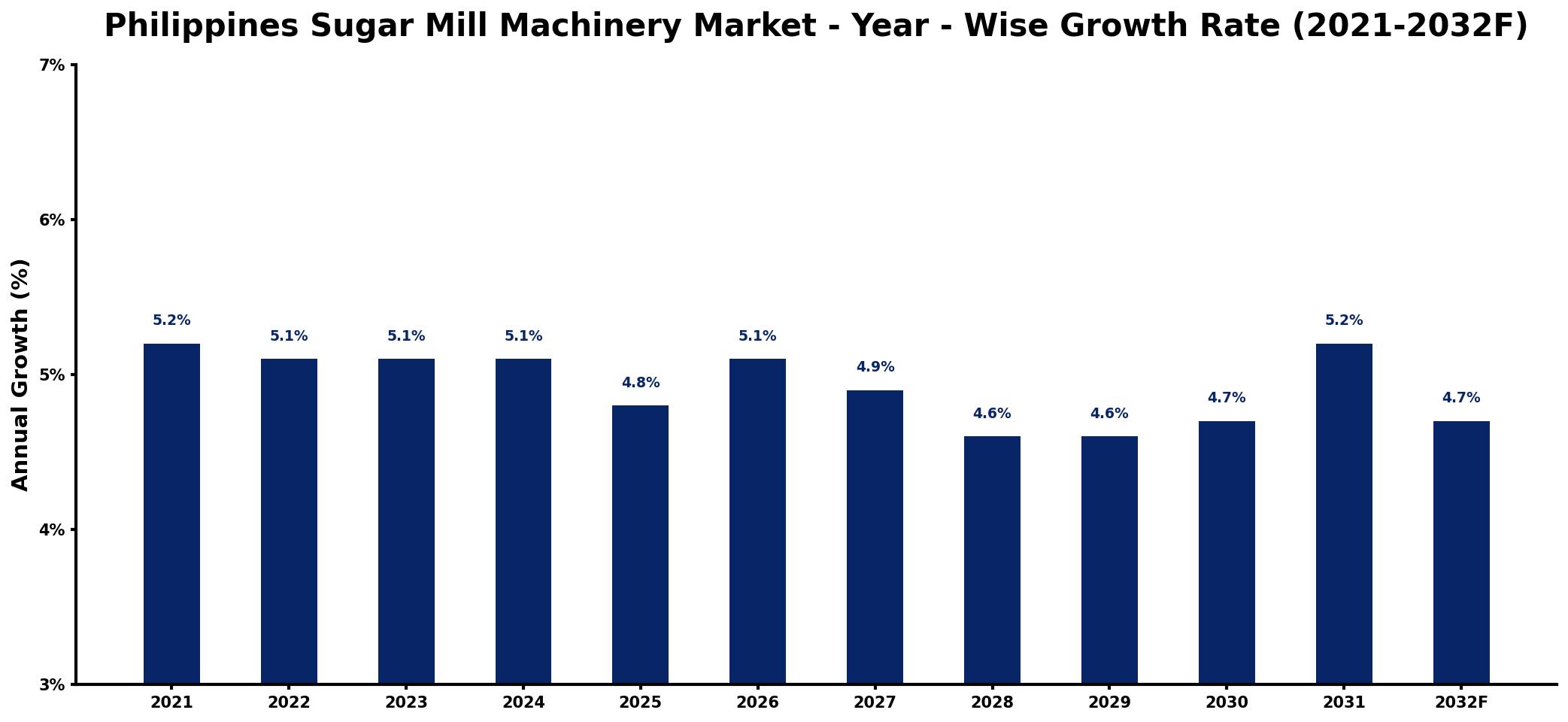
The table below presents the year‑wise growth rates along with the key drivers influencing the market
| Year | Growth Rate | Major Drivers |
| 2021 | 5.2% | Increased agricultural investments observed |
| 2022 | 5.1% | Rising demand for renewable energy |
| 2023 | 5.1% | Expansion of export markets identified |
| 2024 | 5.1% | Technological advancements enhancing efficiency |
| 2025 | 4.8% | Growing focus on sustainability initiatives |
| 2026 | 5.1% | Emergence of new processing techniques |
| 2027 | 4.9% | Increased government support programs |
| 2028 | 4.6% | Rising consumer preferences for alternatives |
| 2029 | 4.6% | Strengthened regional trade agreements established |
| 2030 | 4.7% | rising export shipment volumes |
| 2031 | 5.2% | Surge in foreign direct investments |
| 2032 | 4.7% | Growth in eco-friendly product offerings |
Note: Market size estimations and growth projections presented in this report are based on 6Wresearch's proprietary forecasting methodology, utilizing the latest available industry data, government publications, and primary research inputs.
Philippines Sugar Mill Machinery Market Synopsis
Recent momentum in the Philippines sugar mill machinery market has highlighted a shift towards advanced technology and sustainable practices. As mills look to replace outdated equipment with cutting-edge alternatives, the industry is preparing for a significant transformation. This evolution is not merely a response to current demands but also a proactive strategy aimed at improving the overall efficiency of sugar production.
Looking ahead, the market is positioned for consistent growth, propelled by increasing sugar consumption and a focused push for modernization across sugar mills. The ongoing development of more sophisticated equipment, such as energy-efficient cane crushers and advanced roller systems, will be instrumental in meeting the changing needs of producers while addressing environmental considerations.
Philippines Sugar Mill Machinery Market Key Takeaways
- The market is expected to grow steadily, driven by modernization and increased sugar production efficiency.
- Energy-efficient machinery is becoming essential to remain competitive amidst rising energy costs.
- There is a notable shift towards sustainable practices in sugar production machinery.
- COVID-19 has posed challenges, yet recovery is anticipated as economic activities resume.
- Key players are focusing on innovations to enhance productivity and operational efficiency.
Evaluation of Restraints in Philippines Sugar Mill Machinery Market
Several factors could impede the growth of the Philippines sugar mill machinery market. Primarily, fluctuations in sugar consumption patterns necessitate that machinery manufacturers remain adaptable and responsive. Additionally, the escalating costs of energy pose a significant challenge for mills, often limiting their ability to invest in new technologies. Navigating these constraints requires strategic investment in energy-efficient solutions and the exploration of diverse product offerings to align with market demands.
Philippines Sugar Mill Machinery Market Trends
Current trends in the Philippines sugar mill machinery market reflect an increasing integration of technology and sustainability. Automation is gaining traction, with mills investing in smart machinery that enhances operational efficiency and reduces labor costs. Moreover, the focus on renewable energy sources for machinery operation signifies a commitment to environmentally friendly practices. The development of compact, high-efficiency equipment is also on the rise, catering to the needs of smaller scale operations while maximizing output.
Philippines Sugar Mill Machinery Market Opportunities
The outlook for investment opportunities in the Philippines sugar mill machinery market appears promising. As the government continues to support the agricultural sector, initiatives aimed at enhancing technological advancements within sugar production present significant potential. Furthermore, the demand for eco-friendly machinery can open avenues for companies specializing in energy-efficient and low-emission solutions. Targeting local and international markets with modern equipment that meets evolving quality standards will be pivotal for growth.
Government Initiatives in the Philippines Sugar Mill Machinery Market
The Philippine government has demonstrated a proactive approach to strengthening its agricultural sector, including the sugar industry. Policies aimed at providing financial incentives for modernization and technology adoption are crucial in supporting sugar mill operators. Public spending on infrastructure improvements and research initiatives that focus on developing more efficient and sustainable sugar production techniques also play a vital role in bolstering this market's growth potential.
Future Insights of the Philippines Sugar Mill Machinery Market
From 2026 to 2032, the Philippines sugar mill machinery market is poised for noteworthy advancements as modernization continues to reshape the industry landscape. Factors such as rising sugar consumption, coupled with increased focus on productivity, will drive demand for more sophisticated machinery. As mills invest in cutting-edge technology and sustainable practices, the market is likely to witness a significant transformation that aligns with global trends toward efficiency and environmental responsibility.
Philippines Sugar Mill Machinery Market Latest Developments (2025 - 2026)
Recent developments within the Philippines sugar mill machinery market reflect an ongoing trend towards innovation and efficiency enhancement. Several local manufacturers are unveiling new energy-efficient technologies aimed at reducing operational costs for sugar mills. There has also been a notable emphasis on partnerships between machinery suppliers and sugar producers to tailor solutions that address specific production challenges, thereby fostering industry collaboration in the face of changing market demands.
Philippines Sugar Mill Machinery Market - Key Attractiveness of the Report
- 10 Years of Market Numbers
- Historical Data Starting from 2022 to 2025
- Base Year: 2025
- Forecast Data until 2032
- Key Performance Indicators Impacting the Market
- Major Upcoming Developments and Projects
Key Highlights of the Report:
- Philippines Sugar Mill Machinery Market Outlook
- Market Size of Philippines Sugar Mill Machinery Market, 2025
- Forecast of Philippines Sugar Mill Machinery Market, 2032
- Historical Data and Forecast of Philippines Sugar Mill Machinery Revenues & Volume for the Period 2022-2032F
- Philippines Sugar Mill Machinery Market Trend Evolution
- Philippines Sugar Mill Machinery Market Drivers and Challenges
- Philippines Sugar Mill Machinery Price Trends
- Philippines Sugar Mill Machinery Porter's Five Forces
- Philippines Sugar Mill Machinery Industry Life Cycle
- Historical Data and Forecast of Philippines Sugar Mill Machinery Market Revenues & Volume By Machinery Type for the Period 2022-2032F
- Historical Data and Forecast of Philippines Sugar Mill Machinery Market Revenues & Volume By Cane Handling Equipment for the Period 2022-2032F
- Historical Data and Forecast of Philippines Sugar Mill Machinery Market Revenues & Volume By Cutting & Grinding Equipment for the Period 2022-2032F
- Historical Data and Forecast of Philippines Sugar Mill Machinery Market Revenues & Volume By Processing Equipment for the Period 2022-2032F
- Historical Data and Forecast of Philippines Sugar Mill Machinery Market Revenues & Volume By Packaging Equipment for the Period 2022-2032F
- Historical Data and Forecast of Philippines Sugar Mill Machinery Market Revenues & Volume By Refineries Type for the Period 2022-2032F
- Historical Data and Forecast of Philippines Sugar Mill Machinery Market Revenues & Volume By Front End Refineries for the Period 2022-2032F
- Historical Data and Forecast of Philippines Sugar Mill Machinery Market Revenues & Volume By Back End Refineries for the Period 2022-2032F
- Philippines Sugar Mill Machinery Import Export Trade Statistics
- Market Opportunity Assessment By Machinery Type
- Market Opportunity Assessment By Refineries Type
- Philippines Sugar Mill Machinery Top Companies Market Share
- Philippines Sugar Mill Machinery Competitive Benchmarking By Technical and Operational Parameters
- Philippines Sugar Mill Machinery Company Profiles
- Philippines Sugar Mill Machinery Key Strategic Recommendations






































