Philippines Survival Tools Market Top 5 Importing Countries and Market Competition (HHI) Analysis
The import shipments of survival tools to the Philippines in 2024 continued to be dominated by key exporting countries such as China, Japan, USA, Germany, and South Korea. The high Herfindahl-Hirschman Index (HHI) indicates a concentrated market. With a significant Compound Annual Growth Rate (CAGR) of 18.23% from 2020 to 2024, the industry experienced a rapid expansion. The impressive growth rate of 27.96% from 2023 to 2024 suggests a promising outlook for the survival tools market in the Philippines, driven by strong demand and robust import activities.
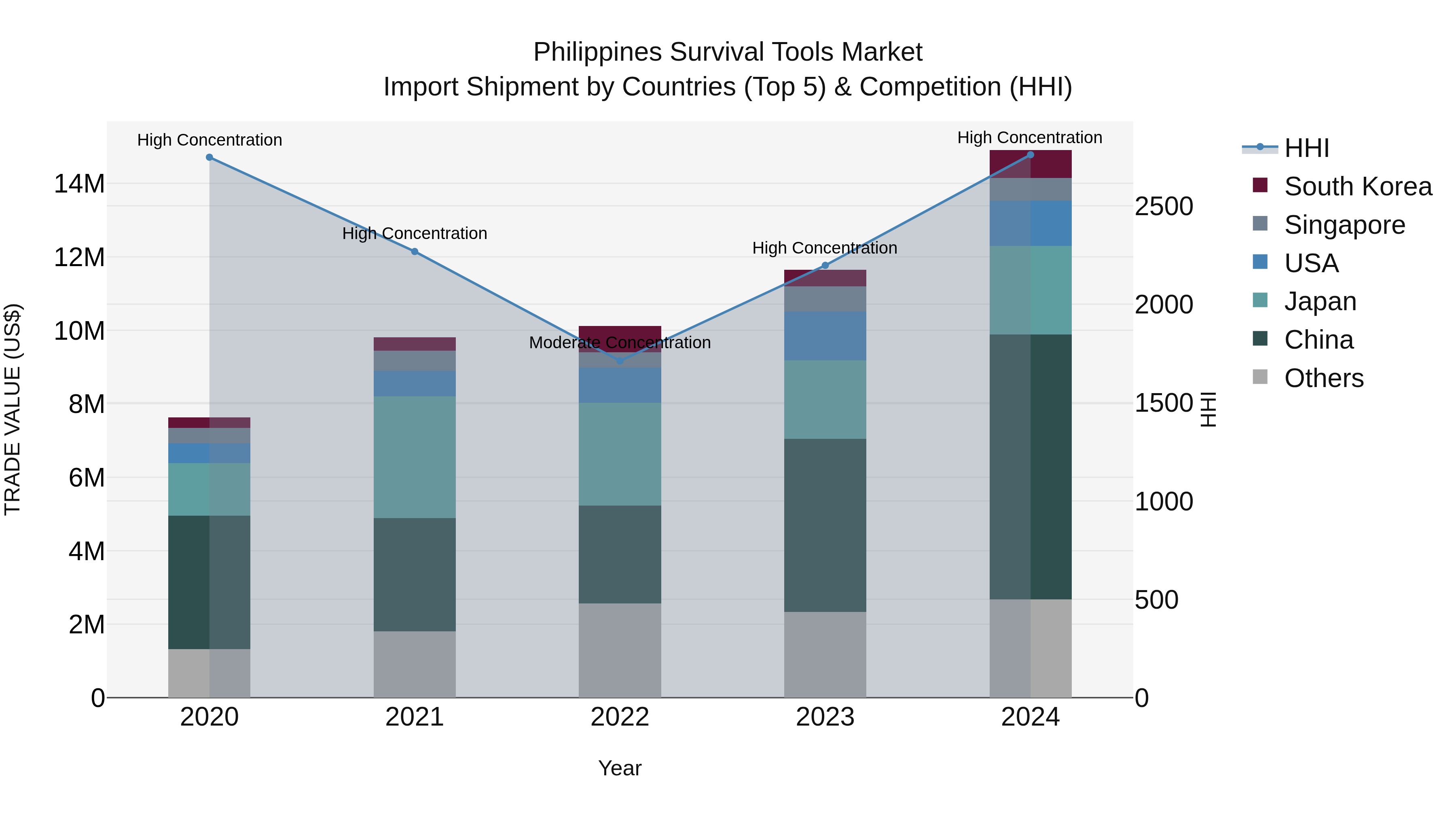
Philippines Survival Tools Market Synopsis
The survival tools market in the Philippines is expanding as outdoor recreation grows in popularity and disaster preparedness becomes a national priority. Given the countrys vulnerability to natural disasters such as typhoons and earthquakes, government agencies and private consumers alike are investing in essential gear including multi-tools, fire starters, emergency kits, and water purifiers.
Trends of the market
The survival tools market is growing as awareness around disaster preparedness rises in this disaster-prone country. Consumers are increasingly investing in multi-functional kits, portable power sources, and water purification tools. Outdoor adventure tourism and military procurement also contribute to steady demand for high-quality, durable survival gear.
Challenges of the market
The Philippines Survival Tools market encounters challenges linked to the accessibility and affordability of quality products. While survival tools are essential in disaster-prone areas like the Philippines, many consumers face difficulties in accessing durable and effective tools, especially in rural regions. Additionally, counterfeit or substandard products flood the market, causing concerns over product reliability and safety. Moreover, the growing number of natural disasters and the lack of standardized regulations for survival tools contribute to inconsistent product quality and limited consumer confidence.
Investment opportunities in the Market
The Philippines survival tools market is seeing a surge in demand due to the country`s susceptibility to natural disasters such as typhoons and earthquakes. Survival tools, including first aid kits, emergency food supplies, water purifiers, and multi-functional devices, are critical in disaster preparedness and recovery. Investment opportunities in this market can be found in the development of high-quality, portable, and all-inclusive survival kits. Additionally, there is potential in expanding distribution channels through e-commerce platforms and retail partnerships to improve accessibility to these life-saving products.
Government Policy of the market
The survival tools market in the Philippines is largely influenced by government policies aimed at disaster preparedness. The National Disaster Risk Reduction and Management Council (NDRRMC) promotes the use of survival tools such as first aid kits, emergency lights, and portable shelters as part of disaster relief efforts. The government provides guidelines for the distribution of survival tools during emergencies.
Key Highlights of the Report:
- Philippines Survival Tools Market Outlook
- Market Size of Philippines Survival Tools Market, 2024
- Forecast of Philippines Survival Tools Market, 2031
- Historical Data and Forecast of Philippines Survival Tools Revenues & Volume for the Period 2021- 2031
- Philippines Survival Tools Market Trend Evolution
- Philippines Survival Tools Market Drivers and Challenges
- Philippines Survival Tools Price Trends
- Philippines Survival Tools Porter's Five Forces
- Philippines Survival Tools Industry Life Cycle
- Historical Data and Forecast of Philippines Survival Tools Market Revenues & Volume By Type for the Period 2021- 2031
- Historical Data and Forecast of Philippines Survival Tools Market Revenues & Volume By Shovels for the Period 2021- 2031
- Historical Data and Forecast of Philippines Survival Tools Market Revenues & Volume By Ropes for the Period 2021- 2031
- Historical Data and Forecast of Philippines Survival Tools Market Revenues & Volume By Compasses for the Period 2021- 2031
- Historical Data and Forecast of Philippines Survival Tools Market Revenues & Volume By Pocket Tools for the Period 2021- 2031
- Historical Data and Forecast of Philippines Survival Tools Market Revenues & Volume By Hatchets for the Period 2021- 2031
- Historical Data and Forecast of Philippines Survival Tools Market Revenues & Volume By First Aid Kits for the Period 2021- 2031
- Historical Data and Forecast of Philippines Survival Tools Market Revenues & Volume By Application for the Period 2021- 2031
- Historical Data and Forecast of Philippines Survival Tools Market Revenues & Volume By Hiking for the Period 2021- 2031
- Historical Data and Forecast of Philippines Survival Tools Market Revenues & Volume By Hunting and Fishing for the Period 2021- 2031
- Historical Data and Forecast of Philippines Survival Tools Market Revenues & Volume By Camping for the Period 2021- 2031
- Historical Data and Forecast of Philippines Survival Tools Market Revenues & Volume By Other Wilderness Activities for the Period 2021- 2031
- Philippines Survival Tools Import Export Trade Statistics
- Market Opportunity Assessment By Type
- Market Opportunity Assessment By Application
- Philippines Survival Tools Top Companies Market Share
- Philippines Survival Tools Competitive Benchmarking By Technical and Operational Parameters
- Philippines Survival Tools Company Profiles
- Philippines Survival Tools Key Strategic Recommendations






































