Philippines Swine Feed Market Top 5 Importing Countries and Market Competition (HHI) Analysis
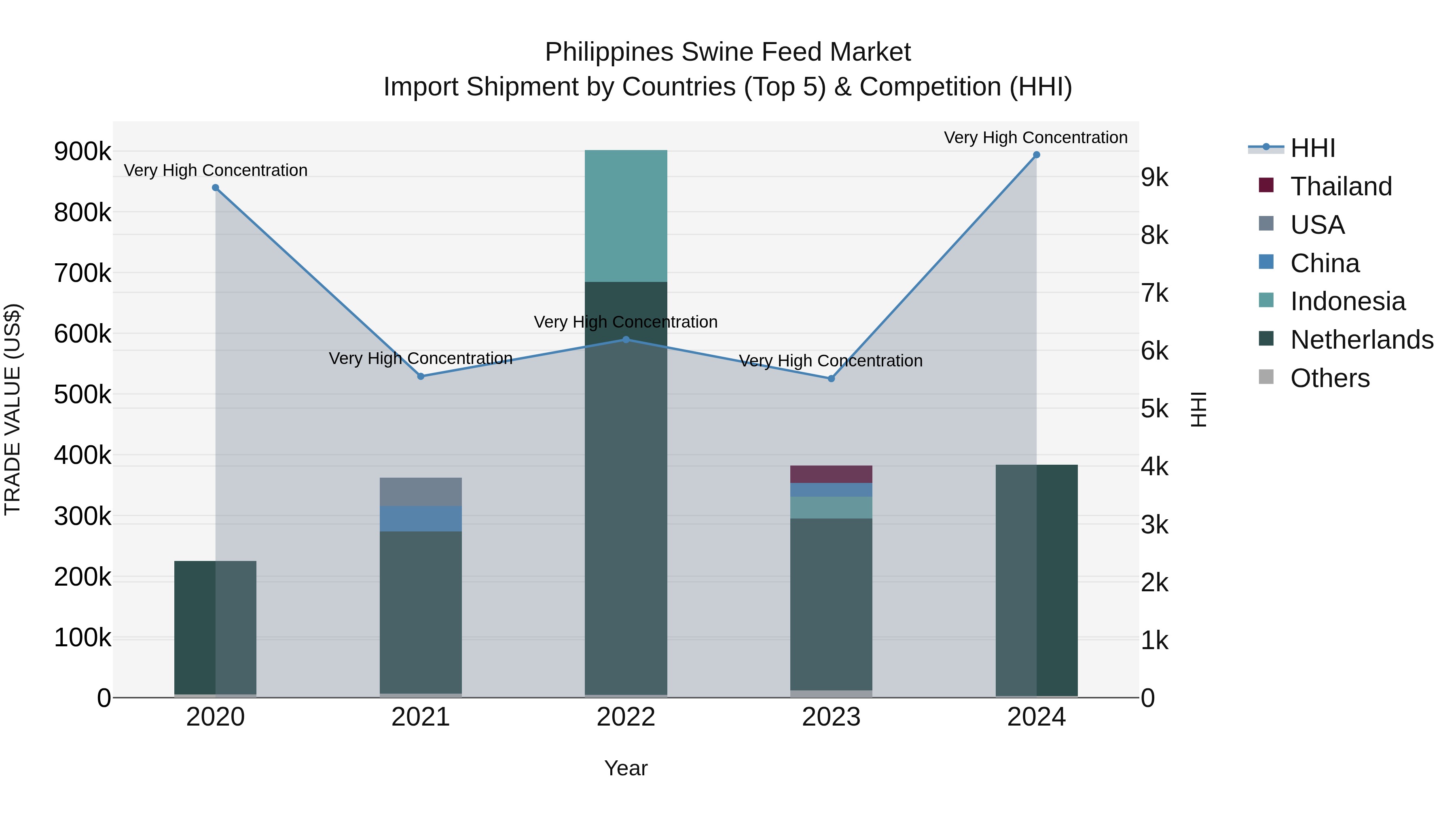
The Philippines swine feed import market saw a significant increase in shipments in 2024, with top exporting countries being Netherlands, Germany, Belgium, India, and China. Despite high concentration with a high Herfindahl-Hirschman Index (HHI), the market continued to experience strong growth with a Compound Annual Growth Rate (CAGR) of 14.21% from 2020 to 2024. The marginal growth rate from 2023 to 2024 at 0.32% indicates a steady expansion of the market, reflecting sustained demand for swine feed imports in the Philippines.
philippines swine feed market Synopsis
The Philippines swine feed market plays a crucial role in the country`s livestock and agriculture sector. With pork being a dietary staple for Filipinos, the demand for high-quality swine feed remains steady. The market is influenced by factors such as feed efficiency, nutritional advancements, and disease prevention. As the Philippines works towards enhancing its domestic pork production and addressing challenges posed by diseases like African swine fever, investments in advanced swine feed formulations and production practices are being made. The market`s future will be shaped by sustainable sourcing of feed ingredients, research into innovative formulations, and collaborations within the agribusiness ecosystem.
Drivers of the Market
The Philippines swine feed market is closely tied to the country`s livestock industry. As urbanization progresses, there is a growing demand for meat products, including pork. This drives the need for quality swine feed to ensure optimal livestock growth and health. Agricultural development policies and the quest for self-sufficiency in meat production further fuel the swine feed market.
Challenges of the Market
The Philippines swine feed market encounters challenges related to feed formulation and supply chain management. Ensuring balanced and nutritious swine feed while managing costs can be challenging. Volatile prices of feed ingredients, such as grains and protein sources, can impact the economics of swine farming. Additionally, concerns about disease outbreaks and antibiotic use in swine production influence feed formulations that support animal health.
COVID-19 Impact on the Market
The Philippines swine feed market faced challenges due to the COVID-19 pandemic. The disruptions in the supply chain for feed ingredients, labor shortages, and logistical issues impacted the production of swine feed. Moreover, the temporary closure of some processing plants and restrictions on livestock transportation affected the overall swine industry. Market players had to navigate uncertainties related to demand fluctuations and supply chain disruptions. Despite these challenges, the need for protein sources remained, and as the industry adapted to new operating conditions, the swine feed market gradually adjusted to the evolving landscape.
Key Players in the Market
The Philippines has a substantial swine industry, and thus, the swine feed market is significant. Key players in this market encompass feed producers such as San Miguel Foods and Universal Robina Corporation, which offer animal nutrition solutions including swine feed.
Key Highlights of the Report:
- Philippines Swine Feed Market Outlook
- Market Size of Philippines Swine Feed Market, 2024
- Forecast of Philippines Swine Feed Market, 2031
- Historical Data and Forecast of Philippines Swine Feed Revenues & Volume for the Period 2021-2031
- Philippines Swine Feed Market Trend Evolution
- Philippines Swine Feed Market Drivers and Challenges
- Philippines Swine Feed Price Trends
- Philippines Swine Feed Porter's Five Forces
- Philippines Swine Feed Industry Life Cycle
- Historical Data and Forecast of Philippines Swine Feed Market Revenues & Volume By Product Type for the Period 2021-2031
- Historical Data and Forecast of Philippines Swine Feed Market Revenues & Volume By Grower for the Period 2021-2031
- Historical Data and Forecast of Philippines Swine Feed Market Revenues & Volume By Starter for the Period 2021-2031
- Historical Data and Forecast of Philippines Swine Feed Market Revenues & Volume By Sow for the Period 2021-2031
- Historical Data and Forecast of Philippines Swine Feed Market Revenues & Volume By Others for the Period 2021-2031
- Historical Data and Forecast of Philippines Swine Feed Market Revenues & Volume By Feed Essence for the Period 2021-2031
- Historical Data and Forecast of Philippines Swine Feed Market Revenues & Volume By Vitamins for the Period 2021-2031
- Historical Data and Forecast of Philippines Swine Feed Market Revenues & Volume By Antioxidants for the Period 2021-2031
- Historical Data and Forecast of Philippines Swine Feed Market Revenues & Volume By Feed Acidifiers for the Period 2021-2031
- Historical Data and Forecast of Philippines Swine Feed Market Revenues & Volume By Feed Enzymes for the Period 2021-2031
- Historical Data and Forecast of Philippines Swine Feed Market Revenues & Volume By Amino Acids for the Period 2021-2031
- Historical Data and Forecast of Philippines Swine Feed Market Revenues & Volume By Others for the Period 2021-2031
- Historical Data and Forecast of Philippines Swine Feed Market Revenues & Volume By Feed Additive Type for the Period 2021-2031
- Historical Data and Forecast of Philippines Swine Feed Market Revenues & Volume By Zootechnical Feed Additives for the Period 2021-2031
- Historical Data and Forecast of Philippines Swine Feed Market Revenues & Volume By Sensory Feed Additives for the Period 2021-2031
- Historical Data and Forecast of Philippines Swine Feed Market Revenues & Volume By Nutritional Feed Additives for the Period 2021-2031
- Philippines Swine Feed Import Export Trade Statistics
- Market Opportunity Assessment By Product Type
- Market Opportunity Assessment By Feed Essence
- Market Opportunity Assessment By Feed Additive Type
- Philippines Swine Feed Top Companies Market Share
- Philippines Swine Feed Competitive Benchmarking By Technical and Operational Parameters
- Philippines Swine Feed Company Profiles
- Philippines Swine Feed Key Strategic Recommendations






































