Philippines Talc and Steatite Market Size, Share & Growth Rate
The Philippines Talc and Steatite Market was estimated at USD 180 Million in 2025 and is projected to reach USD 235 Million by 2032, growing at a CAGR of 3.9% from 2026 to 2032. This growth trajectory is largely driven by increasing demand in the cosmetics and personal care sectors, particularly for talc in products such as baby powder and face powders. Additionally, the expansion of the construction and industrial manufacturing sectors is expected to bolster the use of talc and steatite in various applications, ensuring sustained market momentum.
Philippines Talc and Steatite Market Year-wise Growth Rate and Key Drivers
This graph highlights how the Philippines Talc and Steatite Market has steadily grown over the years, supported by major growth factors.
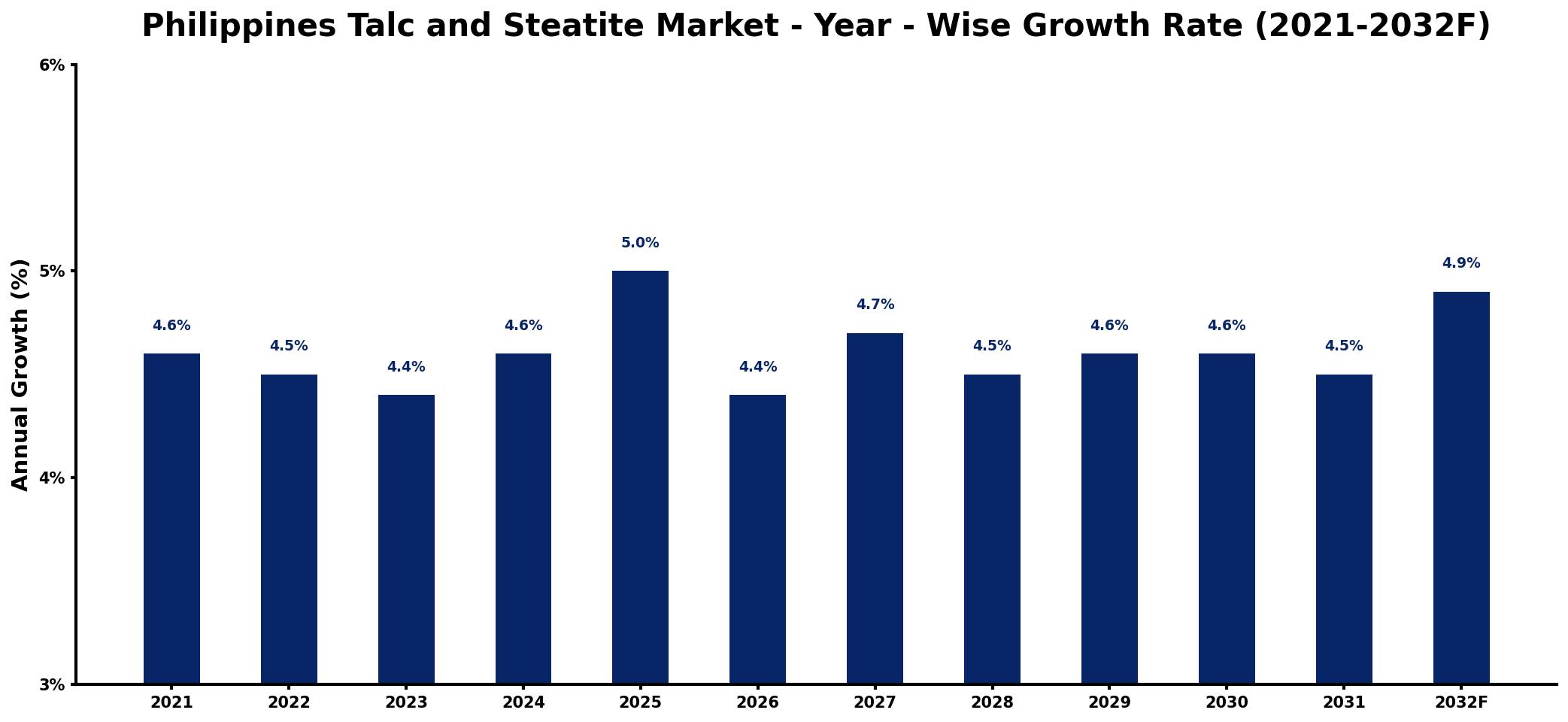
The table below presents the year‑wise growth rates along with the key drivers influencing the market
| Year | Growth Rate | Major Drivers |
| 2021 | 4.6% | Rising demand in cosmetics sector |
| 2022 | 4.5% | Increased investment in manufacturing |
| 2023 | 4.4% | Growth in personal care applications |
| 2024 | 4.6% | Expansion of construction industry projects |
| 2025 | 5.0% | Surge in paper production needs |
| 2026 | 4.4% | Higher demand from rubber industry |
| 2027 | 4.7% | Boost in food processing sector |
| 2028 | 4.5% | Growing interest in pharmaceuticals applications |
| 2029 | 4.6% | Increased utilization in plastics production |
| 2030 | 4.6% | growing commercial sector adoption |
| 2031 | 4.5% | Rising needs in electronics industry |
| 2032 | 4.9% | Growing demand for sustainable materials |
Note: Market size estimations and growth projections presented in this report are based on 6Wresearch's proprietary forecasting methodology, utilizing the latest available industry data, government publications, and primary research inputs.
Philippines Talc and Steatite Market Synopsis
The Philippines has seen a notable rise in demand for talc and steatite, driven primarily by the booming cosmetics industry, where these minerals are prized for their textural properties. Furthermore, as industries like ceramics and plastics expand, they increasingly rely on talc as a crucial ingredient for improved product performance.
However, this market also faces considerable challenges, particularly regarding environmental concerns associated with talc mining. The sector is actively seeking sustainable practices that not only address ecological impacts but also align with regulatory frameworks aimed at minimizing health risks associated with talc use.
Philippines Talc and Steatite Market Key Takeaways
- The cosmetics sector is a primary driver of growth, reflecting changing consumer preferences and increased disposable income.
- Investments in sustainable mining practices are critical for mitigating environmental impacts and ensuring long-term viability.
- Technological advancements in mineral processing are enhancing product quality and broadening application scopes.
- The recovery from COVID-19 has revitalized demand across all key sectors, particularly beauty and personal care.
- Regulatory scrutiny surrounding health impacts is prompting shifts in consumer behavior and industry practices.
Evaluation of Restraints in Philippines Talc and Steatite Market
The Philippines talc and steatite market is constrained by several factors, notably environmental concerns surrounding mining operations. These concerns can lead to increased regulatory scrutiny and potential operational shutdowns if ecological damage occurs. Additionally, the perception of health risks associated with talc usage poses a challenge to market growth, as consumer awareness grows and alternative ingredients become more readily available in personal care products. Industries are thus pressured to innovate and adapt to this changing landscape, creating a barrier to rapid expansion.
Philippines Talc and Steatite Market Trends
Current trends in the Philippines talc and steatite market include a shift towards organic and natural ingredients in cosmetics, influencing demand for talc alternatives. Moreover, advancements in processing technologies are enabling producers to enhance the purity and quality of talc products, making them more appealing to manufacturers. Additionally, as global sustainability initiatives gain traction, there is a growing emphasis on eco-friendly extraction practices and end-product formulations, which are reshaping market dynamics.
Philippines Talc and Steatite Market Opportunities
The Philippines talc and steatite market is poised for significant opportunities, particularly in the construction and ceramics sectors. Increased government spending on infrastructure projects is likely to drive demand for high-quality talc in construction materials. Furthermore, the rising consumer focus on sustainable and natural products in cosmetics opens avenues for innovative formulations that incorporate responsibly sourced talc. These trends indicate a fertile ground for investment and development in this evolving market landscape.
Government Initiatives in the Philippines Talc and Steatite Market
The government of the Philippines has implemented various initiatives aimed at regulating the mining sector to promote sustainable practices. These include policies focused on environmental protection and stricter regulations on mineral extraction to ensure safety for both workers and communities. Additionally, programs that encourage research and development in sustainable mining technologies highlight the government's commitment to fostering a more responsible minerals sector, thereby influencing the talc and steatite market positively.
Future Insights of the Philippines Talc and Steatite Market
Looking ahead to 2026-2032, the Philippines talc and steatite market is expected to evolve alongside shifting consumer preferences and regulatory landscapes. With the cosmetics industry continuing to innovate, there is likely to be an increased focus on product safety and sustainability, ultimately shaping the demand for talc. Furthermore, technological advancements in mining and processing will play a crucial role in enhancing product quality and operational efficiency, positioning the market for steady growth in the coming years.
Philippines Talc and Steatite Market Latest Developments (2025 - 2026)
In recent months, the Philippines talc and steatite market has witnessed a surge in companies adopting eco-friendly practices to address growing environmental concerns. Industry players are increasingly investing in cleaner extraction methods and exploring collaborations aimed at enhancing product transparency. Additionally, there has been a notable emphasis on developing formulations that leverage sustainable sources of talc, aligning with global trends towards natural and organic ingredients. These directions indicate a robust industry commitment to evolving practices in response to market dynamics.
Philippines Talc and Steatite Market - Key Attractiveness of the Report
- 10 Years of Market Numbers
- Historical Data Starting from 2022 to 2025
- Base Year: 2025
- Forecast Data until 2032
- Key Performance Indicators Impacting the Market
- Major Upcoming Developments and Projects
Key Highlights of the Report:
- Philippines Talc and Steatite Market Outlook
- Market Size of Philippines Talc and Steatite Market, 2025
- Forecast of Philippines Talc and Steatite Market, 2032
- Historical Data and Forecast of Philippines Talc and Steatite Revenues & Volume for the Period 2022-2032F
- Philippines Talc and Steatite Market Trend Evolution
- Philippines Talc and Steatite Market Drivers and Challenges
- Philippines Talc and Steatite Price Trends
- Philippines Talc and Steatite Porter's Five Forces
- Philippines Talc and Steatite Industry Life Cycle
- Historical Data and Forecast of Philippines Talc and Steatite Market Revenues & Volume By Product Type for the Period 2022-2032F
- Historical Data and Forecast of Philippines Talc and Steatite Market Revenues & Volume By Crushed for the Period 2022-2032F
- Historical Data and Forecast of Philippines Talc and Steatite Market Revenues & Volume By Powdered for the Period 2022-2032F
- Philippines Talc and Steatite Import Export Trade Statistics
- Market Opportunity Assessment By Product Type
- Philippines Talc and Steatite Top Companies Market Share
- Philippines Talc and Steatite Competitive Benchmarking By Technical and Operational Parameters
- Philippines Talc and Steatite Company Profiles
- Philippines Talc and Steatite Key Strategic Recommendations






































