Philippines Thread Rolling Machine Market Size, Share & Growth Rate
The Philippines Thread Rolling Machine Market was estimated at USD 1338 Million in 2025 and is projected to reach USD 1940 Million by 2032, growing at a CAGR of 5.5% from 2026 to 2032. This impressive growth trajectory is primarily driven by the booming automotive and construction sectors, which are increasingly relying on precision-engineered threaded components for their manufacturing processes. Additionally, advancements in machine technology, including automation and customization, are enabling manufacturers to enhance production efficiency and product quality.
Philippines Thread Rolling Machine Market Year-wise Growth Rate and Key Drivers
This graph highlights how the Philippines Thread Rolling Machine Market has steadily grown over the years, supported by major growth factors.
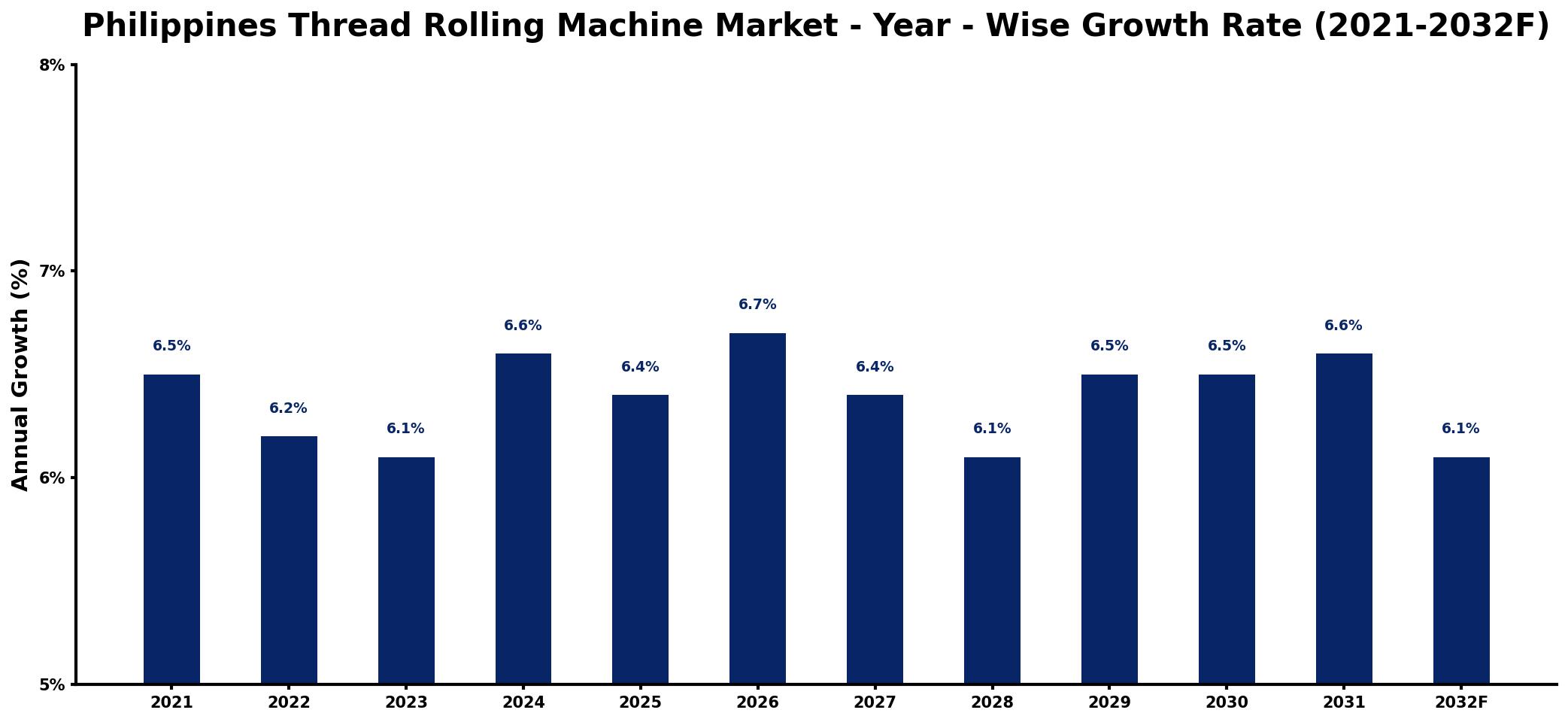
The table below presents the year‑wise growth rates along with the key drivers influencing the market
| Year | Growth Rate | Major Drivers |
| 2021 | 6.5% | Rising industrial manufacturing output |
| 2022 | 6.2% | Increased automotive sector investments |
| 2023 | 6.1% | Growing aerospace component production |
| 2024 | 6.6% | Expanding construction infrastructure projects |
| 2025 | 6.4% | Higher demand from electronics industry |
| 2026 | 6.7% | Strengthening energy sector initiatives |
| 2027 | 6.4% | Surge in consumer goods production |
| 2028 | 6.1% | Boost in export manufacturing capabilities |
| 2029 | 6.5% | Increased adoption of automation technologies |
| 2030 | 6.5% | Growing focus on sustainable practices |
| 2031 | 6.6% | Expansion of regional trade agreements |
| 2032 | 6.1% | Rising interest in advanced materials |
Note: Market size estimations and growth projections presented in this report are based on 6Wresearch's proprietary forecasting methodology, utilizing the latest available industry data, government publications, and primary research inputs.
Philippines Thread Rolling Machine Market Synopsis
The demand for threaded components in the Philippines is significantly bolstered by the ongoing construction and infrastructure projects throughout the nation. As these initiatives expand, the need for robust and precise threaded fasteners becomes critical. Thread rolling machines, known for their efficiency in producing high-quality threads, are becoming indispensable to meet this demand.
Moreover, the thread rolling machine market is seeing increased investments as manufacturers adopt modern technologies to enhance operational capabilities. The shift towards automation not only improves precision but also caters to a diverse range of threading requirements, thereby positioning manufacturers to respond adeptly to the evolving market landscape.
Philippines Thread Rolling Machine Market Key Takeaways
- The market is experiencing consistent growth, driven by increased demand from the automotive and construction sectors.
- Technological advancements are enabling manufacturers to improve production efficiency and precision.
- Customization and automation are emerging as key trends among thread rolling machine manufacturers.
- The impact of the COVID-19 pandemic has been felt, leading to temporary disruptions in manufacturing activities.
- Investment in infrastructure is poised to sustain long-term demand for threaded components.
Evaluation of Restraints in Philippines Thread Rolling Machine Market
While the market shows promising growth, several factors act as restraints. The need for versatility in thread types can pose challenges for manufacturers, particularly in high-volume production scenarios. Additionally, maintaining precise tolerances across diverse applications requires continuous investment in technology and skilled labor. Economic fluctuations can also impact manufacturers' ability to invest in new machinery, potentially hindering market growth.
Philippines Thread Rolling Machine Market Trends
Several trends are shaping the Philippines thread rolling machine market, notably the push towards automation. As factories evolve, incorporating robotic systems and smart technologies, the need for traditional manual processes diminishes. Furthermore, the rising focus on sustainability and eco-friendly manufacturing practices is prompting manufacturers to explore energy-efficient machinery options. Customization is another vital trend; more businesses are seeking tailored solutions that meet their specific threading requirements, highlighting the shift towards client-centric product offerings.
Philippines Thread Rolling Machine Market Opportunities
The Philippines presents several opportunities for growth in the thread rolling machine market. With continued government investment in infrastructure and construction, the demand for high-quality threaded components will likely surge. Additionally, as industries increasingly adopt advanced manufacturing technologies, there's a ripe opportunity for machine manufacturers to innovate, creating smarter and more efficient thread rolling solutions that can capture the market's attention. Emerging sectors, such as renewable energy and electric vehicles, also offer new avenues for growth and diversification.
Government Initiatives in the Philippines Thread Rolling Machine Market
The Philippine government has implemented various initiatives aimed at bolstering the manufacturing sector, which indirectly supports the thread rolling machine market. Efforts to enhance infrastructure through public-private partnerships are being prioritized, thus increasing demand for threaded components. Additionally, policies aimed at improving industry standards and encouraging investments in advanced manufacturing technologies provide a conducive environment for market growth. Enhanced training programs for skilled labor are also vital to sustain the demand for high-precision machinery.
Future Insights of the Philippines Thread Rolling Machine Market
Looking ahead to 2026-2032, the Philippines thread rolling machine market is poised for significant advancements. The expected growth in various sectors, particularly automotive and construction, will underpin demand for these machines. With the ongoing trend towards automation and the integration of smart technologies, manufacturers will need to continuously adapt to remain competitive. As companies increasingly prioritize efficiency and sustainability, the market will likely witness innovations aimed at reducing production costs while enhancing output quality.
Philippines Thread Rolling Machine Market Latest Developments (2025 - 2026)
Recent developments in the Philippines thread rolling machine market indicate a strong focus on automation and advanced manufacturing technologies. Manufacturers are actively investing in research and development to introduce innovative machine features that enhance productivity. Additionally, partnerships between domestic and international firms are becoming more common, as local manufacturers seek to leverage global expertise to improve their offerings. This trend is expected to stimulate healthy competition and drive further advancements in machine capabilities.
Philippines Thread Rolling Machine Market - Key Attractiveness of the Report
- 10 Years of Market Numbers
- Historical Data Starting from 2022 to 2025
- Base Year: 2025
- Forecast Data until 2032
- Key Performance Indicators Impacting the Market
- Major Upcoming Developments and Projects
Key Highlights of the Report:
- Philippines Thread Rolling Machine Market Outlook
- Market Size of Philippines Thread Rolling Machine Market, 2025
- Forecast of Philippines Thread Rolling Machine Market, 2032
- Historical Data and Forecast of Philippines Thread Rolling Machine Revenues & Volume for the Period 2022-2032F
- Philippines Thread Rolling Machine Market Trend Evolution
- Philippines Thread Rolling Machine Market Drivers and Challenges
- Philippines Thread Rolling Machine Price Trends
- Philippines Thread Rolling Machine Porter's Five Forces
- Philippines Thread Rolling Machine Industry Life Cycle
- Historical Data and Forecast of Philippines Thread Rolling Machine Market Revenues & Volume By Type for the Period 2022-2032F
- Historical Data and Forecast of Philippines Thread Rolling Machine Market Revenues & Volume By Two Axis Thread Rolling Machine for the Period 2022-2032F
- Historical Data and Forecast of Philippines Thread Rolling Machine Market Revenues & Volume By Three Axis Thread Rolling Machine for the Period 2022-2032F
- Historical Data and Forecast of Philippines Thread Rolling Machine Market Revenues & Volume By Application for the Period 2022-2032F
- Historical Data and Forecast of Philippines Thread Rolling Machine Market Revenues & Volume By Construction for the Period 2022-2032F
- Historical Data and Forecast of Philippines Thread Rolling Machine Market Revenues & Volume By Industrial for the Period 2022-2032F
- Historical Data and Forecast of Philippines Thread Rolling Machine Market Revenues & Volume By Others for the Period 2022-2032F
- Philippines Thread Rolling Machine Import Export Trade Statistics
- Market Opportunity Assessment By Type
- Market Opportunity Assessment By Application
- Philippines Thread Rolling Machine Top Companies Market Share
- Philippines Thread Rolling Machine Competitive Benchmarking By Technical and Operational Parameters
- Philippines Thread Rolling Machine Company Profiles
- Philippines Thread Rolling Machine Key Strategic Recommendations






































