Philippines Twine Market Top 5 Importing Countries and Market Competition (HHI) Analysis
The Philippines continues to heavily rely on twine imports, with top suppliers including China, Hong Kong, Taiwan, Vietnam, and South Korea in 2024. Despite a high concentration with the Herfindahl-Hirschman Index (HHI), the market saw a significant decline in compound annual growth rate (CAGR) of -12.85% from 2020-2024. However, there was a promising growth rate of 15.72% from 2023-2024, indicating potential opportunities for expansion in the coming years.
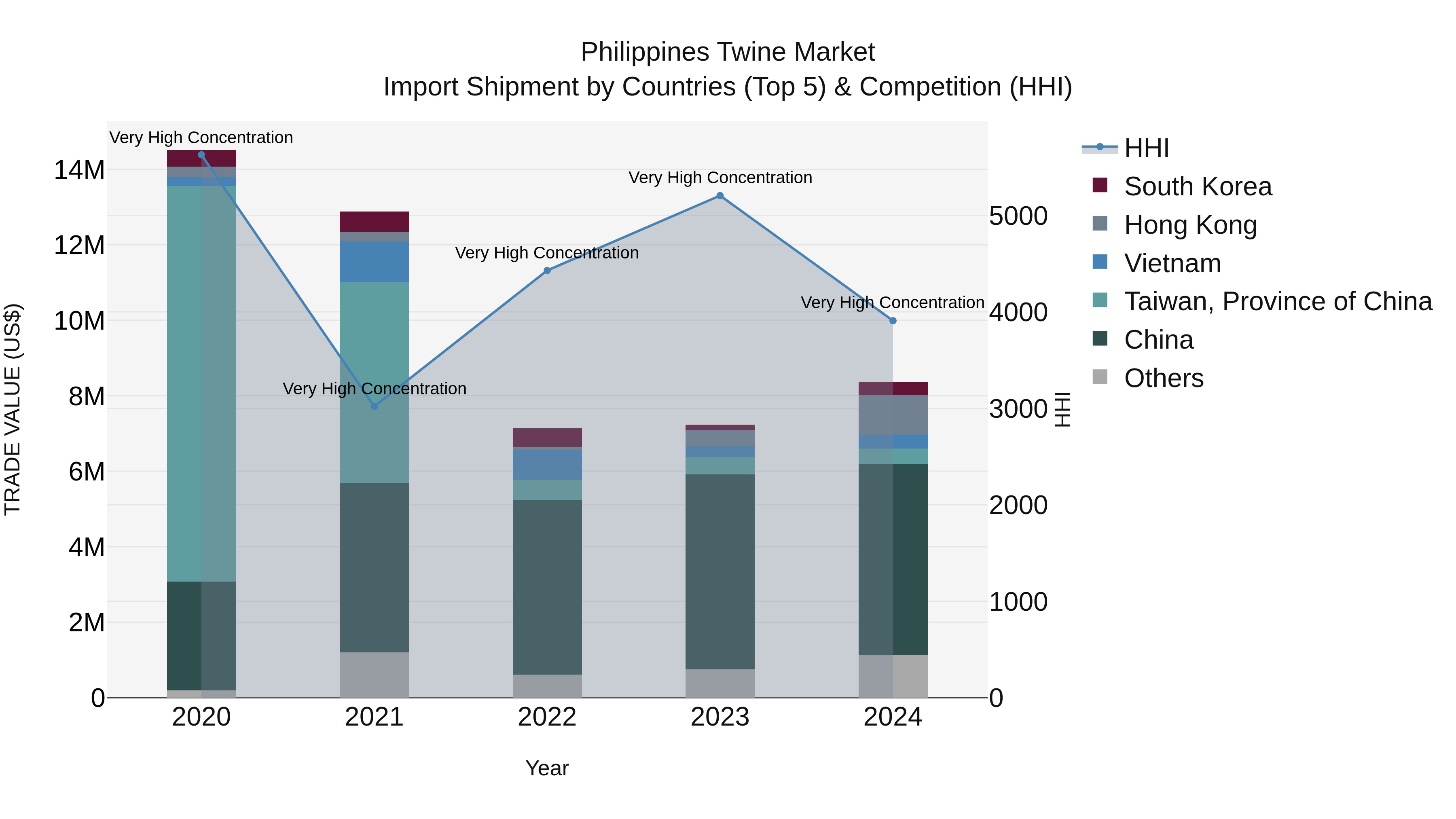
Philippines Twine Market Synopsis
The Twine Market in the Philippines is expected to witness a steady growth during 2020-2026. The market is driven by factors such as increasing demand for twine components in various industrial and consumer applications, growing need for packaging materials, and rising awareness about sustainable packages among consumers. Additionally, advancements in technology have enabled manufacturers to produce superior quality of twines that are stronger than before and cost-effective. However, high raw material costs may hamper the growth of the market over the forecast period.
Key Trends of The Market
In order to reduce plastic pollution caused due to non-biodegradable products and packaging materials, biodegradable products made out of twine are becoming popular among end users such as retail stores and food service providers since these products are environment friendly. This trend has been witnessed across several industries including agriculture and food sectors which will drive the adoption rate of twines over an extended period of time. Further, the consumers prefer aesthetically pleasing designs on their product packaging which necessitates personalized solutions offered by manufacturers through printed labels or logos on them using customized printing technology facilitated by stringed tags or cords woven with custom color patterns used for tying up packages like gift boxes etc., thereby driving vendors offering such services furthering boosting sales prospects within this vertical segmentation within this industry space going forward. Additionally, manufacturers are innovating towards automating production lines leveraging technological advances enabling them to reduce labor costs while improving efficiency hence enhancing profitability margins widening scope for expansion opportunities amongst participants operating within this domain space leading towards increased scale operability.
Key Challenges Faced by The Market
Due To Introduction Of Stringed Components Into Several Different Industries Such As Agriculture , Food Processing , Fishing , Textiles And Logistics There Is An Increase In Demand For Twine Materials Utilized Within These Sectors Driving Volume Sales Forecasts Over The Coming Years. Further, there Is An Increasing Need For Sustainable Options That Are Environment Friendly Which Can Be Easily Met By Using Twines Instead Of Plastic Wraps Or Bags Therefore Boosting Prospects From This Perspective Going Forward.
Key Highlights of the Report:
- Philippines Twine Market Outlook
- Market Size of Philippines Twine Market, 2023
- Forecast of Philippines Twine Market, 2030
- Historical Data and Forecast of Philippines Twine Revenues & Volume for the Period 2020-2030
- Philippines Twine Market Trend Evolution
- Philippines Twine Market Drivers and Challenges
- Philippines Twine Price Trends
- Philippines Twine Porter's Five Forces
- Philippines Twine Industry Life Cycle
- Historical Data and Forecast of Philippines Twine Market Revenues & Volume By Type for the Period 2020-2030
- Historical Data and Forecast of Philippines Twine Market Revenues & Volume By Polethylene Rope Twine for the Period 2020-2030
- Historical Data and Forecast of Philippines Twine Market Revenues & Volume By Metal Rope Twine for the Period 2020-2030
- Historical Data and Forecast of Philippines Twine Market Revenues & Volume By Other for the Period 2020-2030
- Historical Data and Forecast of Philippines Twine Market Revenues & Volume By Applications for the Period 2020-2030
- Historical Data and Forecast of Philippines Twine Market Revenues & Volume By Industrial for the Period 2020-2030
- Historical Data and Forecast of Philippines Twine Market Revenues & Volume By Counstruction for the Period 2020-2030
- Historical Data and Forecast of Philippines Twine Market Revenues & Volume By Oil for the Period 2020-2030
- Historical Data and Forecast of Philippines Twine Market Revenues & Volume By Coal mine for the Period 2020-2030
- Historical Data and Forecast of Philippines Twine Market Revenues & Volume By Other for the Period 2020-2030
- Philippines Twine Import Export Trade Statistics
- Market Opportunity Assessment By Type
- Market Opportunity Assessment By Applications
- Philippines Twine Top Companies Market Share
- Philippines Twine Competitive Benchmarking By Technical and Operational Parameters
- Philippines Twine Company Profiles
- Philippines Twine Key Strategic Recommendations






































