Philippines Ultrasonic Cleaning Equipment Market Size, Share & Growth Rate
The Philippines Ultrasonic Cleaning Equipment Market was estimated at USD 529 Million in 2025 and is projected to reach USD 752 Million by 2032, growing at a CAGR of 5.2% from 2026 to 2032. This growth is predominantly fueled by rising industrial demand for effective cleaning solutions that offer both efficiency and sustainability. As various sectors, particularly manufacturing and healthcare, increasingly adopt non-invasive cleaning technologies, the market stands poised for significant expansion.
Philippines Ultrasonic Cleaning Equipment Market Year-wise Growth Rate and Key Drivers
This graph highlights how the Philippines Ultrasonic Cleaning Equipment Market has steadily grown over the years, supported by major growth factors.
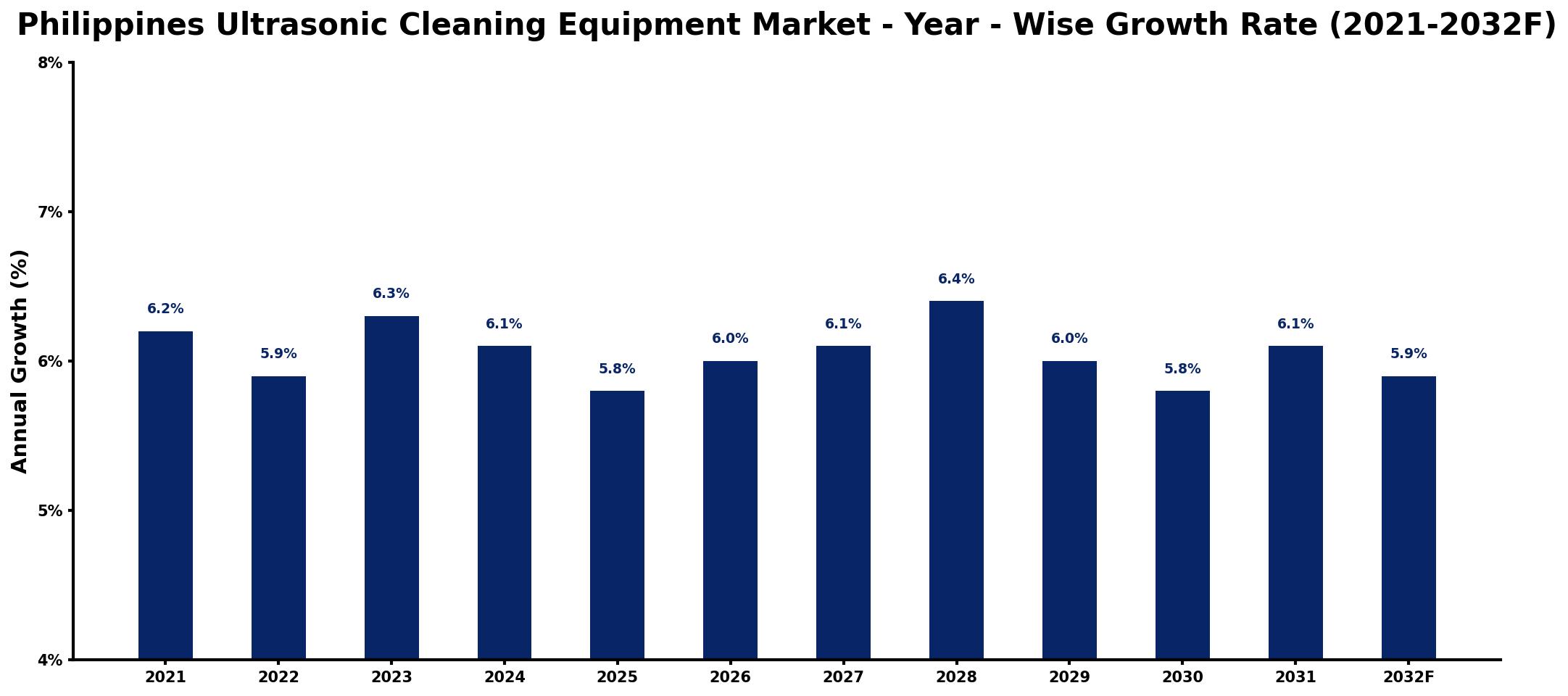
The table below presents the year‑wise growth rates along with the key drivers influencing the market
| Year | Growth Rate | Major Drivers |
| 2021 | 6.2% | Rising demand from healthcare sector |
| 2022 | 5.9% | Increased industrial automation investments |
| 2023 | 6.3% | Growing awareness of sustainability practices |
| 2024 | 6.1% | Expansion of electronics manufacturing facilities |
| 2025 | 5.8% | Emerging applications in automotive industry |
| 2026 | 6.0% | increased pharmaceutical industry usage |
| 2027 | 6.1% | Boost in consumer electronics production |
| 2028 | 6.4% | rising export shipment volumes |
| 2029 | 6.0% | Growth in precision engineering sectors |
| 2030 | 5.8% | Increase in maintenance service contracts |
| 2031 | 6.1% | Rising popularity of eco-friendly solutions |
| 2032 | 5.9% | growing emerging market penetration |
Note: Market size estimations and growth projections presented in this report are based on 6Wresearch's proprietary forecasting methodology, utilizing the latest available industry data, government publications, and primary research inputs.
Philippines Ultrasonic Cleaning Equipment Market Synopsis
In the Philippines, industries are increasingly recognizing the advantages of ultrasonic cleaning equipment for applications that require meticulous cleanliness without damaging sensitive components. This technology's ability to deliver rapid, comprehensive cleaning while minimizing the use of harmful chemicals aligns well with the country's move towards more sustainable industrial practices.
Moreover, the growing emphasis on hygiene, especially within the healthcare sector post-COVID-19, has prompted healthcare facilities to invest in ultrasonic cleaning solutions. This shift is not merely about compliance but about ensuring the highest standards of cleanliness and patient safety, thus further propelling market demand.
Philippines Ultrasonic Cleaning Equipment Market Key Takeaways
- Adoption of ultrasonic cleaning technology is accelerating across key industries in the Philippines.
- Environmental concerns drive the transition towards sustainable cleaning solutions.
- The healthcare sector's focus on hygiene enhancement plays a pivotal role in market growth.
- Education and training regarding the benefits of ultrasonic cleaning remain vital for further adoption.
- Market players are exploring innovations to expand equipment versatility for diverse applications.
Evaluation of Restraints in Philippines Ultrasonic Cleaning Equipment Market
Despite its potential, the Philippines Ultrasonic Cleaning Equipment Market faces several constraints. A significant barrier is the lack of awareness regarding the benefits and applications of ultrasonic cleaning technology across various sectors. Many industries remain hesitant to invest in new equipment due to perceived complexities and upfront costs. Additionally, adapting ultrasonic systems for specific industrial needs requires investment in technology customization, which can further deter potential adopters.
Philippines Ultrasonic Cleaning Equipment Market Trends
Several trends are currently shaping the Philippines ultrasonic cleaning equipment landscape. Firstly, the push for automation is evident, as more companies are integrating ultrasonic cleaning solutions with automated systems for enhanced efficiency. Secondly, there is a growing focus on compact, user-friendly equipment that fits into varied industrial environments. Lastly, the increasing demand for biodegradable and eco-friendly cleaning agents is influencing the development of ultrasonic cleaning solutions tailored to meet these criteria.
Philippines Ultrasonic Cleaning Equipment Market Opportunities
There are significant growth opportunities within the Philippines ultrasonic cleaning equipment market. As industries adopt stricter regulations regarding environmental sustainability, ultrasonic cleaning technology presents an attractive alternative. Moreover, sectors such as electronics, dental, and jewelry are exploring ultrasonic solutions to meet their specialized cleaning needs. Collaboration with educational institutions for training programs could also enhance industry knowledge and spur market expansion.
Government Initiatives in the Philippines Ultrasonic Cleaning Equipment Market
The Philippine government has introduced several initiatives aimed at promoting environmentally friendly industrial practices, including support for technologies such as ultrasonic cleaning. Public spending on healthcare and manufacturing facilities has seen increased allocations, which indirectly benefits sectors looking to upgrade to advanced cleaning solutions. Various incentives for energy-efficient technologies also encourage businesses to invest in ultrasonic cleaning equipment.
Future Insights of the Philippines Ultrasonic Cleaning Equipment Market
Looking ahead to 2026-2032, the Philippines ultrasonic cleaning equipment market is set for transformative growth. Increasing industrial output, coupled with heightened regulatory standards for cleanliness and hygiene, will drive demand for these solutions. Additionally, innovations in technology are expected to broaden the applicability of ultrasonic cleaning systems, making them suitable for a wider array of industries. Overall, the market is on track to evolve in tandem with the countrys industrial landscape, presenting a wealth of possibilities.
Philippines Ultrasonic Cleaning Equipment Market Latest Developments (2025 - 2026)
Recently, there has been a notable shift towards smarter ultrasonic cleaning solutions, integrating IoT capabilities for real-time monitoring and control. Industry stakeholders are focusing on collaborations to enhance research and development, aiming to create more efficient and versatile cleaning systems. Furthermore, trade exhibitions and conferences have begun highlighting the benefits of ultrasonic cleaning, fostering greater awareness and interest among potential end-users.
Philippines Ultrasonic Cleaning Equipment Market - Key Attractiveness of the Report
- 10 Years of Market Numbers
- Historical Data Starting from 2022 to 2025
- Base Year: 2025
- Forecast Data until 2032
- Key Performance Indicators Impacting the Market
- Major Upcoming Developments and Projects
Key Highlights of the Report:
- Philippines Ultrasonic Cleaning Equipment Market Outlook
- Market Size of Philippines Ultrasonic Cleaning Equipment Market, 2025
- Forecast of Philippines Ultrasonic Cleaning Equipment Market, 2032
- Historical Data and Forecast of Philippines Ultrasonic Cleaning Equipment Revenues & Volume for the Period 2022-2032F
- Philippines Ultrasonic Cleaning Equipment Market Trend Evolution
- Philippines Ultrasonic Cleaning Equipment Market Drivers and Challenges
- Philippines Ultrasonic Cleaning Equipment Price Trends
- Philippines Ultrasonic Cleaning Equipment Porter's Five Forces
- Philippines Ultrasonic Cleaning Equipment Industry Life Cycle
- Historical Data and Forecast of Philippines Ultrasonic Cleaning Equipment Market Revenues & Volume By Type for the Period 2022-2032F
- Historical Data and Forecast of Philippines Ultrasonic Cleaning Equipment Market Revenues & Volume By Standalone for the Period 2022-2032F
- Historical Data and Forecast of Philippines Ultrasonic Cleaning Equipment Market Revenues & Volume By Benchtop for the Period 2022-2032F
- Historical Data and Forecast of Philippines Ultrasonic Cleaning Equipment Market Revenues & Volume By Multistage for the Period 2022-2032F
- Historical Data and Forecast of Philippines Ultrasonic Cleaning Equipment Market Revenues & Volume By Application for the Period 2022-2032F
- Historical Data and Forecast of Philippines Ultrasonic Cleaning Equipment Market Revenues & Volume By Automotive for the Period 2022-2032F
- Historical Data and Forecast of Philippines Ultrasonic Cleaning Equipment Market Revenues & Volume By Healthcare for the Period 2022-2032F
- Historical Data and Forecast of Philippines Ultrasonic Cleaning Equipment Market Revenues & Volume By Electrical & Electronics for the Period 2022-2032F
- Historical Data and Forecast of Philippines Ultrasonic Cleaning Equipment Market Revenues & Volume By Aerospace & Defense for the Period 2022-2032F
- Historical Data and Forecast of Philippines Ultrasonic Cleaning Equipment Market Revenues & Volume By Others for the Period 2022-2032F
- Philippines Ultrasonic Cleaning Equipment Import Export Trade Statistics
- Market Opportunity Assessment By Type
- Market Opportunity Assessment By Application
- Philippines Ultrasonic Cleaning Equipment Top Companies Market Share
- Philippines Ultrasonic Cleaning Equipment Competitive Benchmarking By Technical and Operational Parameters
- Philippines Ultrasonic Cleaning Equipment Company Profiles
- Philippines Ultrasonic Cleaning Equipment Key Strategic Recommendations






































