Philippines Underwater Concrete Market Size, Share & Growth Rate
The Philippines Underwater Concrete Market was estimated at USD 272 Million in 2025 and is projected to reach USD 381 Million by 2032, growing at a CAGR of 4.9% from 2026 to 2032. This robust growth trajectory is primarily driven by an increasing demand for durable construction solutions in coastal and marine infrastructure projects. As urbanization accelerates and investment in infrastructure expands, the need for specialized concrete that can withstand underwater environments will continue to rise.
Philippines Underwater Concrete Market Year-wise Growth Rate and Key Drivers
This graph highlights how the Philippines Underwater Concrete Market has steadily grown over the years, supported by major growth factors.
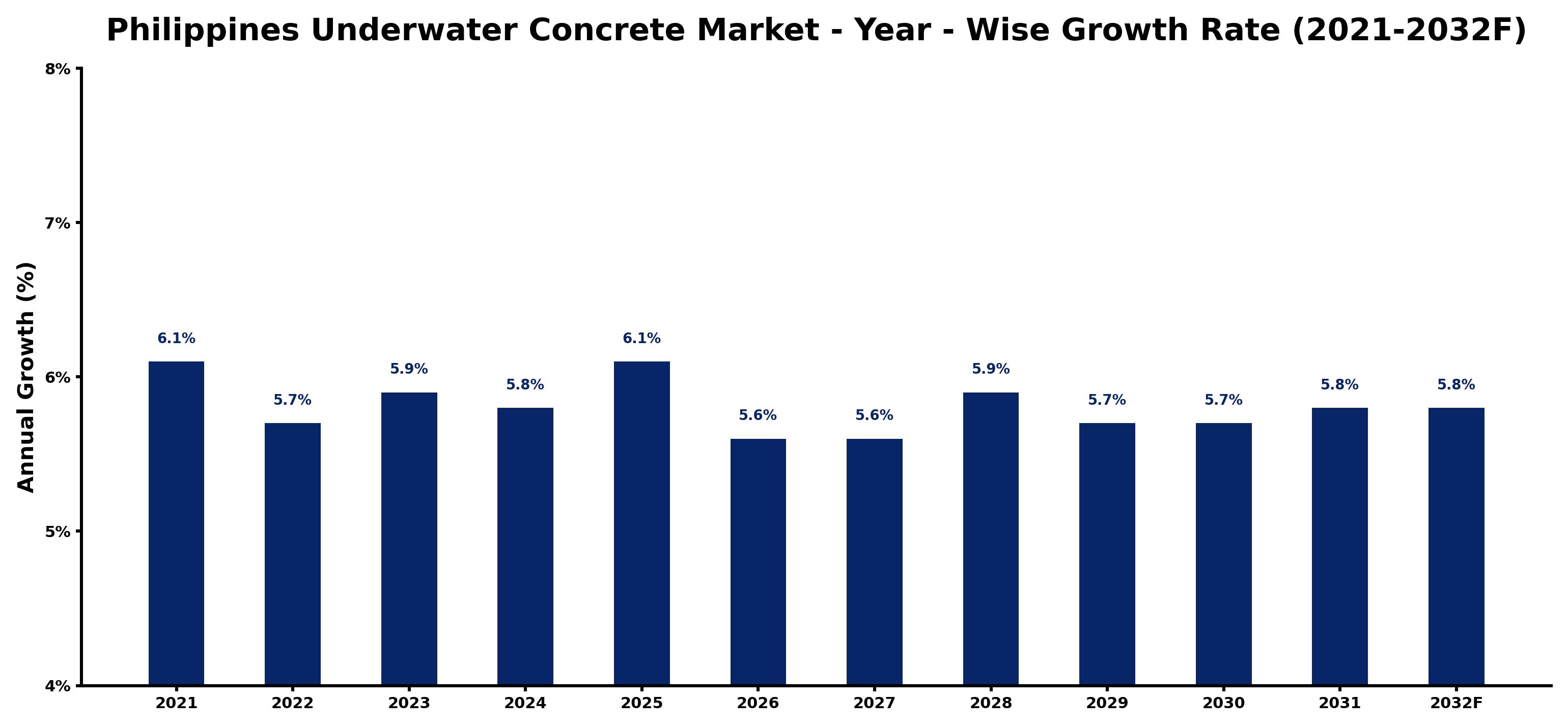
The table below presents the year‑wise growth rates along with the key drivers influencing the market
| Year | Growth Rate | Major Drivers |
| 2021 | 6.1% | Manufacturing investments in underwater construction boost concrete demand significantly |
| 2022 | 5.7% | Advanced underwater concrete applications drive specialized equipment investments |
| 2023 | 5.9% | Innovative underwater concrete formulations boost infrastructure project timelines |
| 2024 | 5.8% | Domestic infrastructure projects boost demand for underwater concrete solutions |
| 2025 | 6.1% | Domestic infrastructure projects boosted underwater concrete production capacities |
| 2026 | 5.6% | Sustainable construction projects boost demand for underwater concrete applications |
| 2027 | 5.6% | Local construction boom drives demand for underwater concrete solutions |
| 2028 | 5.9% | Adoption of advanced robotics boosted underwater concrete application efficiency |
| 2029 | 5.7% | Increased construction projects stimulate underwater concrete supply chain activities |
| 2030 | 5.7% | Increased infrastructure projects drive underwater concrete demand and production |
| 2031 | 5.8% | Domestic infrastructure projects drove demand for underwater concrete solutions |
| 2032 | 5.8% | Infrastructure projects boost demand for advanced underwater concrete solutions |
Note - Market size estimations and growth projections presented in this report are based on 6Wresearch’s advanced forecasting approach, validated with industry datasets as of June 2026.
Philippines Underwater Concrete Market Synopsis
The strongest force currently shaping the Philippines Underwater Concrete Market is the surge in infrastructure repair and restoration activities. As the government emphasizes the enhancement of ports, airports, and bridges, the demand for specialized underwater concrete solutions becomes increasingly vital. This trend underscores a nationwide commitment to developing resilient infrastructure capable of withstanding the rigors of aquatic environments.
In addition, the expansion of coastal infrastructure projects and marine constructions is driving growth. As coastal protection measures, harbor developments, and offshore installations become a priority, the industry is witnessing a significant uptick in the utilization of advanced concrete formulations designed specifically for underwater applications.
Philippines Underwater Concrete Market Key Takeaways
- The market is projected to experience substantial growth driven by increased investment in infrastructure.
- Demand for durable and corrosion-resistant concrete solutions is at an all-time high.
- Government initiatives aimed at enhancing coastal and marine infrastructure will boost market activity.
- Challenges related to formulation and placement techniques are critical to navigate for successful project execution.
- COVID-19 impacts were mixed, with essential infrastructure projects sustaining market activity despite disruptions.
Evaluation of Restraints in Philippines Underwater Concrete Market
Despite the promising outlook, several restraints hinder the Philippines Underwater Concrete Market's progress. One significant challenge lies in achieving optimal durability in corrosive underwater environments. The formulation of concrete that can resist saltwater exposure while maintaining structural integrity is technically demanding. Furthermore, logistical complexities in the placement and curing processes of underwater concrete can create project delays and complications, making it crucial for stakeholders to innovate continuously.
Philippines Underwater Concrete Market Trends
A notable trend is the increasing adoption of advanced materials and technologies that enhance the performance of underwater concrete. Innovations in mix designs that incorporate fibers and additives for improved resistance to environmental stressors are gaining traction. Additionally, the industry's movement towards sustainable construction practices is prompting a rise in the use of eco-friendly raw materials, which are increasingly demanded by both clients and regulatory bodies.
Philippines Underwater Concrete Market Opportunities
Opportunities abound within the Philippines Underwater Concrete Market, particularly in the areas of coastal protection and restoration projects. As climate change concerns continue to grow, there is a heightened focus on developing infrastructure resilient to natural disasters. Investment in research and development for specialized concrete formulations offers pathways for innovation, while collaborations with governmental agencies can facilitate project funding and execution.
Government Initiatives in the Philippines Underwater Concrete Market
The Philippine government is actively investing in infrastructure development as part of its broader economic strategy. Initiatives focused on enhancing coastal infrastructure and maritime projects are receiving significant attention. Public spending on these projects is poised to drive demand for specialized underwater concrete solutions, thereby stimulating market growth. Programs aimed at sustainability and resilience in construction also support innovations within the sector.
Future Insights of the Philippines Underwater Concrete Market
Looking ahead to 2026-2032, the Philippines Underwater Concrete Market is expected to navigate through evolving challenges while capitalizing on growth opportunities. The continued focus on infrastructure development, coupled with technological advancements in concrete formulations, will play a pivotal role in the market's expansion. Stakeholders must remain agile to adapt to changing environmental regulations and embrace sustainable practices as a core component of future projects.
Philippines Underwater Concrete Market Latest Developments (May 2025 - June 2026)
Recent industry trends indicate a shift towards more innovative underwater concrete solutions in response to the growing complexity of marine construction. Ongoing government projects highlight the importance of robust materials that can withstand harsh marine conditions. Furthermore, collaborations between construction firms and technology providers are becoming increasingly common as they seek to develop concrete mixes that enhance performance while adhering to environmental standards.
Philippines Underwater Concrete Market - Key Attractiveness of the Report
- 10 Years of Market Numbers
- Historical Data Starting from 2022 to 2025
- Base Year: 2025
- Forecast Data until 2032
- Key Performance Indicators Impacting the Market
- Major Upcoming Developments and Projects
Key Highlights of the Report:
- Philippines Underwater Concrete Market Outlook
- Market Size of Philippines Underwater Concrete Market, 2025
- Forecast of Philippines Underwater Concrete Market, 2032
- Historical Data and Forecast of Philippines Underwater Concrete Revenues & Volume for the Period 2022-2032F
- Philippines Underwater Concrete Market Trend Evolution
- Philippines Underwater Concrete Market Drivers and Challenges
- Philippines Underwater Concrete Price Trends
- Philippines Underwater Concrete Porter's Five Forces
- Philippines Underwater Concrete Industry Life Cycle
- Historical Data and Forecast of Philippines Underwater Concrete Market Revenues & Volume By Raw Material for the Period 2022-2032F
- Historical Data and Forecast of Philippines Underwater Concrete Market Revenues & Volume By Admixtures for the Period 2022-2032F
- Historical Data and Forecast of Philippines Underwater Concrete Market Revenues & Volume By Aggregates for the Period 2022-2032F
- Historical Data and Forecast of Philippines Underwater Concrete Market Revenues & Volume By Cement for the Period 2022-2032F
- Historical Data and Forecast of Philippines Underwater Concrete Market Revenues & Volume By Others for the Period 2022-2032F
- Historical Data and Forecast of Philippines Underwater Concrete Market Revenues & Volume By Application for the Period 2022-2032F
- Historical Data and Forecast of Philippines Underwater Concrete Market Revenues & Volume By Hydropower for the Period 2022-2032F
- Historical Data and Forecast of Philippines Underwater Concrete Market Revenues & Volume By Marine for the Period 2022-2032F
- Historical Data and Forecast of Philippines Underwater Concrete Market Revenues & Volume By Shore protection for the Period 2022-2032F
- Historical Data and Forecast of Philippines Underwater Concrete Market Revenues & Volume By Underwater repairs for the Period 2022-2032F
- Historical Data and Forecast of Philippines Underwater Concrete Market Revenues & Volume By Tunnels for the Period 2022-2032F
- Historical Data and Forecast of Philippines Underwater Concrete Market Revenues & Volume By Swimming pools for the Period 2022-2032F
- Historical Data and Forecast of Philippines Underwater Concrete Market Revenues & Volume By Others for the Period 2022-2032F
- Philippines Underwater Concrete Import Export Trade Statistics
- Market Opportunity Assessment By Raw Material
- Market Opportunity Assessment By Application
- Philippines Underwater Concrete Top Companies Market Share
- Philippines Underwater Concrete Competitive Benchmarking By Technical and Operational Parameters
- Philippines Underwater Concrete Company Profiles
- Philippines Underwater Concrete Key Strategic Recommendations






































