Philippines Used Cooking Oil Market Top 5 Importing Countries and Market Competition (HHI) Analysis
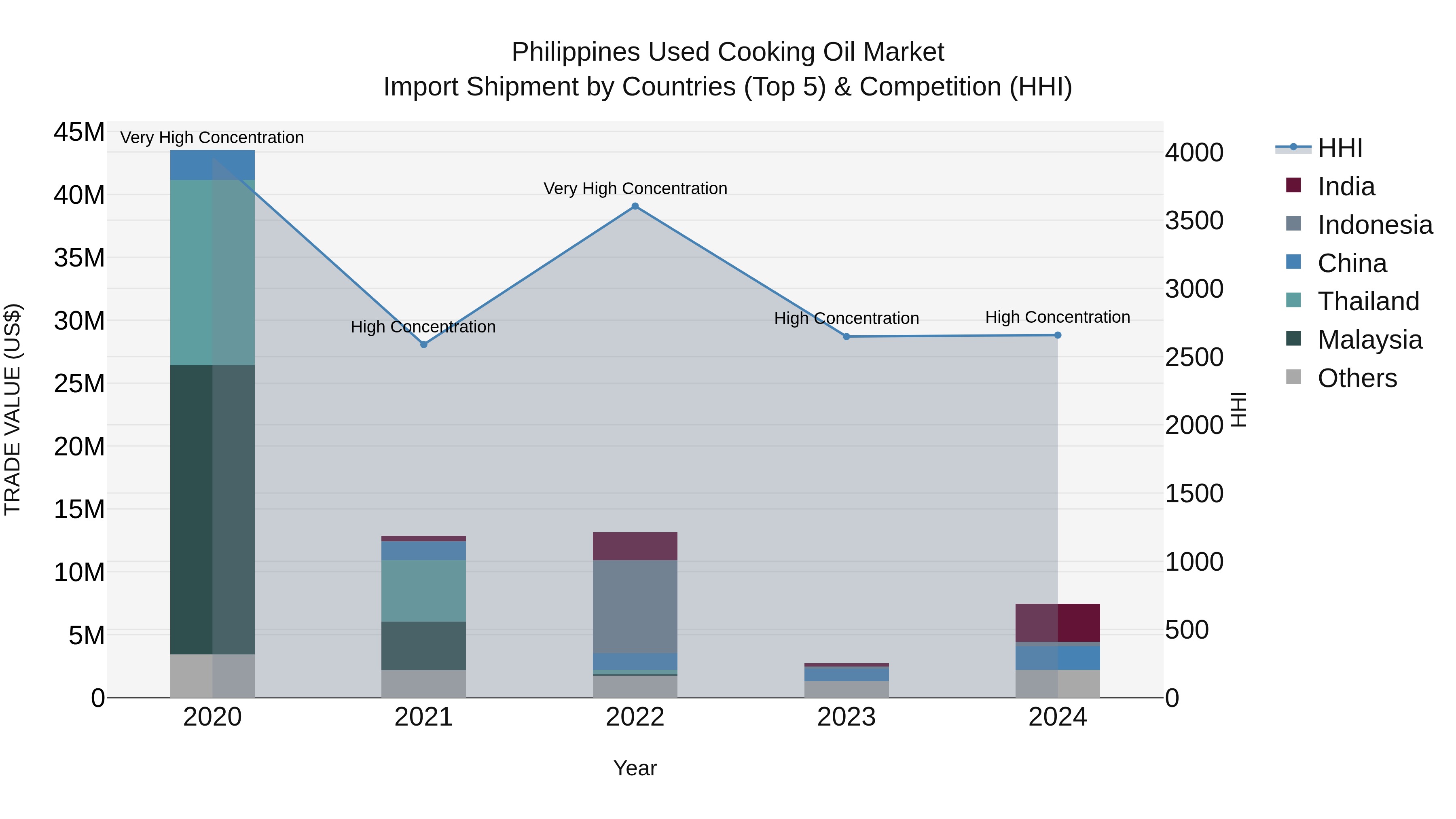
The Philippines continues to rely on imported used cooking oil, with key exporters in 2024 being India, China, Italy, USA, and Indonesia. Despite a significant negative CAGR from 2020 to 2024, the industry experienced a remarkable growth rate of 174.53% in 2024. High Herfindahl-Hirschman Index (HHI) indicates a concentrated import market, suggesting potential challenges for market competition and pricing dynamics. It will be interesting to monitor how these trends shape the future landscape of the used cooking oil import market in the Philippines.
Philippines Used Cooking Oil Market Synopsis
The used cooking oil (UCO) market is emerging due to its application in biodiesel production and environmental sustainability efforts. Collection systems are gradually being formalized through partnerships between restaurants, recyclers, and green energy firms. Regulatory support and ESG initiatives further encourage UCO reuse.
Trends of the market
The used cooking oil (UCO) market is gaining traction in the Philippines, particularly due to rising environmental awareness and the growing biodiesel industry. Restaurants, food processing units, and households are now more involved in the collection and resale of UCO. Regulatory encouragement for biofuel blending and sustainable waste management has bolstered interest in this market. However, challenges remain, including the informal nature of much of the collection process and limited infrastructure for refining and converting UCO into high-grade biodiesel.
Challenges of the market
The used cooking oil market is affected by a fragmented collection system, lack of regulatory oversight, and weak demand for biodiesel conversion. Informal reuse of used oil in food establishments presents health risks and undermines organized collection efforts. Additionally, awareness of sustainable disposal practices is low.
Investment opportunities in the Market
With the push towards sustainability, used cooking oil (UCO) is increasingly being utilized for biodiesel production. Investors can set up collection and filtration systems to supply biofuel companies locally or internationally. Collaborations with fast-food chains, hotels, and restaurants will ensure a steady UCO supply chain.
Government Policy of the market
The trade and recycling of used cooking oil are governed by DENR Administrative Orders related to waste management, as used cooking oil is considered hazardous when disposed improperly. The Ecological Solid Waste Management Act (RA 9003) mandates proper segregation, and businesses reprocessing the oil for biodiesel or animal feed must obtain Environmental Compliance Certificates (ECCs). The Biofuels Act of 2006 also plays a role if the oil is to be used in biofuel production, requiring accreditation from the DOE and coordination with the National Biofuels Board.
Key Highlights of the Report:
- Philippines Used Cooking Oil Market Outlook
- Market Size of Philippines Used Cooking Oil Market, 2024
- Forecast of Philippines Used Cooking Oil Market, 2031
- Historical Data and Forecast of Philippines Used Cooking Oil Revenues & Volume for the Period 2021- 2031
- Philippines Used Cooking Oil Market Trend Evolution
- Philippines Used Cooking Oil Market Drivers and Challenges
- Philippines Used Cooking Oil Price Trends
- Philippines Used Cooking Oil Porter's Five Forces
- Philippines Used Cooking Oil Industry Life Cycle
- Historical Data and Forecast of Philippines Used Cooking Oil Market Revenues & Volume By Type for the Period 2021- 2031
- Historical Data and Forecast of Philippines Used Cooking Oil Market Revenues & Volume By Vegetable Oil for the Period 2021- 2031
- Historical Data and Forecast of Philippines Used Cooking Oil Market Revenues & Volume By Animal Oil for the Period 2021- 2031
- Historical Data and Forecast of Philippines Used Cooking Oil Market Revenues & Volume By Processed Oil for the Period 2021- 2031
- Historical Data and Forecast of Philippines Used Cooking Oil Market Revenues & Volume By End User for the Period 2021- 2031
- Historical Data and Forecast of Philippines Used Cooking Oil Market Revenues & Volume By Biodiesel for the Period 2021- 2031
- Historical Data and Forecast of Philippines Used Cooking Oil Market Revenues & Volume By Oleo Chemicals for the Period 2021- 2031
- Historical Data and Forecast of Philippines Used Cooking Oil Market Revenues & Volume By Animal Feed for the Period 2021- 2031
- Philippines Used Cooking Oil Import Export Trade Statistics
- Market Opportunity Assessment By Type
- Market Opportunity Assessment By End User
- Philippines Used Cooking Oil Top Companies Market Share
- Philippines Used Cooking Oil Competitive Benchmarking By Technical and Operational Parameters
- Philippines Used Cooking Oil Company Profiles
- Philippines Used Cooking Oil Key Strategic Recommendations






































