Philippines Vacuum Pumps Market Summary
The philippines vacuum pumps market was estimated at USD 983 Million in 2025 and is projected to reach USD 1399 Million by 2032, growing at a CAGR of 5.8% from 2026 to 2032.
Philippines Vacuum Pumps Market Year-wise Growth Rate and Key Drivers
This graph highlights how the Philippines Vacuum Pumps Market has steadily grown over the past five years, supported by major growth factors.
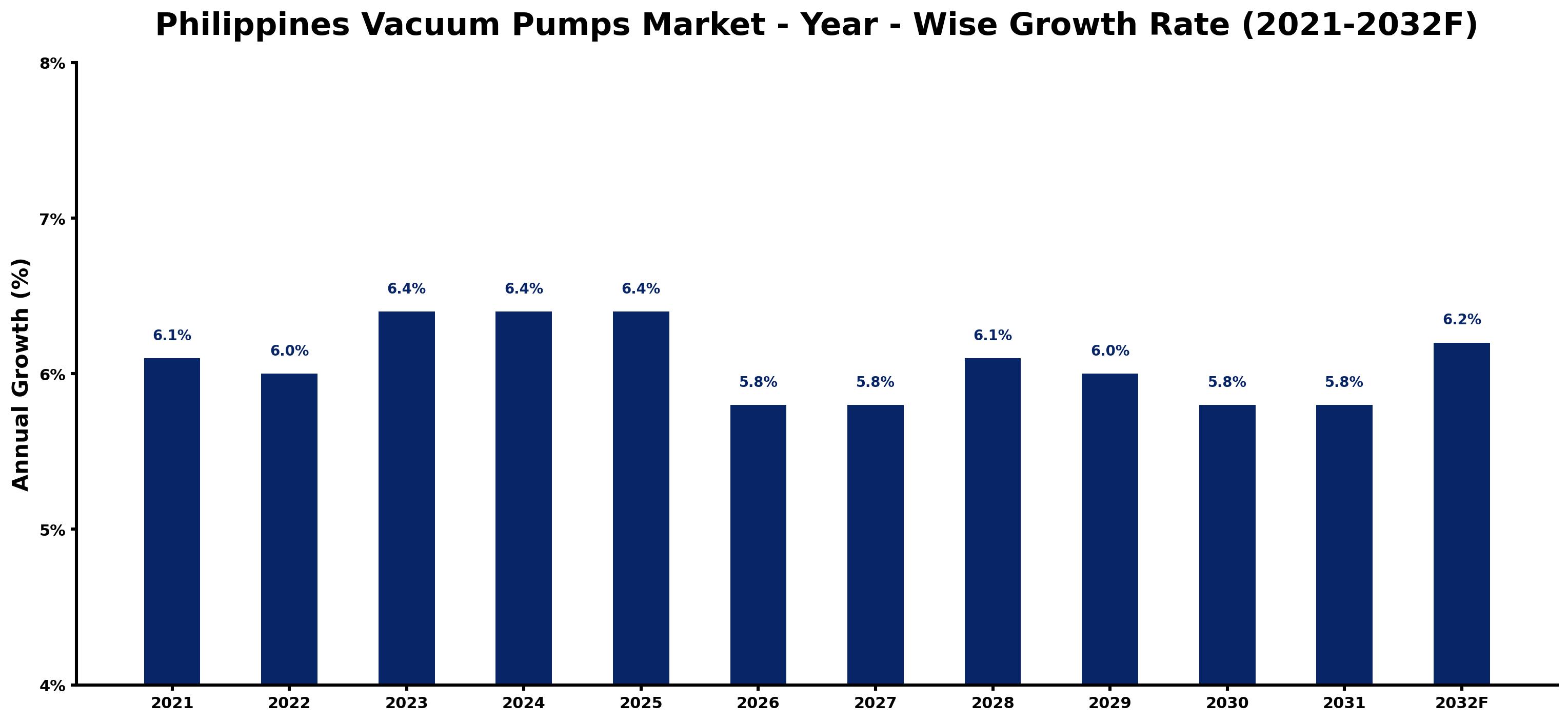
The table below presents the year wise growth rates along with the key drivers influencing the market
| Year | Growth Rate | Major Drivers |
| 2021 | 6.1% | Economic recovery post-pandemic spurred investments in manufacturing and infrastructure projects. |
| 2022 | 6.0% | Emerging sectors like pharmaceuticals increased the need for efficient vacuum solutions. |
| 2023 | 6.4% | Local production capabilities expanded, reducing reliance on imported vacuum pump technologies. |
| 2024 | 6.4% | Technological innovations in pump efficiency attracted interest from various industrial applications. |
| 2025 | 6.4% | Sustainability initiatives prompted industries to adopt more energy-efficient vacuum systems. |
| 2026 | 5.8% | A focus on quality control in manufacturing heightened the necessity for precise vacuum pumps. |
| 2027 | 5.8% | The expanding electronics sector demanded specialized vacuum solutions for semiconductor production. |
| 2028 | 6.1% | Logistical advancements improved supply chain resilience, facilitating quicker product availability. |
| 2029 | 6.0% | Investment in renewable energy projects led to a surge in vacuum pump applications. |
| 2030 | 5.8% | Collaborations between local firms and international manufacturers enhanced market competitiveness. |
| 2031 | 5.8% | Increased awareness of industrial automation drove demand for advanced vacuum technologies. |
| 2032 | 6.2% | Rising urbanization created a broader market for vacuum solutions across various industries. |
Note - Market size estimations and growth projections presented in this report are based on 6Wresearch's advanced forecasting approach, validated with industry datasets as of June 2026.
Philippines Vacuum Pumps Market Synopsis
The Philippines Vacuum Pumps Market is projected to reach 5.8% and witness significant growth during the forecast period (2026-2032). The market is expected to benefit from the acceleration of industrial development and substantial investments across both public and private sectors. This growth trajectory is driven by the increasing demand for energy-efficient solutions, such as converted energy systems, efficient motors drives, and advanced technologies like programmable logic controllers (PLCs).
Philippines Vacuum Pumps Market Growth Drivers
Key factors influencing the expansion of the Philippines vacuum pumps market include:
- Rapid industrialization is resulting in increased requirements for vacuum systems within various sectors, including manufacturing and chemical processing, thereby propelling demand.
- Investments in infrastructure improvements, particularly in rural areas, are fostering industrial growth and necessitating the use of vacuum pumps across multiple applications.
- Technological advancements are enhancing product durability and cost-effectiveness, allowing companies to adopt innovative vacuum solutions more readily.
- Environmental initiatives aimed at waste management are significantly driving the need for vacuum systems, especially in applications like incineration and flue gas scrubbing.
- Government incentives targeting capital equipment investments have created a conducive environment for the growth of vacuum pump applications across various industries.
Philippines Vacuum Pumps Market Trends and Opportunities
The market is witnessing several trends that are shaping its future landscape:
- There is a growing preference for rotary vane pumps due to their low operational costs and minimal maintenance needs, positioning them as a favored choice for many industries.
- Oil-sealed liquid ring vacuum pumps are gaining traction owing to their operational efficiency, making them suitable for a variety of demanding environments.
- Technological innovations related to filtration systems are enhancing the overall performance and reliability of vacuum pumps, thus driving adoption in high-stakes applications.
- Electric-driven, water-based units are becoming increasingly popular for their high performance and reduced noise levels, appealing to industries focused on sustainability.
- The shift towards dry screw type models reflects a significant trend within industries that prioritize clean processes, further expanding market opportunities.
Philippines Vacuum Pumps Market Challenges and Restraints
Despite its growth potential, the Philippines vacuum pumps market faces several challenges:
- The irregular availability of raw materials necessary for manufacturing vacuum pumps can impose constraints, affecting production timelines and pricing strategies.
- Fluctuating raw material costs can lead to unpredictable pricing, putting pressure on suppliers and affecting profitability across the sector.
- Intense competition, particularly from established manufacturers in countries such as China and Japan, presents an ongoing challenge for local producers to innovate and maintain market share.
- The necessity for constant technological advancements to stay competitive can strain resources, particularly for smaller firms with limited R&D budgets.
- The economic landscape's volatility may create uncertainties that affect investment levels and operational decisions within the vacuum pumps market.
Philippines Vacuum Pumps Market Government Investment and Initiatives
The Philippine government has actively promoted industrial growth through various investment initiatives that have a direct impact on the vacuum pumps market. Key initiatives include:
- Government support for infrastructure development has invigorated industrial sectors, leading to a higher demand for advanced vacuum systems.
- Programs aimed at enhancing the capabilities of small and medium enterprises (SMEs) include grants and advisory services that encourage the adoption of modern vacuum technology.
- Environmental regulations promoting sustainable practices are fostering growth in waste management sectors that rely on vacuum solutions for efficiency.
- Infrastructure projects financed by public spending create additional avenues for vacuum pump applications in construction and public utilities.
- Government incentives for energy-efficient technologies further encourage industries to invest in vacuum pumps that align with sustainability goals.
Philippines Vacuum Pumps Market Latest Developments (May 2025 - June 2026)
Recent developments in the Philippines vacuum pumps market reflect ongoing trends and shifts within the industry. Advancements in technology have led to the introduction of more efficient and compact vacuum systems, catering to the increasing demand from various sectors. Companies are also focusing on enhancing the durability of their products, addressing the need for lower maintenance options. Moreover, government policies aimed at supporting sustainable practices have resulted in increased attention towards eco-friendly vacuum solutions. The heightened interest in electric-driven units has also surged, with end-users recognizing their operational advantages including lower noise and emissions. Overall, these developments signify a robust trajectory for the vacuum pumps market in the Philippines.
Philippines Vacuum Pumps Market - Key Attractiveness of the Report
- 10 Years of Market Numbers
- Historical Data Starting from 2022 to 2025
- Base Year: 2025
- Forecast Data until 2032
- Key Performance Indicators Impacting the Market
- Major Upcoming Developments and Projects
Key Highlights of the Report:
- Philippines Vacuum Pumps Market Outlook
- Market Size of Philippines Vacuum Pumps Market, 2025
- Forecast of Philippines Vacuum Pumps Market, 2032
- Historical Data and Forecast of Philippines Vacuum Pumps Revenues & Volume for the Period 2022-2032F
- Philippines Vacuum Pumps Market Trend Evolution
- Philippines Vacuum Pumps Market Drivers and Challenges
- Philippines Vacuum Pumps Price Trends
- Philippines Vacuum Pumps Porter's Five Forces
- Philippines Vacuum Pumps Industry Life Cycle
- Historical Data and Forecast of Philippines Vacuum Pumps Market Revenues & Volume By Lubrication for the Period 2022-2032F
- Historical Data and Forecast of Philippines Vacuum Pumps Market Revenues & Volume By Dry for the Period 2022-2032F
- Historical Data and Forecast of Philippines Vacuum Pumps Market Revenues & Volume By Wet for the Period 2022-2032F
- Historical Data and Forecast of Philippines Vacuum Pumps Market Revenues & Volume By Technology for the Period 2022-2032F
- Historical Data and Forecast of Philippines Vacuum Pumps Market Revenues & Volume By Gas Capture/Binding Pumps for the Period 2022-2032F
- Historical Data and Forecast of Philippines Vacuum Pumps Market Revenues & Volume By Gas Transfer Pumps for the Period 2022-2032F
- Historical Data and Forecast of Philippines Vacuum Pumps Market Revenues & Volume By Product Type for the Period 2022-2032F
- Historical Data and Forecast of Philippines Vacuum Pumps Market Revenues & Volume By Low vacuum pumps for the Period 2022-2032F
- Historical Data and Forecast of Philippines Vacuum Pumps Market Revenues & Volume By Medium vacuum pumps for the Period 2022-2032F
- Historical Data and Forecast of Philippines Vacuum Pumps Market Revenues & Volume By High vacuum pumps for the Period 2022-2032F
- Historical Data and Forecast of Philippines Vacuum Pumps Market Revenues & Volume By End-Users for the Period 2022-2032F
- Historical Data and Forecast of Philippines Vacuum Pumps Market Revenues & Volume By Chemical & pharmaceutical for the Period 2022-2032F
- Historical Data and Forecast of Philippines Vacuum Pumps Market Revenues & Volume By Semiconductor & electronics for the Period 2022-2032F
- Historical Data and Forecast of Philippines Vacuum Pumps Market Revenues & Volume By Oil & gas for the Period 2022-2032F
- Historical Data and Forecast of Philippines Vacuum Pumps Market Revenues & Volume By Food & beverages for the Period 2022-2032F
- Historical Data and Forecast of Philippines Vacuum Pumps Market Revenues & Volume By Wood, paper & pulp for the Period 2022-2032F
- Historical Data and Forecast of Philippines Vacuum Pumps Market Revenues & Volume By Other for the Period 2022-2032F
- Philippines Vacuum Pumps Import Export Trade Statistics
- Market Opportunity Assessment By Lubrication
- Market Opportunity Assessment By Technology
- Market Opportunity Assessment By Product Type
- Market Opportunity Assessment By End-Users
- Philippines Vacuum Pumps Top Companies Market Share
- Philippines Vacuum Pumps Competitive Benchmarking By Technical and Operational Parameters
- Philippines Vacuum Pumps Company Profiles
- Philippines Vacuum Pumps Key Strategic Recommendations






































