Philippines Vegetable Seed Market Top 5 Importing Countries and Market Competition (HHI) Analysis
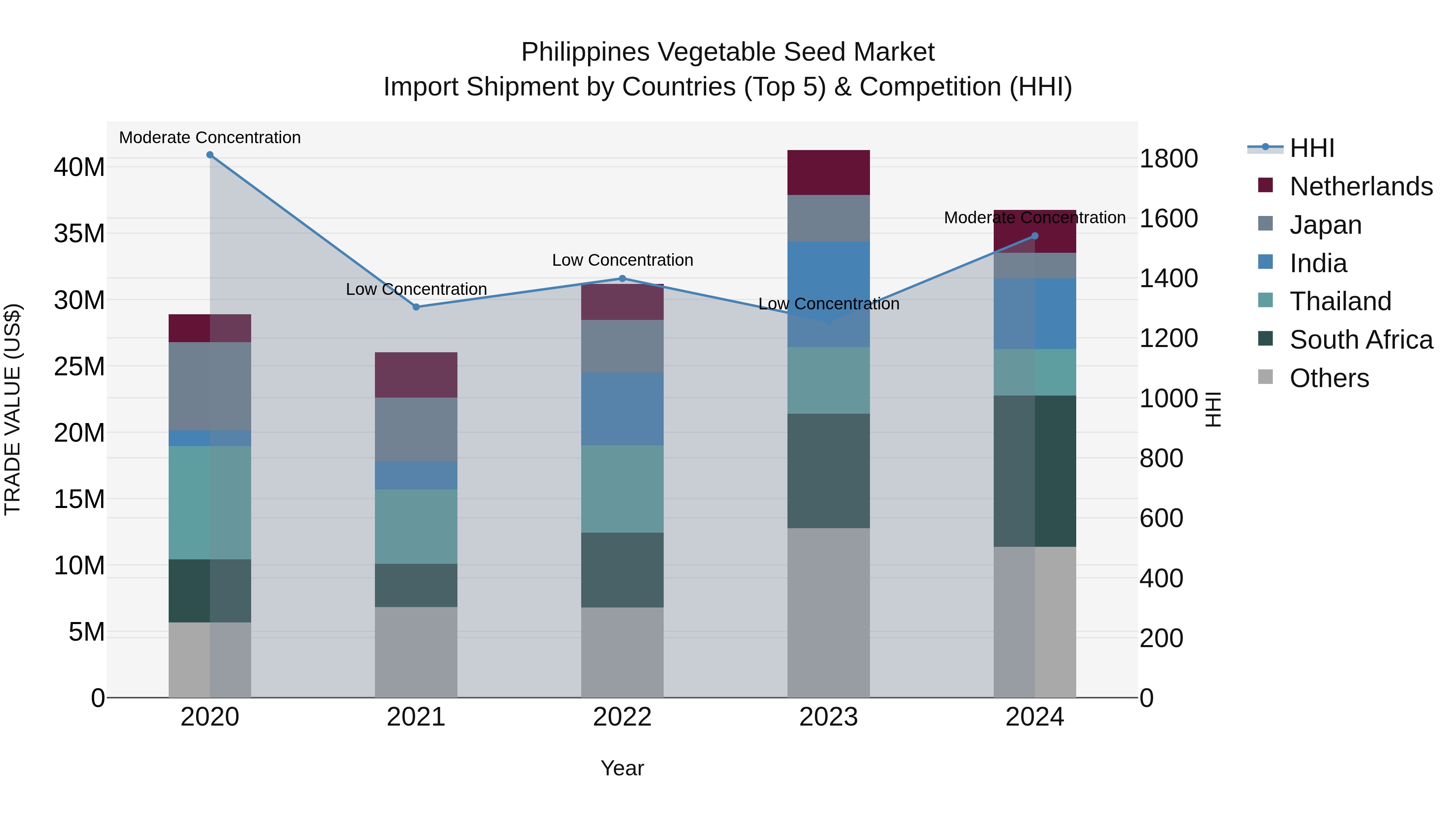
The Philippines vegetable seed import market saw a shift in concentration from low to moderate in 2024, with top exporters being South Africa, India, Thailand, Netherlands, and the USA. Despite a negative growth rate in 2024, the market has shown a healthy compound annual growth rate of 6.2% from 2020 to 2024. This indicates a steady demand for vegetable seeds in the Philippines, with diverse sourcing from different countries contributing to the market`s resilience and competitive dynamics.
Philippines Vegetable Seed Market Synopsis
The vegetable seed market in the Philippines is showing consistent growth fueled by rising demand for high-yield and disease-resistant seed varieties. Government support for agriculture, combined with the adoption of hybrid seeds and improved farming practices, has spurred demand across smallholder and commercial farms. Seed companies are focusing on localizing seed varieties suited for tropical climates.
Trends of the market
The vegetable seed market in the Philippines is growing, driven by increased demand for high-yield, disease-resistant, and climate-resilient crops. Both hybrid and genetically modified seeds are gaining traction among commercial farmers. Government programs promoting food security and modern agriculture techniques further support market expansion, though challenges include pricing and smallholder farmer access.
Challenges of the market
Challenges in the vegetable seed market include the dominance of imported seeds, which are often expensive and not always optimized for local climates. Smallholder farmers struggle with affordability and awareness of hybrid or genetically improved seed varieties. Theres also a lack of strong extension services to promote the use of high-quality seeds, while the domestic R&D capability remains limited compared to neighboring agricultural economies.
Investment opportunities in the Market
The vegetable seed market in the Philippines presents significant investment opportunities due to the country`s expanding horticulture sector, rising demand for hybrid and high-yield seed varieties, and government support for agribusiness. Investors can consider seed production partnerships, setting up localized R&D and breeding programs, and establishing distribution networks to reach smallholder farmers. Collaborations with agricultural cooperatives and access to export channels in ASEAN add further potential.
Government Policy of the market
The Bureau of Plant Industry (BPI), under the Department of Agriculture (DA), regulates the importation, certification, and distribution of vegetable seeds in the Philippines. The government actively promotes hybrid and high-yield seed varieties under the Plant Variety Protection Act and through the National Seed Industry Council (NSIC). Local and foreign seed developers can register and receive support for trials and distribution, especially for climate-resilient crops. Subsidized seed distribution is part of government food security programs, particularly for smallholder farmers.
Key Highlights of the Report:
- Philippines Vegetable Seed Market Outlook
- Market Size of Philippines Vegetable Seed Market, 2024
- Forecast of Philippines Vegetable Seed Market, 2031
- Historical Data and Forecast of Philippines Vegetable Seed Revenues & Volume for the Period 2021- 2031
- Philippines Vegetable Seed Market Trend Evolution
- Philippines Vegetable Seed Market Drivers and Challenges
- Philippines Vegetable Seed Price Trends
- Philippines Vegetable Seed Porter's Five Forces
- Philippines Vegetable Seed Industry Life Cycle
- Historical Data and Forecast of Philippines Vegetable Seed Market Revenues & Volume By Type for the Period 2021- 2031
- Historical Data and Forecast of Philippines Vegetable Seed Market Revenues & Volume By Solanaceae for the Period 2021- 2031
- Historical Data and Forecast of Philippines Vegetable Seed Market Revenues & Volume By Cucurbit for the Period 2021- 2031
- Historical Data and Forecast of Philippines Vegetable Seed Market Revenues & Volume By Root&bulb for the Period 2021- 2031
- Historical Data and Forecast of Philippines Vegetable Seed Market Revenues & Volume By Brassica for the Period 2021- 2031
- Historical Data and Forecast of Philippines Vegetable Seed Market Revenues & Volume By Leafy for the Period 2021- 2031
- Historical Data and Forecast of Philippines Vegetable Seed Market Revenues & Volume By Others for the Period 2021- 2031
- Historical Data and Forecast of Philippines Vegetable Seed Market Revenues & Volume By Application for the Period 2021- 2031
- Historical Data and Forecast of Philippines Vegetable Seed Market Revenues & Volume By Farmland for the Period 2021- 2031
- Historical Data and Forecast of Philippines Vegetable Seed Market Revenues & Volume By Greenhouse for the Period 2021- 2031
- Philippines Vegetable Seed Import Export Trade Statistics
- Market Opportunity Assessment By Type
- Market Opportunity Assessment By Application
- Philippines Vegetable Seed Top Companies Market Share
- Philippines Vegetable Seed Competitive Benchmarking By Technical and Operational Parameters
- Philippines Vegetable Seed Company Profiles
- Philippines Vegetable Seed Key Strategic Recommendations






































