Philippines Virtual Private Server Market Size & Growth Rate (2026-2032)
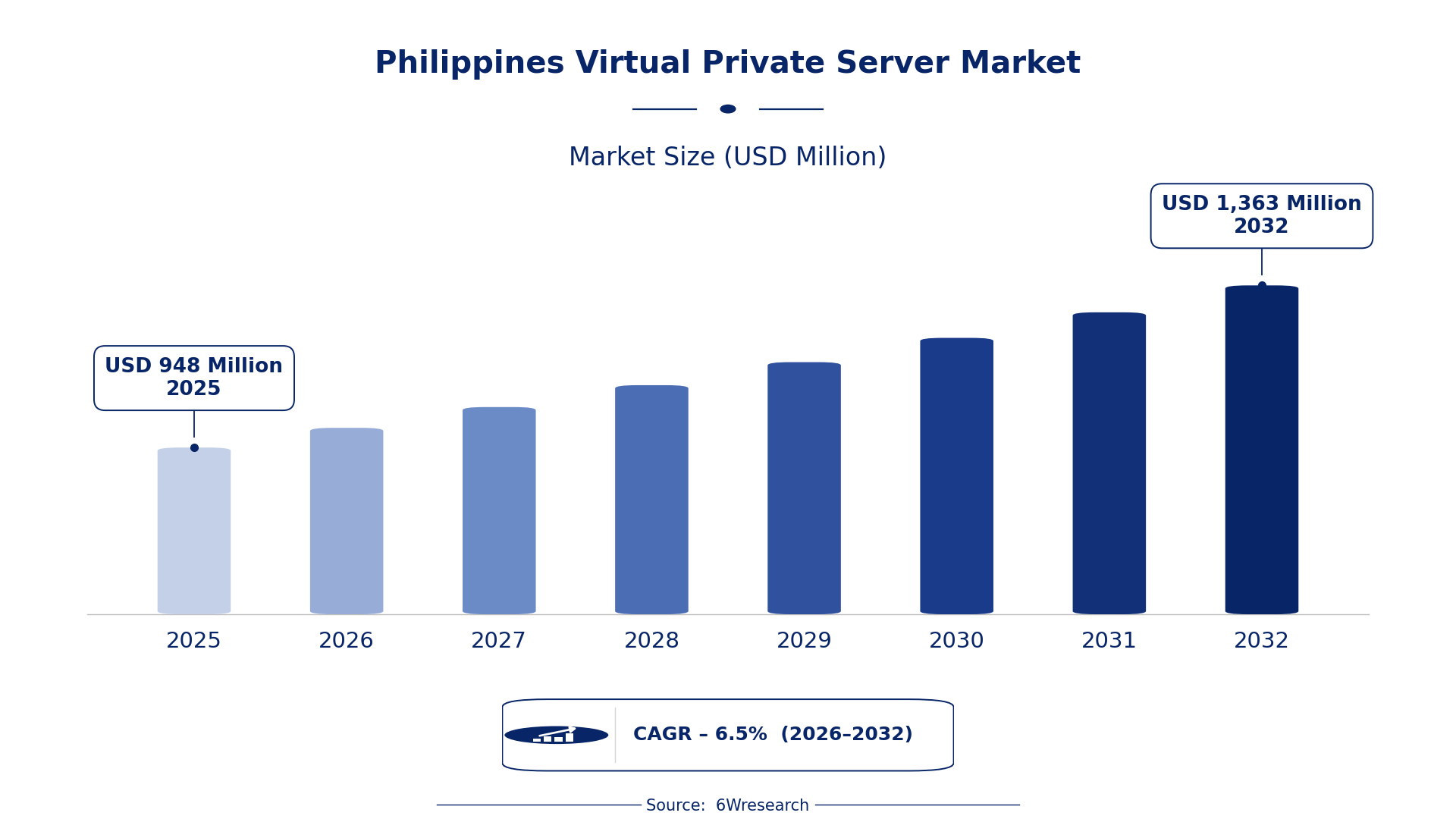
The Philippines Virtual Private Server Market was estimated at USD 948 Million in 2025 and is projected to reach USD 1363 Million by 2032, growing at a CAGR of 6.5% from 2026 to 2032.
Philippines Virtual Private Server Market Synopsis
The Philippines Virtual Private Server market has experienced a notable shift, driven largely by the increasing demand for reliable and scalable hosting solutions among businesses. As companies seek greater control over their online operations, VPS has emerged as a preferred option, offering a blend of performance and affordability.
Looking ahead, the market is set to further expand as cloud adoption accelerates. The ongoing shift towards digitalization across various sectors is creating an environment ripe for VPS providers to thrive, particularly as businesses prioritize security and dedicated resources.
Philippines Virtual Private Server Market Year-wise Growth Rate and Key Drivers
This graph illustrates the annual growth rates of the Philippines Virtual Private Server Market from 2021 to 2032, highlighting a steady upward trajectory and projected expansion over the forecast period.
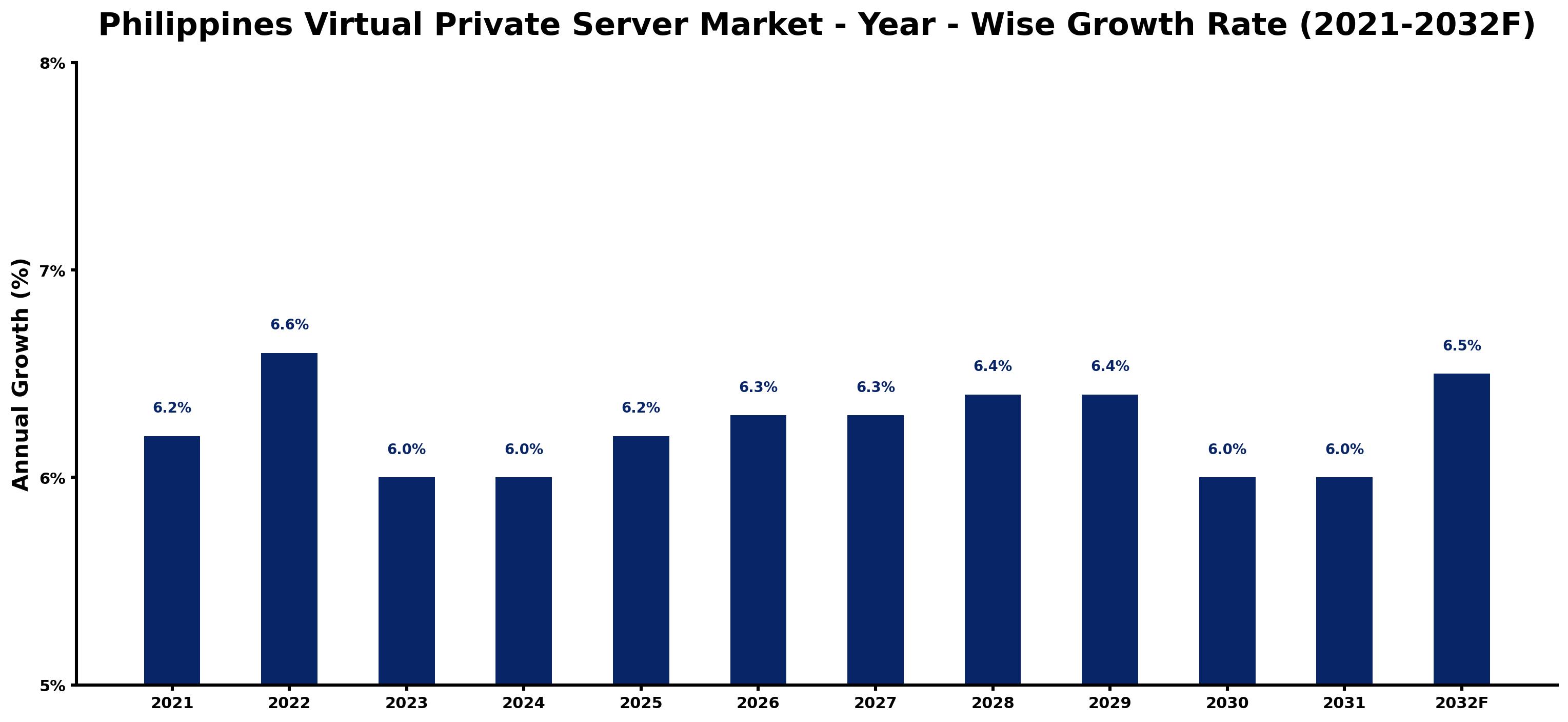
The table below presents the year‑wise growth rates along with the key drivers influencing the market
| Year | Growth Rate | Major Drivers |
| 2021 | 6.2% | Rising online gaming popularity drives server demand. |
| 2022 | 6.6% | Local businesses adopting hybrid cloud solutions. |
| 2023 | 6.0% | Strengthening cybersecurity laws enhance data protection needs. |
| 2024 | 6.0% | Government incentives for tech startups boost VPS adoption. |
| 2025 | 6.2% | Surge in remote work drives cloud infrastructure investments. |
| 2026 | 6.3% | Increased regional data privacy regulations encourage local hosting. |
| 2027 | 6.3% | Local universities promoting IT education stimulates market growth. |
| 2028 | 6.4% | Rapid tech infrastructure upgrades support VPS market expansion. |
| 2029 | 6.4% | Emerging fintech companies require secure hosting solutions. |
| 2030 | 6.0% | Growing digital content creation boosts server usage. |
| 2031 | 6.0% | Enhanced 5G rollout improves cloud service accessibility. |
| 2032 | 6.5% | Increased foreign investments in tech sectors accelerate growth. |
Note: Market size estimations and growth projections presented in this report are based on 6Wresearch's proprietary forecasting methodology, utilizing the latest available industry data, government publications, and primary research inputs.
Philippines Virtual Private Server Market Key Takeaways
Below are some of the specific key takeaways from the market, including:
- Increased demand for cost-effective hosting solutions is driving the growth of VPS.
- The shift towards remote work has accelerated the adoption of VPS in various sectors.
- Competitive pressure from shared hosting solutions remains a challenge for VPS providers.
- Regulatory support is expected to enhance infrastructure development and market growth.
- Cloud adoption trends indicate a favorable outlook for VPS providers in the coming years.
Evaluation of Restraints in Philippines Virtual Private Server Market
While the Philippines Virtual Private Server market is on an upward trajectory, several factors are limiting its potential. The fierce competition from shared hosting solutions presents a significant hurdle, particularly for small businesses that may find VPS options less budget-friendly. Additionally, varying levels of digital literacy and awareness among potential users can impede broader adoption. These challenges necessitate focused strategies from VPS providers to educate the market and demonstrate the value of dedicated server resources.
Philippines Virtual Private Server Market Trends
A key trend shaping the Philippines Virtual Private Server market is the increasing emphasis on data security and privacy. As cyber threats become more sophisticated, businesses are prioritizing secure hosting solutions, making VPS an attractive option. on top of that, the integration of advanced technologies such as artificial intelligence and machine learning into VPS offerings is enhancing service capabilities, allowing for better resource management and performance optimization.
Philippines Virtual Private Server Market Opportunities
The market presents various growth and investment opportunities, particularly in sectors such as e-commerce and digital services. As more businesses move online, the demand for VPS solutions that can scale with their needs will likely increase. Additionally, strategic partnerships between VPS providers and telecom companies could enhance infrastructure access and attract a broader customer base, creating a more favorable environment for growth.
Government Initiatives in the Philippines Virtual Private Server Market
The Philippine government is actively fostering an environment conducive to the growth of the Virtual Private Server market. Public policy is increasingly focused on enhancing digital infrastructure and supporting cloud computing initiatives. This regulatory posture is vital as it encourages investment and innovation in the sector, making VPS solutions more accessible to businesses of all sizes.
- A national digital infrastructure upgrade program recently completed aims to enhance connectivity and reduce latency for VPS providers.
- A current initiative focuses on promoting cybersecurity standards across all digital platforms, benefiting VPS users by ensuring safer online operations.
- The government is working on a planned public-private partnership expected to roll out enhanced cloud services by 2028.
- A regulatory framework introduced in 2025 mandates billing transparency for VPS services, ensuring fair pricing for customers.
- Ongoing training programs aimed at improving digital skills among the workforce are set to boost awareness and adoption of VPS solutions.
Future Insights of the Philippines Virtual Private Server Market
Looking ahead to 2026-2032, the Philippines Virtual Private Server market is expected to witness substantial growth driven by the continued digital transformation across industries. As businesses increasingly recognize the value of dedicated resources and enhanced security, demand for VPS solutions will likely surge. Additionally, ongoing government initiatives aimed at improving digital infrastructure will further facilitate this growth, making VPS an integral part of the country's cloud computing strategy.
Philippines Virtual Private Server Market Latest Developments
In recent months, the Philippines Virtual Private Server market has been active with various developments that signal a forward momentum. Providers are ramping up their offerings to cater to the growing demand for secure and efficient hosting solutions, while businesses are increasingly adopting VPS for their operational needs.
- A major technology vendor launched an upgraded VPS platform in early 2025, enhancing performance and security features.
- Currently underway is a partnership between leading hosting companies and telecom operators aimed at improving service delivery and expanding market reach.
- A VPS service expansion initiative is expected to begin in the second half of 2026, targeting underserved regions of the country.
- A recent upgrade to infrastructure is enhancing data center capabilities, completed by mid-2025, to better support increasing demands.
- An upcoming service enhancement expected in early 2026 will introduce AI-driven management tools for VPS users.
Philippines Virtual Private Server Market - Key Attractiveness of the Report
- 10 Years of Market Numbers
- Historical Data Starting from 2022 to 2025
- Base Year: 2025
- Forecast Data until 2032
- Key Performance Indicators Impacting the Market
- Major Upcoming Developments and Projects
Key Highlights of the Report:
- Philippines Virtual Private Server Market Outlook
- Market Size of Philippines Virtual Private Server Market, 2025
- Forecast of Philippines Virtual Private Server Market, 2032
- Historical Data and Forecast of Philippines Virtual Private Server Revenues & Volume for the Period 2022-2032F
- Philippines Virtual Private Server Market Trend Evolution
- Philippines Virtual Private Server Market Drivers and Challenges
- Philippines Virtual Private Server Price Trends
- Philippines Virtual Private Server Porter's Five Forces
- Philippines Virtual Private Server Industry Life Cycle
- Historical Data and Forecast of Philippines Virtual Private Server Market Revenues & Volume By Operating System for the Period 2022-2032F
- Historical Data and Forecast of Philippines Virtual Private Server Market Revenues & Volume By Windows for the Period 2022-2032F
- Historical Data and Forecast of Philippines Virtual Private Server Market Revenues & Volume By Linux for the Period 2022-2032F
- Historical Data and Forecast of Philippines Virtual Private Server Market Revenues & Volume By Vertical for the Period 2022-2032F
- Historical Data and Forecast of Philippines Virtual Private Server Market Revenues & Volume By BFSI for the Period 2022-2032F
- Historical Data and Forecast of Philippines Virtual Private Server Market Revenues & Volume By Government for the Period 2022-2032F
- Historical Data and Forecast of Philippines Virtual Private Server Market Revenues & Volume By Defense for the Period 2022-2032F
- Historical Data and Forecast of Philippines Virtual Private Server Market Revenues & Volume By IT for the Period 2022-2032F
- Historical Data and Forecast of Philippines Virtual Private Server Market Revenues & Volume By Telecommunication for the Period 2022-2032F
- Historical Data and Forecast of Philippines Virtual Private Server Market Revenues & Volume By Retail for the Period 2022-2032F
- Historical Data and Forecast of Philippines Virtual Private Server Market Revenues & Volume By Healthcare for the Period 2022-2032F
- Historical Data and Forecast of Philippines Virtual Private Server Market Revenues & Volume By Organization Size for the Period 2022-2032F
- Historical Data and Forecast of Philippines Virtual Private Server Market Revenues & Volume By SMEs for the Period 2022-2032F
- Historical Data and Forecast of Philippines Virtual Private Server Market Revenues & Volume By Large Enterprises for the Period 2022-2032F
- Philippines Virtual Private Server Import Export Trade Statistics
- Market Opportunity Assessment By Operating System
- Market Opportunity Assessment By Vertical
- Market Opportunity Assessment By Organization Size
- Philippines Virtual Private Server Top Companies Market Share
- Philippines Virtual Private Server Competitive Benchmarking By Technical and Operational Parameters
- Philippines Virtual Private Server Company Profiles
- Philippines Virtual Private Server Key Strategic Recommendations






































