Philippines Vision Screeners Market Size, Share & Growth Rate
The Philippines Vision Screeners Market was estimated at USD 428 Million in 2025 and is projected to reach USD 591 Million by 2032, growing at a CAGR of 4.7% from 2026 to 2032. This upward trajectory is primarily fueled by a growing awareness of eye health and the critical role of early detection in preventing vision impairment. The increased implementation of vision screening programs, particularly within educational settings, further amplifies demand for effective and accurate screening solutions.
Philippines Vision Screeners Market Year-wise Growth Rate and Key Drivers
This graph highlights how the Philippines Vision Screeners Market has steadily grown over the years, supported by major growth factors.
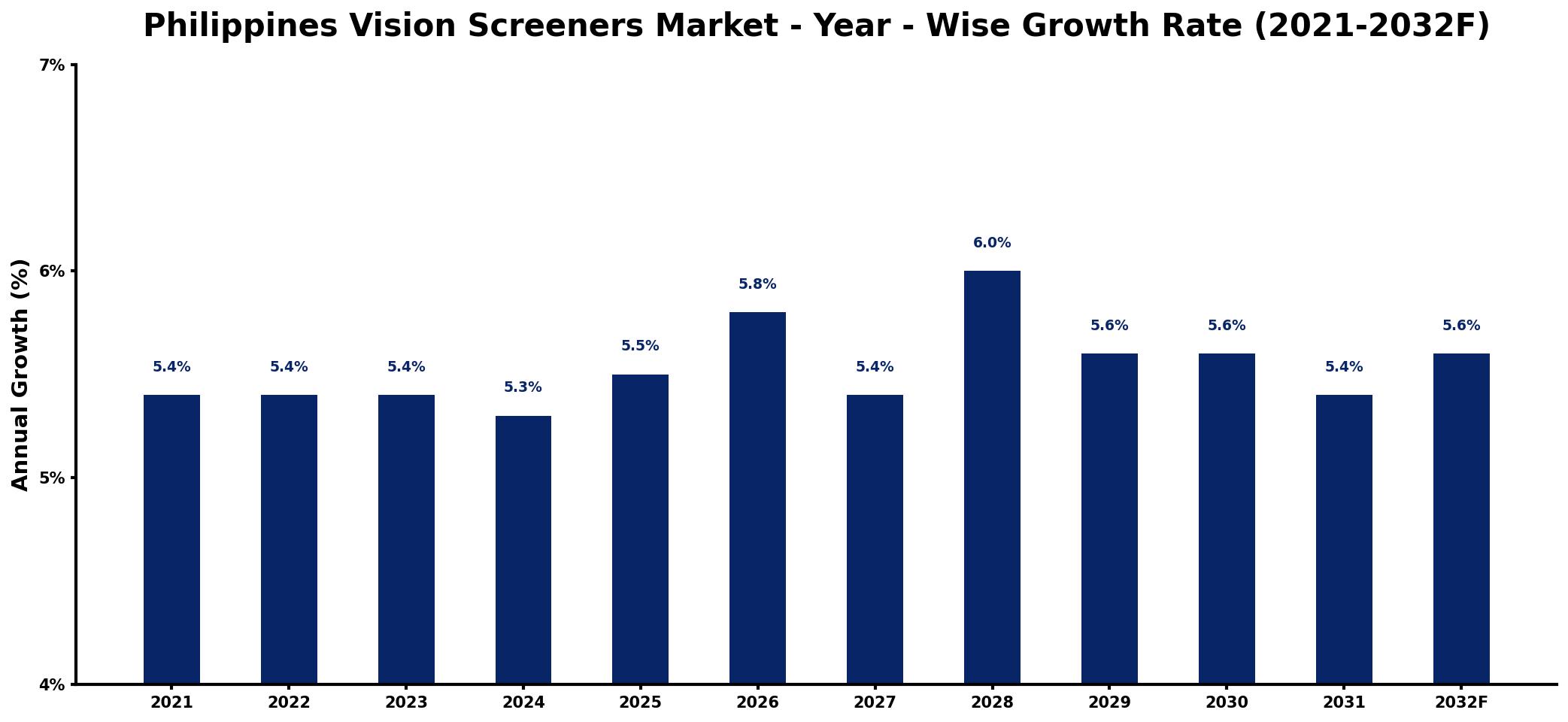
The table below presents the year‑wise growth rates along with the key drivers influencing the market
| Year | Growth Rate | Major Drivers |
| 2021 | 5.4% | Rising demand for healthcare services |
| 2022 | 5.4% | Increased government health initiatives |
| 2023 | 5.4% | Growing awareness of eye health |
| 2024 | 5.3% | Expansion of optical retail sector |
| 2025 | 5.5% | Investment in healthcare technologies |
| 2026 | 5.8% | Surge in preventive health measures |
| 2027 | 5.4% | Enhanced distribution networks established |
| 2028 | 6.0% | Growth in telehealth services adoption |
| 2029 | 5.6% | Emerging markets in rural areas |
| 2030 | 5.6% | Increased public health funding |
| 2031 | 5.4% | Collaboration with educational institutions |
| 2032 | 5.6% | Technological advancements in diagnostics |
Note: Market size estimations and growth projections presented in this report are based on 6Wresearch's proprietary forecasting methodology, utilizing the latest available industry data, government publications, and primary research inputs.
Philippines Vision Screeners Market Synopsis
The pivotal force shaping the Philippines Vision Screeners Market is the rising prevalence of eye disorders among various demographics, especially children. As concerns around eye health rise, stakeholders are more committed to ensuring that reliable and efficient vision screening tools are readily available in schools and healthcare facilities.
Another significant factor is the growing public consciousness regarding healthcare issues, which has led to the implementation of community programs aimed at increasing access to vision screening. This societal shift not only supports better eye health but also promotes broader public health initiatives.
Philippines Vision Screeners Market Key Takeaways
- Vision screening is increasingly prioritized in schools, enhancing early detection of eye disorders among children.
- The market is witnessing robust growth driven by heightened healthcare awareness and early detection initiatives.
- Challenges related to the accuracy and accessibility of vision screeners persist, demanding innovative solutions.
- Government programs and initiatives are playing a critical role in expanding the reach of vision screening services.
- The impact of the COVID-19 pandemic has temporarily hindered demand but is gradually recovering with renewed healthcare focus.
Evaluation of Restraints in Philippines Vision Screeners Market
Despite its growth, the Philippines Vision Screeners Market faces notable restraints. Accuracy remains a significant concern as existing screeners may not uniformly detect all vision issues, leading to potential misdiagnosis. Additionally, accessibility poses challenges; many rural areas lack the necessary healthcare infrastructure to facilitate widespread screening. Bridging this gap requires focused efforts from both public and private sectors to invest in mobile screening solutions and comprehensive training for healthcare providers.
Philippines Vision Screeners Market Trends
Current trends influencing the Philippines Vision Screeners Market include the integration of technology, such as telemedicine, which enhances the capabilities of vision screening. Mobile applications and portable screening devices are gaining traction, making it easier to reach underserved populations. Furthermore, increasing collaboration among educational institutions and healthcare providers is fostering a holistic approach to eye health, emphasizing continuous monitoring and proactive management.
Philippines Vision Screeners Market Opportunities
There are substantial growth opportunities within the Philippines Vision Screeners Market, particularly in the development of affordable, portable screening devices that can be deployed in remote areas. Enhanced partnerships between government entities and private healthcare providers can lead to more robust vision screening programs. Investment in public health campaigns that emphasize the importance of regular eye check-ups will likely drive demand further. In addition, advances in technology, including artificial intelligence, promise to improve the accuracy and efficiency of screening processes.
Government Initiatives in the Philippines Vision Screeners Market
The Philippine government has implemented various initiatives aimed at improving public health, particularly in vision care. Policies promoting regular eye examinations, particularly in school-age children, are crucial for early diagnosis and intervention. Community health programs funded by public spending seek to increase access to vision screening, ensuring that these critical services are available even in underserved regions. These efforts underline a commitment to enhancing overall public health outcomes through preventative care.
Future Insights of the Philippines Vision Screeners Market
Looking ahead to 2026-2032, the Philippines Vision Screeners Market is poised for progressive growth as awareness and demand for eye health continue to rise. Innovations in screening technology and methods will likely lead to improvements in both detection rates and patient experiences. Furthermore, an increased focus on preventive healthcare will encourage more stakeholders to participate in and invest in vision screening programs. This evolving landscape suggests a vibrant future for the market, underpinned by sustained public and private efforts.
Philippines Vision Screeners Market Latest Developments (2025 - 2026)
Recent developments in the Philippines Vision Screeners Market have seen a surge in the adoption of digital screening solutions that facilitate remote assessments. Additionally, several public-private partnerships have emerged, aiming to expand the reach of vision screening initiatives across urban and rural areas. Focus on community outreach programs has intensified, reflecting the increasing importance placed on eye health within public health discourse. The market is navigating a recovery phase as it rebounds from disruptions caused by the pandemic.
Philippines Vision Screeners Market - Key Attractiveness of the Report
- 10 Years of Market Numbers
- Historical Data Starting from 2022 to 2025
- Base Year: 2025
- Forecast Data until 2032
- Key Performance Indicators Impacting the Market
- Major Upcoming Developments and Projects
Key Highlights of the Report:
- Philippines Vision Screeners Market Outlook
- Market Size of Philippines Vision Screeners Market, 2025
- Forecast of Philippines Vision Screeners Market, 2032
- Historical Data and Forecast of Philippines Vision Screeners Revenues & Volume for the Period 2022-2032F
- Philippines Vision Screeners Market Trend Evolution
- Philippines Vision Screeners Market Drivers and Challenges
- Philippines Vision Screeners Price Trends
- Philippines Vision Screeners Porter's Five Forces
- Philippines Vision Screeners Industry Life Cycle
- Historical Data and Forecast of Philippines Vision Screeners Market Revenues & Volume By Product for the Period 2022-2032F
- Historical Data and Forecast of Philippines Vision Screeners Market Revenues & Volume By Table-Top Vision Screeners for the Period 2022-2032F
- Historical Data and Forecast of Philippines Vision Screeners Market Revenues & Volume By Portable/Handheld Vision Screeners for the Period 2022-2032F
- Historical Data and Forecast of Philippines Vision Screeners Market Revenues & Volume By Vision Screening Software for the Period 2022-2032F
- Historical Data and Forecast of Philippines Vision Screeners Market Revenues & Volume By Technology for the Period 2022-2032F
- Historical Data and Forecast of Philippines Vision Screeners Market Revenues & Volume By Digital Vision Screeners for the Period 2022-2032F
- Historical Data and Forecast of Philippines Vision Screeners Market Revenues & Volume By Computer-Based Vision Screeners for the Period 2022-2032F
- Historical Data and Forecast of Philippines Vision Screeners Market Revenues & Volume By Application for the Period 2022-2032F
- Historical Data and Forecast of Philippines Vision Screeners Market Revenues & Volume By Vision Screening Tests for the Period 2022-2032F
- Historical Data and Forecast of Philippines Vision Screeners Market Revenues & Volume By Color Vision Test for the Period 2022-2032F
- Historical Data and Forecast of Philippines Vision Screeners Market Revenues & Volume By Binocular Testing for the Period 2022-2032F
- Historical Data and Forecast of Philippines Vision Screeners Market Revenues & Volume By Others for the Period 2022-2032F
- Historical Data and Forecast of Philippines Vision Screeners Market Revenues & Volume By End Users for the Period 2022-2032F
- Historical Data and Forecast of Philippines Vision Screeners Market Revenues & Volume By Hospitals for the Period 2022-2032F
- Historical Data and Forecast of Philippines Vision Screeners Market Revenues & Volume By Homecare Settings for the Period 2022-2032F
- Historical Data and Forecast of Philippines Vision Screeners Market Revenues & Volume By Specialized Clinics for the Period 2022-2032F
- Historical Data and Forecast of Philippines Vision Screeners Market Revenues & Volume By Rehabilitation Centers for the Period 2022-2032F
- Historical Data and Forecast of Philippines Vision Screeners Market Revenues & Volume By Ambulatory Surgical Centers for the Period 2022-2032F
- Philippines Vision Screeners Import Export Trade Statistics
- Market Opportunity Assessment By Product
- Market Opportunity Assessment By Technology
- Market Opportunity Assessment By Application
- Market Opportunity Assessment By End Users
- Philippines Vision Screeners Top Companies Market Share
- Philippines Vision Screeners Competitive Benchmarking By Technical and Operational Parameters
- Philippines Vision Screeners Company Profiles
- Philippines Vision Screeners Key Strategic Recommendations






































