Philippines Washing Machine Market Size, Share & Growth Rate
The Philippines Washing Machine Market was estimated at USD 163 Million in 2025 and is projected to reach USD 214 Million by 2032, growing at a CAGR of 4.0% from 2026 to 2032. This growth trajectory is primarily driven by urbanization trends, as more households transition to modern living standards. Additionally, the rising disposable incomes and changing lifestyles among Filipinos are fostering a demand for efficient laundry solutions, positioning washing machines as essential home appliances.
Philippines Washing Machine Market Year-wise Growth Rate and Key Drivers
This graph highlights how the Philippines Washing Machine Market has steadily grown over the years, supported by major growth factors.
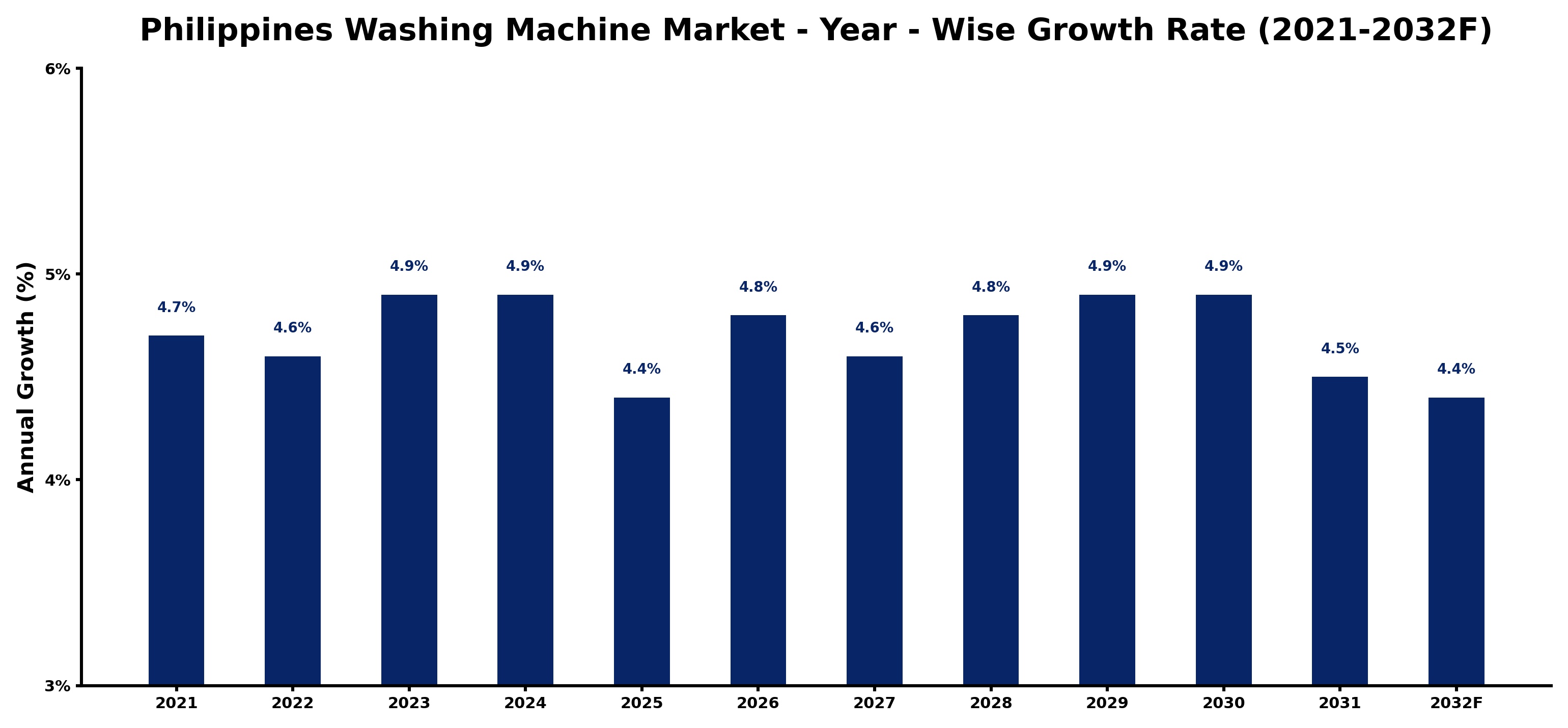
The table below presents the year‑wise growth rates along with the key drivers influencing the market
| Year | Growth Rate | Major Drivers |
| 2021 | 4.7% | Localized assembly operations boosted washing machine production efficiency |
| 2022 | 4.6% | Local manufacturers invest in advanced automation for higher efficiency |
| 2023 | 4.9% | Manufacturing investment growth boosts local washing machine production capacity |
| 2024 | 4.9% | New washing machine plants enhance local assembly line efficiency |
| 2025 | 4.4% | Domestic appliance manufacturers adopted smart technology for competitive differentiation |
| 2026 | 4.8% | Local manufacturers boost washing machine output through facility upgrades |
| 2027 | 4.6% | Smart washing machine integration boosted local component manufacturing demands |
| 2028 | 4.8% | Export demand for locally produced washing machines drives manufacturing investments |
| 2029 | 4.9% | Domestic manufacturing investments boost washing machine assembly capacity expansion |
| 2030 | 4.9% | Local assembly plants boost domestic washing machine manufacturing capacity |
| 2031 | 4.5% | Local manufacturers optimize production lines for enhanced washing machine output |
| 2032 | 4.4% | Local manufacturers invest in automated washing machine production lines |
Note - Market size estimations and growth projections presented in this report are based on 6Wresearch’s advanced forecasting approach, validated with industry datasets as of June 2026.
Philippines Washing Machine Market Synopsis
The washing machine market in the Philippines experienced a significant upswing, with shipments hitting 5.84 million units by 2025, representing a 4.5% increase since 2018. This surge highlights the growing preference for automated laundry solutions, which save time and enhance convenience in households.
Local brands currently dominate the market, holding a substantial 70% share, which underscores the strong consumer loyalty towards homegrown products. Meanwhile, foreign brands, accounting for the remaining 30%, are also gaining traction, particularly among urban consumers seeking premium and innovative washing solutions.
Philippines Washing Machine Market Key Takeaways
- The market is witnessing increasing demand for energy-efficient and water-conserving washing machines.
- Urbanization and rising household incomes are key drivers of market growth.
- Local brands maintain a strong market presence, appealing to consumer loyalty.
- The impact of COVID-19 has heightened awareness of hygiene, further boosting washing machine demand.
- Technological advancements are leading to more smart features in washing machines, aligning with consumer preferences.
Evaluation of Restraints in Philippines Washing Machine Market
Despite the market's optimistic growth outlook, several restraints are affecting its progress. The challenge of enhancing energy efficiency while maintaining cleaning performance poses a significant hurdle for manufacturers. Additionally, the need to develop washing machines that incorporate advanced technology while remaining affordable for a broad consumer base adds complexity to the market dynamics. Moreover, as consumers increasingly seek sustainable products, companies must invest in innovation to meet these evolving preferences, ensuring longevity and durability in diverse usage scenarios.
Philippines Washing Machine Market Trends
A notable trend in the Philippines washing machine market is the growing consumer inclination towards smart appliances. As technology advances, more consumers are looking for features such as Wi-Fi connectivity, app integration, and energy monitoring, which enhance the user experience. Additionally, sustainability is becoming paramount; manufacturers are responding with eco-friendly washing machines that minimize water and energy consumption. These trends indicate a robust shift towards not only convenience but also conscientious consumption.
Philippines Washing Machine Market Opportunities
The Philippines washing machine market presents significant growth opportunities, particularly for companies willing to innovate and adapt to consumer demands. The rising urban population offers a fertile ground for new entrants and existing players to introduce cutting-edge models that cater to evolving laundry needs. Additionally, expanding e-commerce platforms provide a channel for brands to reach a broader audience, allowing for increased market penetration and sales potential. Sustainable technology, including energy-efficient models and eco-friendly materials, also represents a promising avenue for investment.
Government Initiatives in the Philippines Washing Machine Market
The Philippine government is actively promoting energy efficiency and water conservation through various policies and initiatives. Incentives for manufacturers to produce energy-efficient appliances are part of broader environmental sustainability efforts. Programs aimed at raising awareness about the benefits of modern household appliances, including washing machines, are also being implemented to encourage consumer adoption, further bolstering the market.
Future Insights of the Philippines Washing Machine Market
Looking ahead to the period from 2026 to 2032, the Philippines washing machine market is poised for sustained growth. As urbanization continues to accelerate, more Filipinos will prioritize household efficiency, further driving demand. The increasing focus on smart technology integration suggests a shift towards interconnected home appliances, enhancing consumer convenience. Additionally, as environmental awareness rises, brands that prioritize sustainability in their product offerings are likely to gain a competitive edge in this evolving landscape.
Philippines Washing Machine Market Latest Developments (May 2025 - June 2026)
Recent developments in the Philippines washing machine market indicate a focus on introducing energy-efficient models equipped with smart features. Manufacturers are increasingly collaborating with tech companies to enhance product offerings, responding to consumer demands for connectivity and ease of use. Moreover, post-pandemic recovery has led to a renewed emphasis on hygiene, with many brands promoting features that improve cleanliness in laundry processes. The market is also witnessing heightened investment in local production capabilities to better serve consumer needs.
Philippines Washing Machine Market - Key Attractiveness of the Report
- 10 Years of Market Numbers
- Historical Data Starting from 2022 to 2025
- Base Year: 2025
- Forecast Data until 2032
- Key Performance Indicators Impacting the Market
- Major Upcoming Developments and Projects
Key Highlights of the Report:
- Philippines Washing Machine Market Outlook
- Market Size of Philippines Washing Machine Market, 2025
- Forecast of Philippines Washing Machine Market, 2032
- Historical Data and Forecast of Philippines Washing Machine Revenues & Volume for the Period 2022-2032F
- Philippines Washing Machine Market Trend Evolution
- Philippines Washing Machine Market Drivers and Challenges
- Philippines Washing Machine Price Trends
- Philippines Washing Machine Porter's Five Forces
- Philippines Washing Machine Industry Life Cycle
- Historical Data and Forecast of Philippines Washing Machine Market Revenues & Volume By Product for the Period 2022-2032F
- Historical Data and Forecast of Philippines Washing Machine Market Revenues & Volume By Fully automatic for the Period 2022-2032F
- Historical Data and Forecast of Philippines Washing Machine Market Revenues & Volume By Semi-automatic for the Period 2022-2032F
- Historical Data and Forecast of Philippines Washing Machine Market Revenues & Volume By Dryers for the Period 2022-2032F
- Historical Data and Forecast of Philippines Washing Machine Market Revenues & Volume By Technology for the Period 2022-2032F
- Historical Data and Forecast of Philippines Washing Machine Market Revenues & Volume By Smart connected washing machine for the Period 2022-2032F
- Historical Data and Forecast of Philippines Washing Machine Market Revenues & Volume By Conventional washing machine for the Period 2022-2032F
- Historical Data and Forecast of Philippines Washing Machine Market Revenues & Volume By Capacity for the Period 2022-2032F
- Historical Data and Forecast of Philippines Washing Machine Market Revenues & Volume By Below 6 kg for the Period 2022-2032F
- Historical Data and Forecast of Philippines Washing Machine Market Revenues & Volume By 6.1 to 8 kg for the Period 2022-2032F
- Historical Data and Forecast of Philippines Washing Machine Market Revenues & Volume By Above 8 kg for the Period 2022-2032F
- Historical Data and Forecast of Philippines Washing Machine Market Revenues & Volume By End-use for the Period 2022-2032F
- Historical Data and Forecast of Philippines Washing Machine Market Revenues & Volume By Commercial for the Period 2022-2032F
- Historical Data and Forecast of Philippines Washing Machine Market Revenues & Volume By Residential for the Period 2022-2032F
- Historical Data and Forecast of Philippines Washing Machine Market Revenues & Volume By Application for the Period 2022-2032F
- Historical Data and Forecast of Philippines Washing Machine Market Revenues & Volume By Healthcare for the Period 2022-2032F
- Historical Data and Forecast of Philippines Washing Machine Market Revenues & Volume By Hospitality for the Period 2022-2032F
- Historical Data and Forecast of Philippines Washing Machine Market Revenues & Volume By Others for the Period 2022-2032F
- Philippines Washing Machine Import Export Trade Statistics
- Market Opportunity Assessment By Product
- Market Opportunity Assessment By Technology
- Market Opportunity Assessment By Capacity
- Market Opportunity Assessment By End-use
- Market Opportunity Assessment By Application
- Philippines Washing Machine Top Companies Market Share
- Philippines Washing Machine Competitive Benchmarking By Technical and Operational Parameters
- Philippines Washing Machine Company Profiles
- Philippines Washing Machine Key Strategic Recommendations






































