Philippines Water & Wastewater Treatment Market Summary
The philippines water & wastewater treatment market was estimated at USD 488 Million in 2025 and is projected to reach USD 691 Million by 2032, growing at a CAGR of 6.1% from 2026 to 2032.
Philippines Water & Wastewater Treatment Market Year-wise Growth Rate and Key Drivers
This graph highlights how the Philippines Water & Wastewater Treatment Market has steadily grown over the past five years, supported by major growth factors.
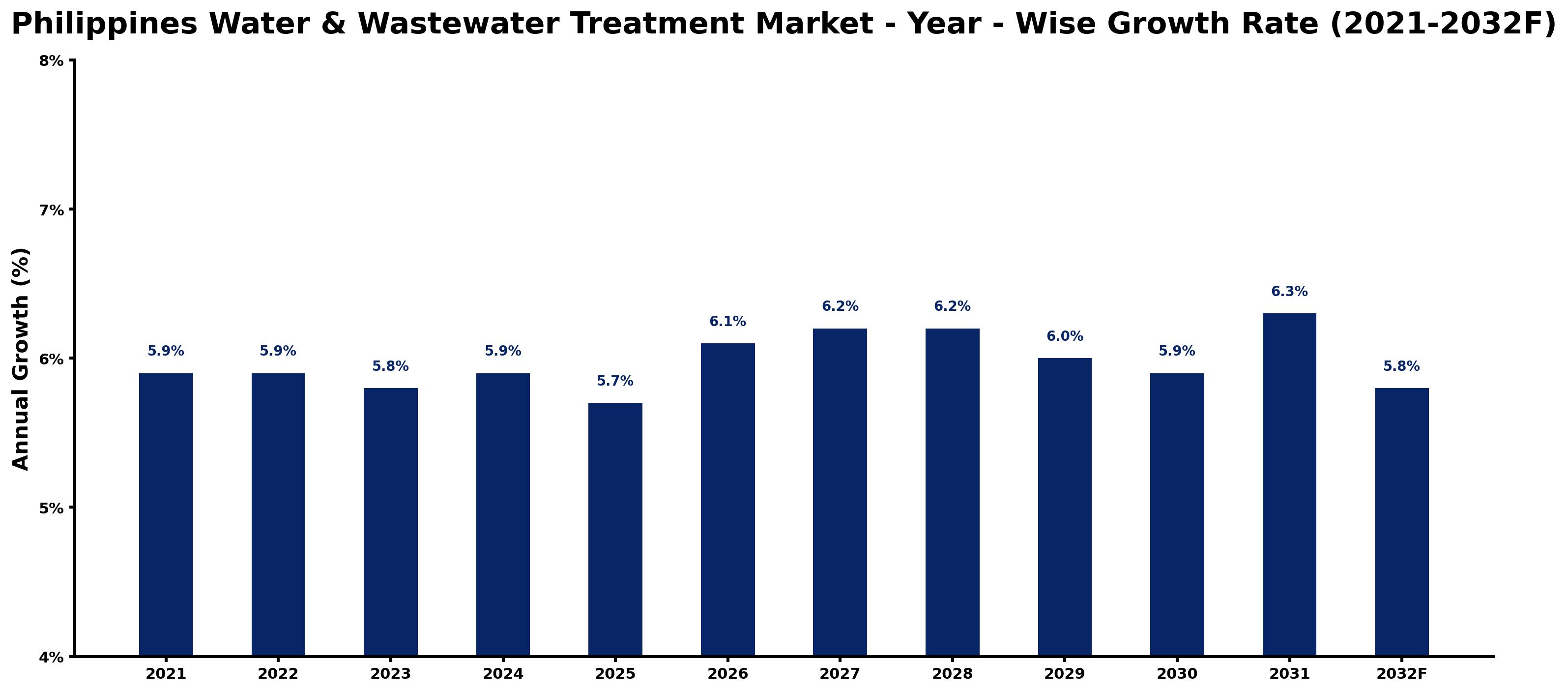
The table below presents the year wise growth rates along with the key drivers influencing the market
| Year | Growth Rate | Major Drivers |
| 2021 | 5.9% | Post-pandemic recovery efforts led to increased focus on water safety and sanitation. |
| 2022 | 5.9% | Local government projects prioritized water infrastructure to enhance public health outcomes. |
| 2023 | 5.8% | Urban migration intensified demand for efficient wastewater management in metropolitan areas. |
| 2024 | 5.9% | Public awareness campaigns highlighted the importance of sustainable water resources utilization. |
| 2025 | 5.7% | Private sector investments surged in modernizing aging treatment facilities and infrastructure. |
| 2026 | 6.1% | International partnerships emerged, introducing advanced technologies to improve water treatment processes. |
| 2027 | 6.2% | Climate change impacts prompted urgency in developing resilient water management systems. |
| 2028 | 6.2% | Population growth necessitated comprehensive plans for expanding water supply and treatment capacity. |
| 2029 | 6.0% | Increased industrial activity highlighted the need for better wastewater treatment regulations. |
| 2030 | 5.9% | Technological innovations led to cost savings, encouraging broader adoption of smart treatment solutions. |
| 2031 | 6.3% | Rural electrification initiatives supported development of localized water treatment systems. |
| 2032 | 5.8% | Public-private collaborations streamlined funding for large-scale water infrastructure projects. |
Note - Market size estimations and growth projections presented in this report are based on 6Wresearch's advanced forecasting approach, validated with industry datasets as of June 2026.
Philippines Water & Wastewater Treatment Market Synopsis
The Philippines Water Wastewater Treatment Market is projected to reach 6.1% and witness significant growth during the forecast period (2026-2032). The driving forces behind this expansion include a pressing need for clean and safe drinking water, accelerated population growth, and ongoing industrialization and urbanization efforts. The Philippine government has made substantial investments in wastewater treatment facilities in recent years, aiming to enhance the nation's overall infrastructure and meet increasing demand. Moreover, initiatives spearheaded by institutions such as the Asian Development Bank (ADB) are playing a pivotal role in propelling the sector forward, particularly through efforts focused on reducing pollution from untreated industrial sewage and agricultural runoff.
Philippines Water & Wastewater Treatment Market Growth Drivers
The Philippines Water & Wastewater Treatment Market is influenced by several key growth drivers:
- Rapid urbanization is significantly increasing the demand for improved sanitation services. Urban centers are expanding, necessitating efficient treatment systems to manage waste properly.
- Increased environmental regulations aimed at controlling water pollution are pushing industries to invest in advanced wastewater treatment processes to comply with legal requirements.
- Technological advancements, such as membrane bioreactor technology, enhance the efficiency and cost-effectiveness of treating industrial sewage, making it more accessible for businesses.
- The proliferation of private enterprises providing tailored solutions is contributing to market growth, as these companies cater to the specific needs of various end users.
- Increased expenditure on research and development by industry stakeholders is fostering innovation, leading to the emergence of more effective and sustainable treatment technologies.
Philippines Water & Wastewater Treatment Market Challenges and Restraints
Despite the positive outlook, the Philippines Water & Wastewater Treatment Market faces several challenges that pose risks to its growth:
- Inadequate financial resources for modernizing existing systems hinder progress and the adoption of innovative solutions, slowing down much-needed upgrades in infrastructure.
- A lack of operational and maintenance expertise can restrict the effective implementation of advanced treatment technologies, resulting in suboptimal performance of treatment facilities.
- High installation costs can deter smaller firms from investing in necessary treatment systems, limiting their ability to contribute to overall market growth.
- The COVID-19 pandemic has disrupted supply chains and caused delays in new project installations, impacting the overall market dynamics in a significant way.
- Public awareness and acceptance of new technologies remain low, which can slow down the adoption of innovative treatment solutions within the community.
Philippines Water & Wastewater Treatment Market Government Investment and Initiatives
The Philippine government is actively involved in the development of the water and wastewater treatment sector through various investments and initiatives designed to enhance infrastructure and service delivery:
- Government agencies are allocating funds for the construction and upgrade of wastewater treatment plants to meet international standards and effectively handle industrial and domestic waste.
- Public-private partnerships are being fostered to leverage private sector expertise and investment in the water treatment domain, ensuring a sustainable approach to infrastructure development.
- Regulatory frameworks are being strengthened to enforce compliance with water quality standards, compelling industries to adopt advanced treatment solutions.
- The government is collaborating with international agencies and organizations to secure funding and technical support for large-scale projects aimed at improving water management in urban and rural areas.
- Public awareness campaigns are being conducted to educate citizens on the importance of water conservation and pollution prevention, fostering community support for treatment initiatives.
Philippines Water & Wastewater Treatment Market Latest Developments (May 2025 - June 2026)
Recent developments from May 2025 to June 2026 in the Philippines Water & Wastewater Treatment Market indicate a strong commitment to enhancing treatment capabilities and addressing environmental challenges:
- The government has initiated several new projects focused on expanding wastewater treatment capacities in metropolitan areas, responding to the growing urban population.
- Investment in research and development has led to pilot programs utilizing cutting-edge technologies, such as biological treatment methods, showcasing potential improvements in efficiency.
- Partnerships with international organizations have resulted in knowledge transfer regarding best practices in wastewater treatment, helping local companies adopt modern methodologies.
- There has been a concerted effort to streamline regulatory processes, facilitating faster project approvals and implementation timelines for essential treatment facilities.
- Sustainability initiatives have gained momentum, with projects focusing on resource recovery from wastewater, such as biogas production, to promote circular economy principles.
Philippines Water & Wastewater Treatment Market - Key Attractiveness of the Report
- 10 Years of Market Numbers
- Historical Data Starting from 2022 to 2025
- Base Year: 2025
- Forecast Data until 2032
- Key Performance Indicators Impacting the Market
- Major Upcoming Developments and Projects
Key Highlights of the Report:
- Philippines Water & Wastewater Treatment Market Outlook
- Market Size of Philippines Water & Wastewater Treatment Market, 2025
- Forecast of Philippines Water & Wastewater Treatment Market, 2032
- Historical Data and Forecast of Philippines Water & Wastewater Treatment Revenues & Volume for the Period 2022-2032F
- Philippines Water & Wastewater Treatment Market Trend Evolution
- Philippines Water & Wastewater Treatment Market Drivers and Challenges
- Philippines Water & Wastewater Treatment Price Trends
- Philippines Water & Wastewater Treatment Porter's Five Forces
- Philippines Water & Wastewater Treatment Industry Life Cycle
- Historical Data and Forecast of Philippines Water & Wastewater Treatment Market Revenues & Volume By Product Category????????????? for the Period 2022-2032F
- Historical Data and Forecast of Philippines Water & Wastewater Treatment Market Revenues & Volume By Treatment Technologies for the Period 2022-2032F
- Historical Data and Forecast of Philippines Water & Wastewater Treatment Market Revenues & Volume By Delivery Equipment for the Period 2022-2032F
- Historical Data and Forecast of Philippines Water & Wastewater Treatment Market Revenues & Volume By Treatment Chemicals for the Period 2022-2032F
- Historical Data and Forecast of Philippines Water & Wastewater Treatment Market Revenues & Volume By Instrumentation for the Period 2022-2032F
- Historical Data and Forecast of Philippines Water & Wastewater Treatment Market Revenues & Volume By Applications for the Period 2022-2032F
- Historical Data and Forecast of Philippines Water & Wastewater Treatment Market Revenues & Volume By Municipal for the Period 2022-2032F
- Historical Data and Forecast of Philippines Water & Wastewater Treatment Market Revenues & Volume By Industrial for the Period 2022-2032F
- Philippines Water & Wastewater Treatment Import Export Trade Statistics
- Market Opportunity Assessment By Product Category?????????????
- Market Opportunity Assessment By Applications
- Philippines Water & Wastewater Treatment Top Companies Market Share
- Philippines Water & Wastewater Treatment Competitive Benchmarking By Technical and Operational Parameters
- Philippines Water & Wastewater Treatment Company Profiles
- Philippines Water & Wastewater Treatment Key Strategic Recommendations






































