Philippines Wheat Bran Market Size, Share & Growth Rate
The Philippines Wheat Bran Market was estimated at USD 349 Million in 2025 and is projected to reach USD 461 Million by 2032, growing at a CAGR of 4.1% from 2026 to 2032. The anticipated growth trajectory is primarily driven by a rising consumer shift towards health-conscious diets, coupled with increased awareness regarding the nutritional benefits of wheat bran. As food and beverage processing industries in the Philippines emphasize healthier formulations, the demand for wheat bran as a key ingredient is expected to solidify its market presence.
Philippines Wheat Bran Market Growth Rate Analysis (2021-2032)
The Philippines wheat bran market is experiencing stable growth, with a yearly increase of 4.4% in 2021, followed by a slight uptick to 4.7% in 2022 and holding steady through 2023. This trend is primarily driven by rising consumer demand for health-conscious food products and increasing investments in the agricultural sector. The market is projected to maintain a robust growth rate, with expected increases of 4.9% in 2026 and 5.1% in 2032, benefiting from enhanced processing technologies and supportive government policies aimed at boosting local production. While fluctuations around 4.6% from 2024 to 2025 reflect global supply chain adjustments, the long-term outlook remains robust as health trends and industry innovations continue to fuel demand.
Philippines Wheat Bran Market Year-wise Growth Rate and Key Drivers
This graph highlights how the Philippines Wheat Bran Market has steadily grown over the past five years, supported by major growth factors.
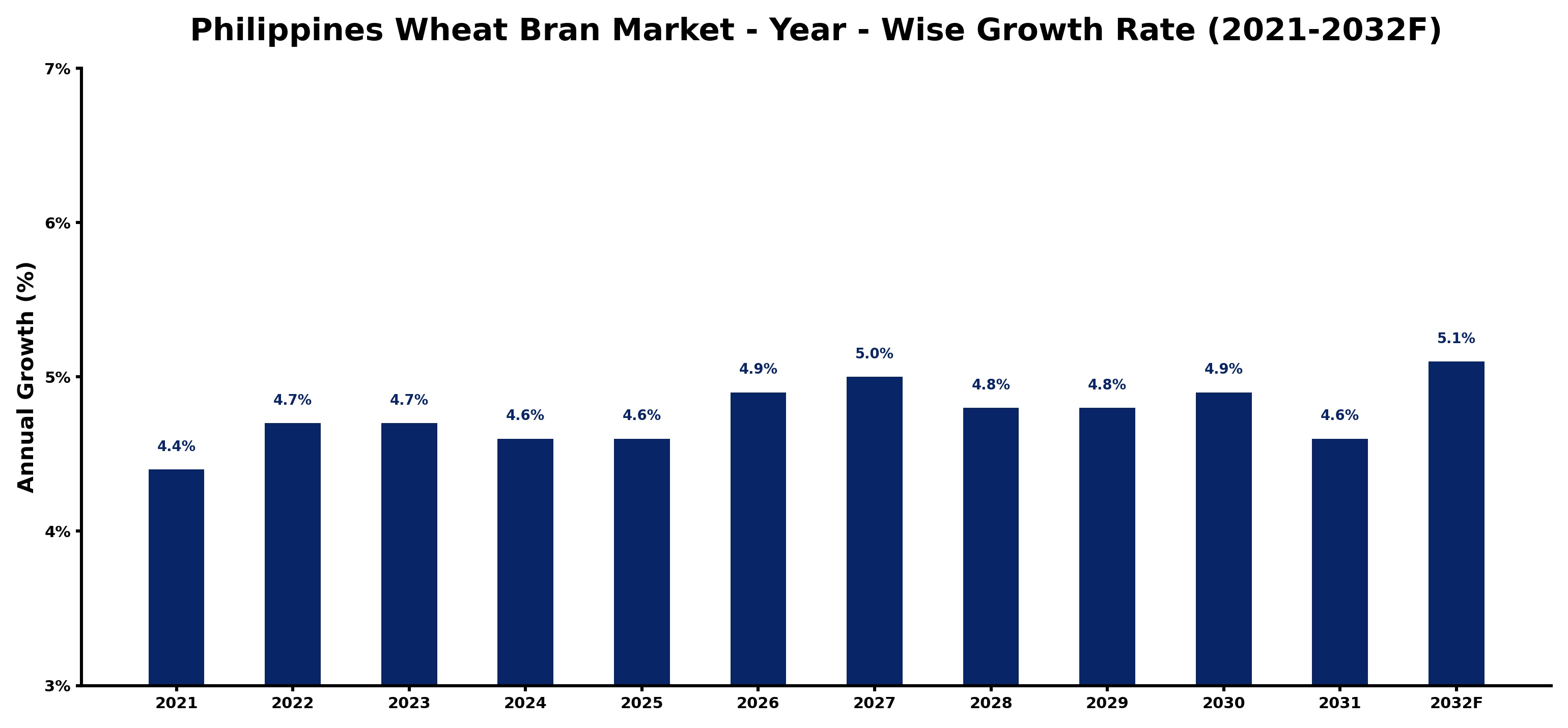
The table below presents the year‑wise growth rates along with the key drivers influencing the market
| Year | Growth Rate | Major Drivers |
| 2021 | 4.4% | Health awareness drove consumption growth |
| 2022 | 4.7% | Increased bakery product demand surged |
| 2023 | 4.7% | Nutritional benefits gained popularity rapidly |
| 2024 | 4.6% | Organic product trends expanded market |
| 2025 | 4.6% | Food fortification initiatives supported growth |
| 2026 | 4.9% | Sustainable sourcing practices gained traction |
| 2027 | 5.0% | Export opportunities enhanced market reach |
| 2028 | 4.8% | Consumer education improved product awareness |
| 2029 | 4.8% | Innovative product formulations attracted interest |
| 2030 | 4.9% | Local sourcing initiatives boosted sales |
| 2031 | 4.6% | Collaborations with chefs increased visibility |
| 2032 | 5.1% | Functional food trends drove demand |
Note - Market size estimations and growth projections presented in this report are based on 6Wresearch’s advanced forecasting approach, validated with industry datasets as of June 2026.
Philippines Wheat Bran Market Synopsis
Recently, the Philippines Wheat Bran market has experienced a surge in demand fueled by heightened health awareness among consumers. This momentum, however, is evolving as food manufacturers increasingly incorporate wheat bran into their products, anticipating long-term growth driven by health trends. With the market transitioning towards a steady growth phase, the focus on dietary fiber's benefits is likely to remain pivotal in shaping future consumption patterns.
The market's expansion is further complemented by consumer preferences shifting towards whole grain products and plant-based diets. As individuals seek dietary solutions that align with their wellness goals, wheat bran's reputation for enhancing digestive health and overall well-being positions it as an attractive choice for both consumers and producers. The trajectory remains promising, signaling a robust path for sustained growth.
Philippines Wheat Bran Market Key Takeaways
- The market is growing steadily due to increasing health consciousness among consumers.
- Wheat bran is being recognized for its diverse health benefits, driving its use in food applications.
- Food manufacturers are focusing on ingredient transparency, which enhances the market's appeal.
- Consumer education regarding the nutritional value of wheat bran remains vital for continued growth.
- The anticipated CAGR of 4.1% indicates a strong future outlook for the market.
Evaluation of Restraints in Philippines Wheat Bran Market
Despite its promising outlook, the Philippines Wheat Bran market is confronted with several restraints that could impact growth. Sourcing quality wheat remains a persistent challenge, especially given the variability in global wheat production and fluctuating prices that can hinder supply consistency. Additionally, while consumer awareness is gradually improving, it still lags behind other health trends. The need for educational initiatives to further highlight the nutritional benefits of wheat bran is imperative, as evolving dietary habits might otherwise overshadow its advantages.
Philippines Wheat Bran Market Trends
Several current trends are shaping the Philippines Wheat Bran market, notably the increasing incorporation of wheat bran in various food segments, from bakery items to health snacks. Furthermore, the rising interest in plant-based foods is encouraging product innovation, with manufacturers exploring novel applications for wheat bran, including gluten-free alternatives. Social media and wellness influencers are also playing a significant role in promoting fiber-rich diets, which amplifies consumer interest in wheat bran.
Philippines Wheat Bran Market Opportunities
Opportunities abound within the Philippines Wheat Bran market, particularly in the realm of product development. As the trend for clean-label products gains traction, there is room for companies to create innovative, fiber-enriched food items that cater to health-focused consumers. Additionally, potential partnerships with health organizations to promote the benefits of dietary fiber could further enhance market penetration. Investing in educational campaigns around the advantages of wheat bran may also yield positive outcomes for growth and brand loyalty.
Government Initiatives in the Philippines Wheat Bran Market
The Philippine government has initiated several programs aimed at promoting healthier eating habits among its population. These initiatives often focus on improving nutritional standards across food products, encouraging the inclusion of whole grains and fiber-rich ingredients. Additionally, investments in agricultural development aim to support local wheat production, which can help stabilize supply chains and enhance the availability of high-quality wheat bran for the market.
Future Insights of the Philippines Wheat Bran Market
Looking ahead to 2026-2032, the Philippines Wheat Bran market is poised for significant evolution. With the growing acknowledgment of health benefits associated with high dietary fiber intake, it is anticipated that demand for wheat bran will escalate. Innovative product formulations, alongside a focus on transparency and sustainability, will be key elements driving the market. As consumer preferences continue to shift towards natural and nutritious food options, the wheat bran market will likely harness these trends to foster a stronger, more resilient growth path.
Philippines Wheat Bran Market Latest Developments (May 2025 - June 2026)
Recent industry developments indicate a notable uptick in the integration of wheat bran in various food products. As food manufacturers embrace innovative formulations, they are increasingly using wheat bran to enhance nutritional content. Furthermore, ongoing discussions about the importance of dietary fiber in preventing chronic diseases are driving further interest from both consumers and producers. This backdrop sets the stage for a revitalized wheat bran market that is dynamically responding to contemporary health trends.
Philippines Wheat Bran Market - Key Attractiveness of the Report
- 10 Years of Market Numbers
- Historical Data Starting from 2022 to 2025
- Base Year: 2025
- Forecast Data until 2032
- Key Performance Indicators Impacting the Market
- Major Upcoming Developments and Projects
Key Highlights of the Report:
- Philippines Wheat Bran Market Outlook
- Market Size of Philippines Wheat Bran Market, 2025
- Forecast of Philippines Wheat Bran Market, 2032F
- Historical Data and Forecast of Philippines Wheat Bran Revenues & Volume for the Period 2022-2032F
- Philippines Wheat Bran Market Trend Evolution
- Philippines Wheat Bran Market Drivers and Challenges
- Philippines Wheat Bran Price Trends
- Philippines Wheat Bran Porter's Five Forces
- Philippines Wheat Bran Industry Life Cycle
- Historical Data and Forecast of Philippines Wheat Bran Market Revenues & Volume By Product Type for the Period 2022-2032F
- Historical Data and Forecast of Philippines Wheat Bran Market Revenues & Volume By Animal Feed Grade for the Period 2022-2032F
- Historical Data and Forecast of Philippines Wheat Bran Market Revenues & Volume By Medical Use Grade for the Period 2022-2032F
- Historical Data and Forecast of Philippines Wheat Bran Market Revenues & Volume By Others for the Period 2022-2032F
- Historical Data and Forecast of Philippines Wheat Bran Market Revenues & Volume By Application for the Period 2022-2032F
- Historical Data and Forecast of Philippines Wheat Bran Market Revenues & Volume By Food Products for the Period 2022-2032F
- Historical Data and Forecast of Philippines Wheat Bran Market Revenues & Volume By Animal Feed for the Period 2022-2032F
- Historical Data and Forecast of Philippines Wheat Bran Market Revenues & Volume By Pharmacuticals for the Period 2022-2032F
- Historical Data and Forecast of Philippines Wheat Bran Market Revenues & Volume By Cosmetics for the Period 2022-2032F
- Historical Data and Forecast of Philippines Wheat Bran Market Revenues & Volume By Others for the Period 2022-2032F
- Philippines Wheat Bran Import Export Trade Statistics
- Market Opportunity Assessment By Product Type
- Market Opportunity Assessment By Application
- Philippines Wheat Bran Top Companies Market Share
- Philippines Wheat Bran Competitive Benchmarking By Technical and Operational Parameters
- Philippines Wheat Bran Company Profiles
- Philippines Wheat Bran Key Strategic Recommendations






































