Philippines Wi-Fi Market Size, Share & Growth Rate
The Philippines Wi-Fi Market was estimated at USD 161 Million in 2025 and is projected to reach USD 212 Million by 2032, growing at a CAGR of 4.0% from 2026 to 2032. This trajectory is primarily fueled by the rising demand for enhanced wireless connectivity in both residential and commercial sectors. Furthermore, the evolving technological landscape, particularly the introduction of Wi-Fi 6 and Wi-Fi 6E, is expected to bolster user experience and access, particularly in urban areas.
Philippines Wi-Fi Market Year-wise Growth Rate and Key Drivers
This graph highlights how the Philippines Wi-Fi Market has steadily grown over the years, supported by major growth factors.
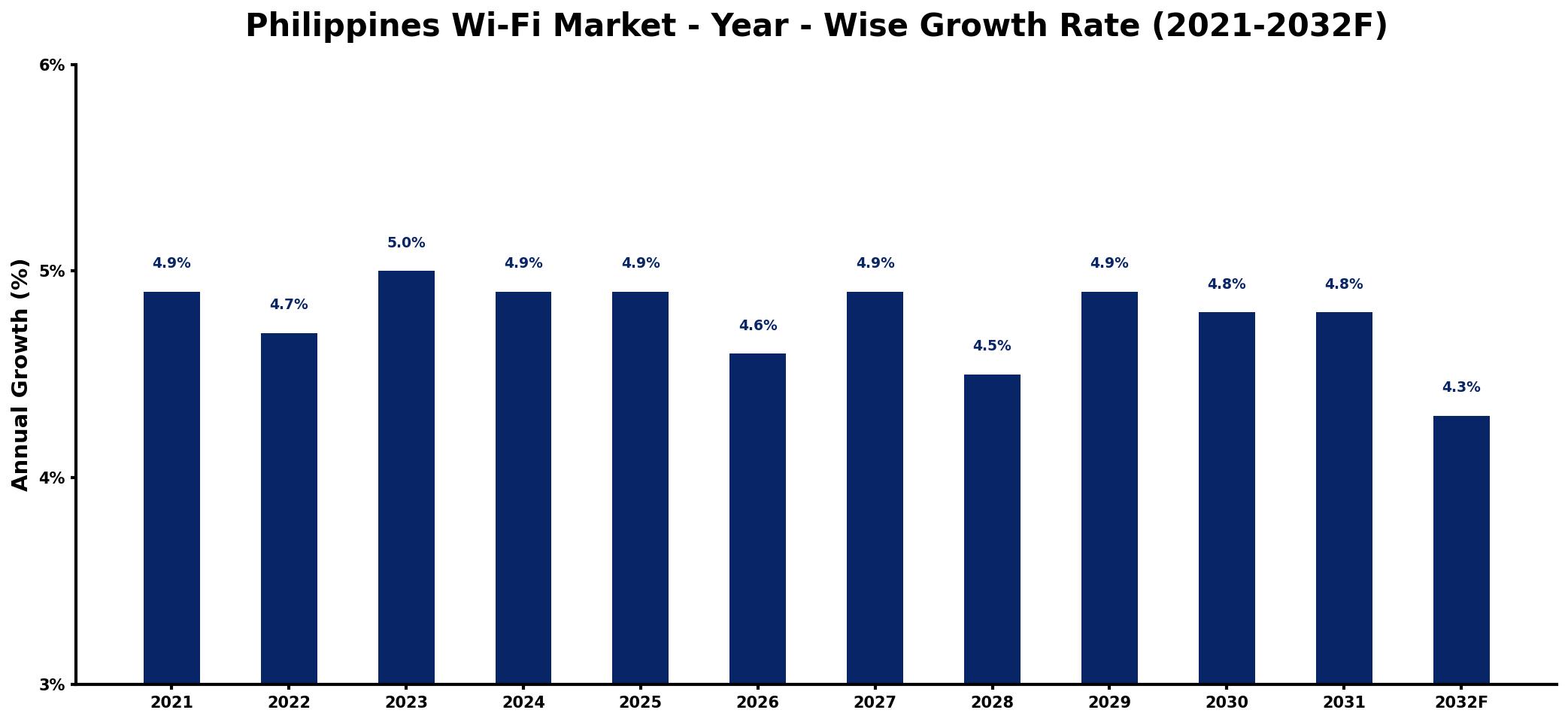
The table below presents the year‑wise growth rates along with the key drivers influencing the market
| Year | Growth Rate | Major Drivers |
| 2021 | 4.9% | rising mobile device penetration |
| 2022 | 4.7% | increased demand for remote work |
| 2023 | 5.0% | growing online education platforms |
| 2024 | 4.9% | expansion of smart home technology |
| 2025 | 4.9% | higher investment in digital infrastructure |
| 2026 | 4.6% | increased usage of streaming services |
| 2027 | 4.9% | growth in e-commerce activities |
| 2028 | 4.5% | rising demand for cloud services |
| 2029 | 4.9% | strengthening international trade flows |
| 2030 | 4.8% | increased focus on cybersecurity solutions |
| 2031 | 4.8% | growing need for telehealth services |
| 2032 | 4.3% | increased adoption of 5G technology |
Note: Market size estimations and growth projections presented in this report are based on 6Wresearch's proprietary forecasting methodology, utilizing the latest available industry data, government publications, and primary research inputs.
Philippines Wi-Fi Market Synopsis
As a nation that values connectivity, the Philippines is witnessing an increasingly vital role for Wi-Fi networks across various domains. From bustling urban centers to educational institutions, reliable wireless access is becoming a staple in daily life. However, the digital divide remains a pressing concern, especially in rural areas where connectivity is significantly lacking.
The COVID-19 pandemic has dramatically reshaped Wi-Fi usage, emphasizing the necessity of home networks and public Wi-Fi in essential spaces. With remote work, e-learning, and telehealth becoming more commonplace, the demand for robust, high-speed wireless internet has surged, further influencing the market's growth dynamics.
Philippines Wi-Fi Market Key Takeaways
- The market is experiencing sustained growth driven by increased demand for wireless connectivity in various sectors.
- Technological advancements like Wi-Fi 6 and 6E are enhancing network performance and user experiences.
- Rural connectivity issues continue to challenge broader market expansion.
- The shift in connectivity requirements post-COVID-19 has increased focus on home and public Wi-Fi infrastructure.
- Government initiatives aimed at enhancing digital access present new opportunities for market players.
Evaluation of Restraints in Philippines Wi-Fi Market
Despite the optimistic growth trajectory, the Philippines Wi-Fi market faces notable constraints. A significant factor is the persistent lack of reliable internet access in many rural and remote areas. This digital divide not only limits market potential but also hinders efforts toward national digital inclusion. Furthermore, varying levels of infrastructural development and inconsistent regulatory environments across regions create additional barriers for service providers aiming to expand their offerings.
Philippines Wi-Fi Market Trends
Current trends indicate a marked shift towards more sophisticated Wi-Fi technologies, such as Wi-Fi 6 and 6E, which promise improved speed and capacity. Additionally, an increasing emphasis on smart home devices is prompting both consumers and businesses to seek advanced wireless solutions. The rise of remote work and e-learning platforms further pushes the demand for robust, high-speed internet access in various settings, making it crucial for service providers to adapt quickly to changing consumer needs.
Philippines Wi-Fi Market Opportunities
Opportunities abound in the Philippines Wi-Fi market, particularly in urban expansion and technological upgrades. The ongoing need for better connectivity solutions in educational institutions and healthcare facilities presents significant growth potential. Additionally, as businesses transition towards digital operations, there is an increasing demand for enterprise-level Wi-Fi solutions that can support larger volumes of users and data transfer, paving the way for new market entrants and innovation.
Government Initiatives in the Philippines Wi-Fi Market
The Philippine government is actively promoting initiatives aimed at enhancing digital connectivity and access throughout the archipelago. Programs focused on increasing Wi-Fi availability in public spaces, particularly in schools and healthcare facilities, are pivotal for bridging the connectivity gap. Furthermore, investments in telecommunications infrastructure are being prioritized to facilitate a smoother digital transition, reflecting a commitment to fostering a more connected society.
Future Insights of the Philippines Wi-Fi Market
Looking ahead, the Philippines Wi-Fi market is poised for a period of notable transformation from 2026 to 2032. With ongoing advancements in technology, users can expect faster and more reliable services, contributing to heightened consumer satisfaction. Moreover, as urbanization continues to accelerate, the demand for seamless connectivity will only intensify, offering strategic opportunities for service providers to innovate and expand their offerings in previously underserved areas.
Philippines Wi-Fi Market Latest Developments (2025 - 2026)
Recent developments within the Philippines Wi-Fi market have showcased a surge in investments aimed at enhancing network capabilities. There is a noticeable trend towards upgrading existing infrastructure to support next-generation Wi-Fi technologies. Moreover, collaborative initiatives between public and private sectors are fostering a more comprehensive approach to addressing connectivity challenges, particularly in remote areas.
Philippines Wi-Fi Market - Key Attractiveness of the Report
- 10 Years of Market Numbers
- Historical Data Starting from 2022 to 2025
- Base Year: 2025
- Forecast Data until 2032
- Key Performance Indicators Impacting the Market
- Major Upcoming Developments and Projects
Key Highlights of the Report:
- Philippines Wi-Fi Market Outlook
- Market Size of Philippines Wi-Fi Market, 2025
- Forecast of Philippines Wi-Fi Market, 2032
- Historical Data and Forecast of Philippines Wi-Fi Revenues & Volume for the Period 2022-2032F
- Philippines Wi-Fi Market Trend Evolution
- Philippines Wi-Fi Market Drivers and Challenges
- Philippines Wi-Fi Price Trends
- Philippines Wi-Fi Porter's Five Forces
- Philippines Wi-Fi Industry Life Cycle
- Historical Data and Forecast of Philippines Wi-Fi Market Revenues & Volume By Component for the Period 2022-2032F
- Historical Data and Forecast of Philippines Wi-Fi Market Revenues & Volume By Hardware for the Period 2022-2032F
- Historical Data and Forecast of Philippines Wi-Fi Market Revenues & Volume By Solutions for the Period 2022-2032F
- Historical Data and Forecast of Philippines Wi-Fi Market Revenues & Volume By Services for the Period 2022-2032F
- Historical Data and Forecast of Philippines Wi-Fi Market Revenues & Volume By Density for the Period 2022-2032F
- Historical Data and Forecast of Philippines Wi-Fi Market Revenues & Volume By High-density Wi-Fi for the Period 2022-2032F
- Historical Data and Forecast of Philippines Wi-Fi Market Revenues & Volume By Enterprise-class Wi-Fi for the Period 2022-2032F
- Historical Data and Forecast of Philippines Wi-Fi Market Revenues & Volume By Location Type for the Period 2022-2032F
- Historical Data and Forecast of Philippines Wi-Fi Market Revenues & Volume By Indoor for the Period 2022-2032F
- Historical Data and Forecast of Philippines Wi-Fi Market Revenues & Volume By Outdoor for the Period 2022-2032F
- Historical Data and Forecast of Philippines Wi-Fi Market Revenues & Volume By Organization Size for the Period 2022-2032F
- Historical Data and Forecast of Philippines Wi-Fi Market Revenues & Volume By Large Enterprises for the Period 2022-2032F
- Historical Data and Forecast of Philippines Wi-Fi Market Revenues & Volume By SMEs for the Period 2022-2032F
- Historical Data and Forecast of Philippines Wi-Fi Market Revenues & Volume By Vertical for the Period 2022-2032F
- Historical Data and Forecast of Philippines Wi-Fi Market Revenues & Volume By Education for the Period 2022-2032F
- Historical Data and Forecast of Philippines Wi-Fi Market Revenues & Volume By Healthcare and Life Sciences for the Period 2022-2032F
- Historical Data and Forecast of Philippines Wi-Fi Market Revenues & Volume By Transportation and Logistics for the Period 2022-2032F
- Historical Data and Forecast of Philippines Wi-Fi Market Revenues & Volume By Retail and Ecommerce for the Period 2022-2032F
- Historical Data and Forecast of Philippines Wi-Fi Market Revenues & Volume By Government for the Period 2022-2032F
- Historical Data and Forecast of Philippines Wi-Fi Market Revenues & Volume By Manufacturing for the Period 2022-2032F
- Historical Data and Forecast of Philippines Wi-Fi Market Revenues & Volume By Hospitality for the Period 2022-2032F
- Historical Data and Forecast of Philippines Wi-Fi Market Revenues & Volume By Other Verticals (BFSI, oil and gas, utilities, IT and telecom, and sports and leisure) for the Period 2022-2032F
- Philippines Wi-Fi Import Export Trade Statistics
- Market Opportunity Assessment By Component
- Market Opportunity Assessment By Density
- Market Opportunity Assessment By Location Type
- Market Opportunity Assessment By Organization Size
- Market Opportunity Assessment By Vertical
- Philippines Wi-Fi Top Companies Market Share
- Philippines Wi-Fi Competitive Benchmarking By Technical and Operational Parameters
- Philippines Wi-Fi Company Profiles
- Philippines Wi-Fi Key Strategic Recommendations






































