Philippines Wine production Machinery Market Summary
The philippines wine production machinery market was estimated at USD 239 Million in 2025 and is projected to reach USD 332 Million by 2032, growing at a CAGR of 5.6% from 2026 to 2032.
Philippines Wine production Machinery Market Year-wise Growth Rate and Key Drivers
This graph highlights how the Philippines Wine production Machinery Market has steadily grown over the past five years, supported by major growth factors.
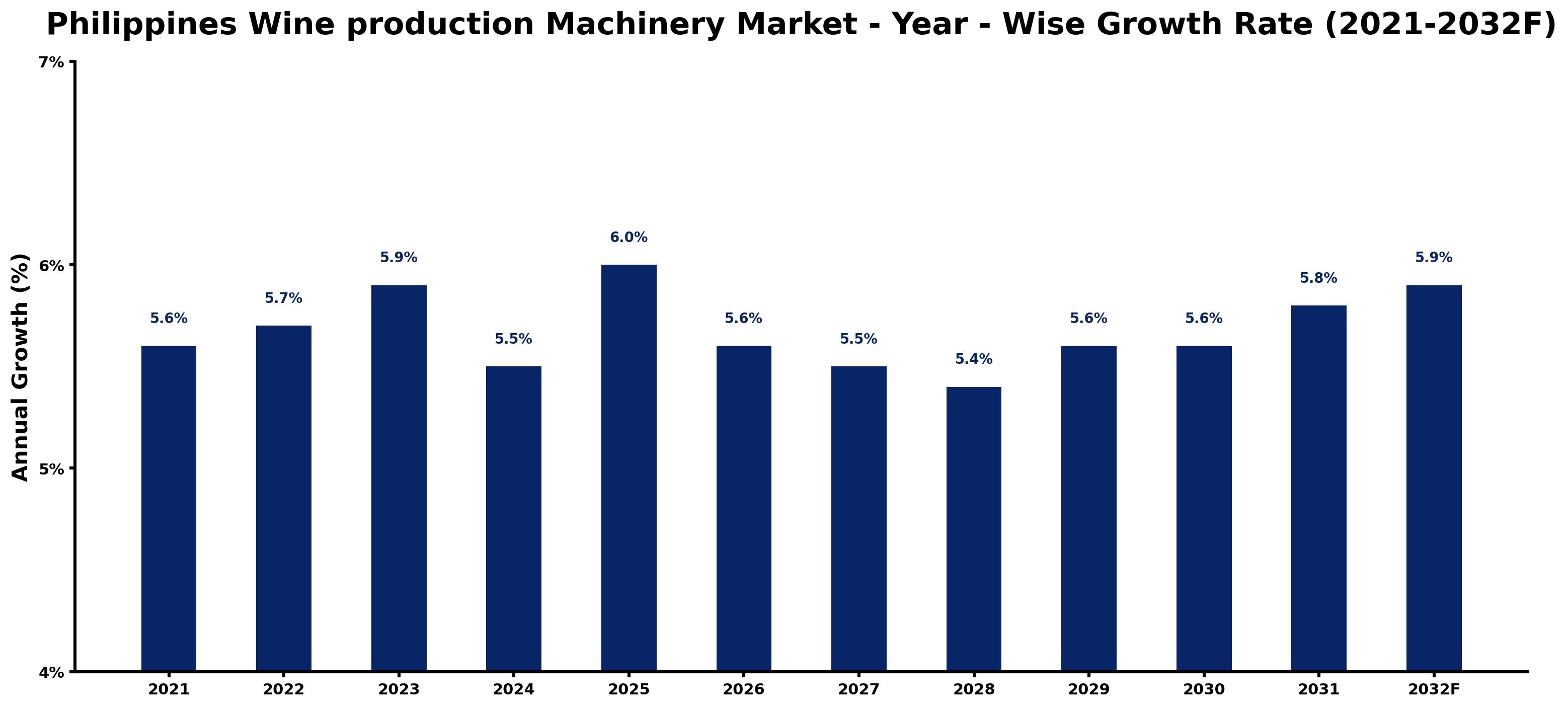
The table below presents the year wise growth rates along with the key drivers influencing the market
| Year | Growth Rate | Major Drivers |
| 2021 | 5.6% | Philippine wine producers focused on modernizing equipment to enhance operational efficiency. |
| 2022 | 5.7% | Increased interest in local wine production prompted investment in specialized machinery. |
| 2023 | 5.9% | Emerging wine regions sought innovative solutions to improve quality and production volume. |
| 2024 | 5.5% | Higher consumer awareness of wine varieties influenced vineyard machinery acquisitions. |
| 2025 | 6.0% | Sustainable practices in agriculture encouraged wineries to upgrade processing technologies. |
| 2026 | 5.6% | Technological partnerships with international suppliers enhanced local production capabilities significantly. |
| 2027 | 5.5% | E-commerce platforms expanded distribution, driving demand for efficient bottling and labeling machinery. |
| 2028 | 5.4% | Wine tourism growth in the Philippines stimulated investments in processing and packaging equipment. |
| 2029 | 5.6% | Education programs on viticulture attracted new entrants, increasing demand for machinery. |
| 2030 | 5.6% | Export potential for Filipino wines necessitated advanced machinery for global compliance standards. |
| 2031 | 5.8% | Local collaborations between vineyards and machinery manufacturers strengthened market dynamics. |
| 2032 | 5.9% | Innovations in automation transformed production processes, boosting the sector's competitiveness. |
Note - Market size estimations and growth projections presented in this report are based on 6Wresearch's advanced forecasting approach, validated with industry datasets as of June 2026.
Philippines Wine production Machinery Market Synopsis
The Philippines Wine production Machinery Market is projected to reach 5.6% and witness significant growth during the forecast period (2026-2032). This growth is primarily driven by enhancing consumer preferences for quality wines, increasing disposable incomes, and elevated urbanization rates within the country. The tropical climate of the Philippines has made it conducive for grape cultivation, prompting wineries to invest in advanced wine production machinery to meet rising demand.
Philippines Wine production Machinery Market Growth Drivers
The economic landscape of the Philippines exhibits a shift in consumer trends, particularly in the alcoholic beverage sector. The key growth drivers influencing the Philippines wine production machinery market include:
- A transition in drinking habits among Filipino consumers is notable, with more individuals opting for high-quality wines over traditional alcoholic beverages like beer and whiskey. This change is reflective of a greater exposure to global consumption patterns and lifestyle shifts.
- Investment in upgraded wine production equipment, such as crushers, destemmers, and filtration systems is becoming increasingly common. Local winemakers are adapting to consumer demands for premium wines that can compete with imported varieties.
- Urbanization is contributing to rising disposable incomes, leading to greater spending power among Filipinos. This trend encourages investments in luxury goods, including fine wines, further stimulating the market for wine production machinery.
- A growing appreciation for premium wines among younger generations enhances market prospects. This demographic shift supports domestic companies anticipating further expansion within the evolving wine industry.
- The favorable climatic conditions for grape cultivation across various regions in the Philippines have led to increased production capabilities and the subsequent demand for innovative machinery.
Philippines Wine production Machinery Market Challenges and Restraints
Despite the promising growth trajectory, the Philippines wine production machinery market faces several challenges that could impede its progress. Key challenges include:
- The significant capital investment required for establishing a winemaking operation is a substantial barrier. The costs associated with acquiring advanced machinery and equipment can deter potential entrants into the market.
- Operational costs related to maintenance and machinery upkeep can add to the financial burden faced by wineries, making profitability analyses crucial before expanding production facilities.
- The complexities involved in the production process, from vineyard management to bottling, require specialized knowledge and expertise, which may pose challenges for new entrants.
- Competition from established foreign wine brands can pressure local wineries to enhance their production quality and marketing strategies, which may demand further investments in state-of-the-art machinery.
- Regulatory hurdles concerning food and beverage production can impose additional compliance costs, presenting another layer of challenge for wineries in the Philippines.
Philippines Wine production Machinery Market Government Investment and Initiatives
The Philippine government has recognized the potential of the wine industry and is taking steps to foster growth through various initiatives. Government policies aim to encourage investment in local winemaking and the associated machinery sectors. Initiatives include:
- Promoting local grape cultivation through subsidies and technical assistance programs to enhance domestic wine production capabilities.
- Investment in infrastructure development, such as improved transportation networks and facilities for wineries, to facilitate easier access to markets.
- Encouraging collaborations between local universities and industry stakeholders to develop expertise and innovative technologies in winemaking and production machinery.
- Implementing tax incentives and funding opportunities for startups and existing businesses in the wine sector to stimulate investment in advanced production technology.
- Supporting marketing initiatives aimed at promoting local wines both domestically and internationally, enhancing the visibility of Philippine-made wine products.
Philippines Wine production Machinery Market Latest Developments (May 2025 - June 2026)
In the recent period from May 2025 to June 2026, the Philippines wine production machinery market has witnessed several developments that highlight the industry's evolution:
- Increased investment from both domestic and international sources has been observed, with a focus on modernizing existing wineries and enhancing production capabilities.
- The introduction of new technologies in wine production machinery has improved efficiency and quality, allowing local wineries to compete more effectively against imported brands.
- Prominent trade exhibitions and conferences regarding winemaking and wine production technologies have facilitated networking opportunities for industry participants.
- Collaborative efforts between government entities and private sectors have led to the establishment of training programs aimed at equipping individuals with necessary skills for modern winemaking processes.
- The evolving consumer preferences towards sustainability have prompted wineries to seek eco-friendly production practices, driving demand for innovative and sustainable production machinery.
Philippines Wine production Machinery Market - Key Attractiveness of the Report
- 10 Years of Market Numbers
- Historical Data Starting from 2022 to 2025
- Base Year: 2025
- Forecast Data until 2032
- Key Performance Indicators Impacting the Market
- Major Upcoming Developments and Projects
Key Highlights of the Report:
- Philippines Wine production Machinery Market Outlook
- Market Size of Philippines Wine production Machinery Market, 2025
- Forecast of Philippines Wine production Machinery Market, 2032
- Historical Data and Forecast of Philippines Wine production Machinery Revenues & Volume for the Period 2022-2032F
- Philippines Wine production Machinery Market Trend Evolution
- Philippines Wine production Machinery Market Drivers and Challenges
- Philippines Wine production Machinery Price Trends
- Philippines Wine production Machinery Porter's Five Forces
- Philippines Wine production Machinery Industry Life Cycle
- Historical Data and Forecast of Philippines Wine production Machinery Market Revenues & Volume By Type for the Period 2022-2032F
- Historical Data and Forecast of Philippines Wine production Machinery Market Revenues & Volume By Tanks & fermenters for the Period 2022-2032F
- Historical Data and Forecast of Philippines Wine production Machinery Market Revenues & Volume By Crushing & Pressing Equipment for the Period 2022-2032F
- Historical Data and Forecast of Philippines Wine production Machinery Market Revenues & Volume By Temperature Control Equipment for the Period 2022-2032F
- Historical Data and Forecast of Philippines Wine production Machinery Market Revenues & Volume By Filtration Equipment for the Period 2022-2032F
- Historical Data and Forecast of Philippines Wine production Machinery Market Revenues & Volume By Others for the Period 2022-2032F
- Philippines Wine production Machinery Import Export Trade Statistics
- Market Opportunity Assessment By Type
- Philippines Wine production Machinery Top Companies Market Share
- Philippines Wine production Machinery Competitive Benchmarking By Technical and Operational Parameters
- Philippines Wine production Machinery Company Profiles
- Philippines Wine production Machinery Key Strategic Recommendations






































