Philippines Wire Harness Market Size, Share & Growth Rate
The Philippines Wire Harness Market was estimated at USD 525 Million in 2025 and is projected to reach USD 766 Million by 2032, growing at a CAGR of 5.5% from 2026 to 2032. This growth trajectory is largely fueled by the booming automotive sector, where the rise in commercial and passenger vehicle production is translating into increased demand for wiring harnesses. Additionally, the electronics industry is undergoing a significant transformation, contributing to heightened investments in electronic components, thereby driving the overall market expansion.
Philippines Wire Harness Market Year-wise Growth Rate and Key Drivers
This graph highlights how the Philippines Wire Harness Market has steadily grown over the years, supported by major growth factors.
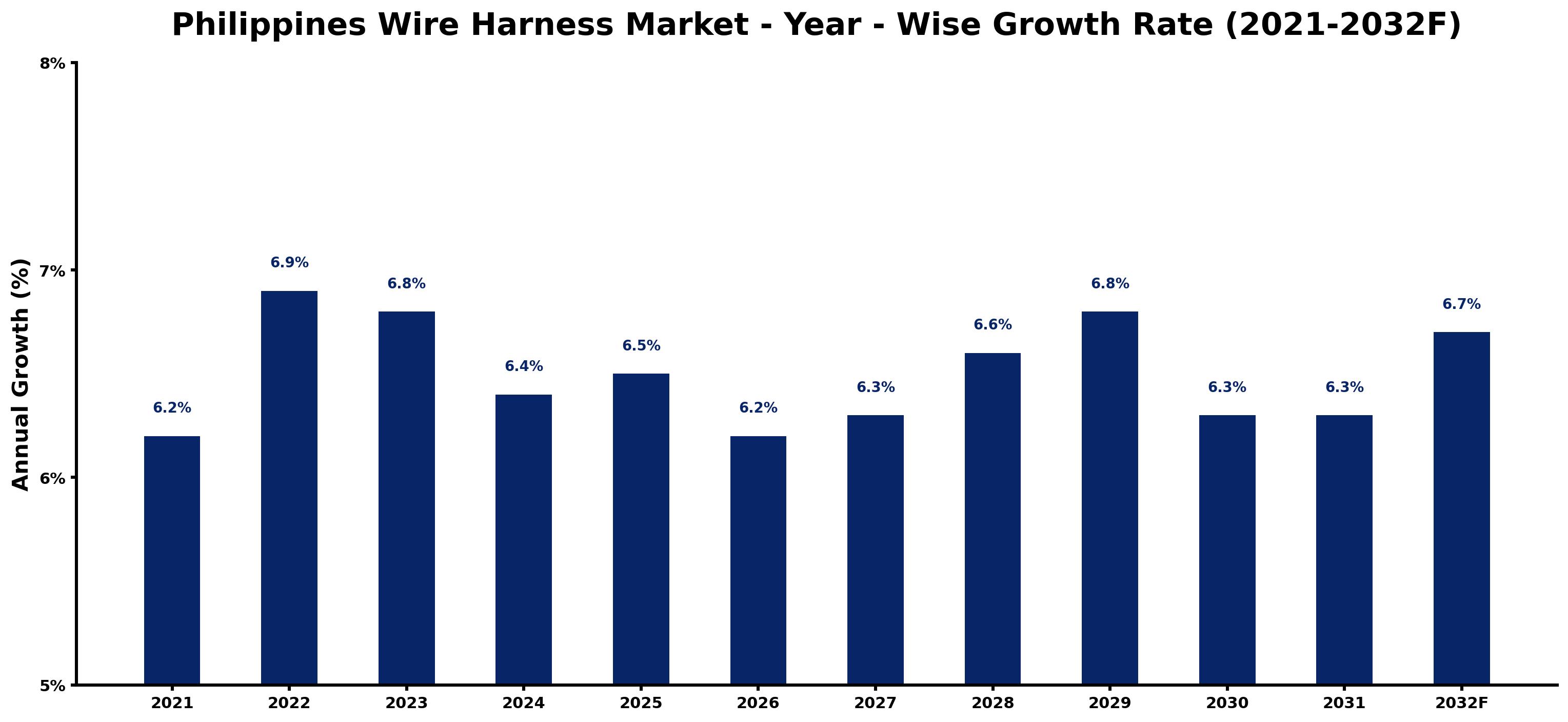
The table below presents the year‑wise growth rates along with the key drivers influencing the market
| Year | Growth Rate | Major Drivers |
| 2021 | 6.2% | Expansion of commercial construction activities |
| 2022 | 6.9% | Increasing industrial infrastructure investments |
| 2023 | 6.8% | Rapid growth in telecom and data center sectors |
| 2024 | 6.4% | Expansion of transportation and logistics networks |
| 2025 | 6.5% | Growing urbanization and commercial development |
| 2026 | 6.2% | Growing urbanization and commercial development |
| 2027 | 6.3% | Expansion of transportation and logistics networks |
| 2028 | 6.6% | Increasing smart city development projects |
| 2029 | 6.8% | Rising electricity demand across industries |
| 2030 | 6.3% | Growing urbanization and commercial development |
| 2031 | 6.3% | Expansion of transportation and logistics networks |
| 2032 | 6.7% | Expansion of commercial construction activities |
Note - Market size estimations and growth projections presented in this report are based on 6Wresearch’s advanced forecasting approach, validated with industry datasets as of June 2026.
Philippines Wire Harness Market Synopsis
The automotive industry's resurgence stands as the strongest force shaping the Philippines Wire Harness Market today. With consumer spending on the rise, more individuals are purchasing vehicles, which in turn amplifies the need for advanced wiring harnesses.
Furthermore, the electronics sector is also gaining momentum, fueled by increasing demand for consumer electronics and industrial automation equipment. This dual-driven growth underscores a robust market environment, making it an attractive arena for both domestic and foreign investments.
Philippines Wire Harness Market Key Takeaways
- The market is experiencing a strong growth phase, largely attributed to automotive and electronics sector demands.
- Foreign investments are being attracted due to favorable manufacturing conditions in the Philippines.
- Consumer electronics, including smartphones and tablets, are significantly driving the demand for wiring harnesses.
- Low maintenance and high durability of wiring harnesses make them ideal for long-term applications across various sectors.
- The rise in disposable income is boosting the aftermarket products sector, including wiring harnesses.
Evaluation of Restraints in Philippines Wire Harness Market
Despite its promising growth, the Philippines Wire Harness Market faces significant challenges, particularly in establishing manufacturing capabilities. The high capital requirements for setting up full-scale assembly lines deter many small and medium-sized enterprises from entering the market. This financial burden often restricts their ability to compete with larger corporations, which can leverage economies of scale to reduce costs. As a result, this creates a bottleneck in overall market growth, limiting the diversification of suppliers and innovation in product offerings.
Philippines Wire Harness Market Trends
Emerging trends in the Philippines Wire Harness Market include a shift towards eco-friendly materials and manufacturing processes. Companies are increasingly adopting sustainable practices to meet consumer preferences and regulatory requirements. Additionally, the integration of smart technology in wiring harness designs is gaining traction, particularly in the automotive sector, where connectivity and efficiency are paramount. This focus on innovation is not only enhancing product value but also attracting investment into the sector.
Philippines Wire Harness Market Opportunities
The Philippines offers several lucrative opportunities for growth and investment in the wire harness sector. The government's push towards industrialization presents a favorable landscape for foreign investments, particularly in manufacturing. Moreover, the growing demand for electric vehicles represents a significant untapped market, as wiring harnesses are integral to these advanced automotive technologies. Furthermore, expansion into niche markets, such as medical devices and aerospace systems, can diversify applications and drive revenue.
Government Initiatives in the Philippines Wire Harness Market
The Philippine government is actively encouraging investments in the manufacturing sector through various initiatives aimed at enhancing infrastructure and reducing barriers to entry. Policies that promote foreign direct investment and provide incentives for setting up manufacturing facilities are particularly beneficial for the wire harness market. Public spending on infrastructure development further enhances the operational landscape for manufacturers, enabling better logistics and supply chain efficiencies.
Future Insights of the Philippines Wire Harness Market
Looking forward to 2026-2032, the Philippines Wire Harness Market is expected to continue its upward trajectory, driven by robust demand across multiple sectors. The automotive industry will remain a key contributor as the market adapts to emerging technologies and increasing vehicle electrification. Furthermore, advancements in manufacturing technologies and materials are set to enhance product performance, which will attract further investments. Overall, the outlook for the market remains positive, with substantial opportunities for growth and innovation.
Philippines Wire Harness Market Latest Developments (May 2025 - June 2026)
Recent developments in the Philippines Wire Harness Market highlight a trend towards consolidation among manufacturers, aiming to enhance operational efficiency and expand product offerings. Additionally, various companies are investing in R&D to develop smarter and more sustainable wire harness solutions. The rise of local startups focusing on innovative designs and eco-friendly materials is also indicative of a shifting market landscape, promoting competition and driving product diversity.
Philippines Wire Harness Market - Key Attractiveness of the Report
- 10 Years of Market Numbers
- Historical Data Starting from 2022 to 2025
- Base Year: 2025
- Forecast Data until 2032
- Key Performance Indicators Impacting the Market
- Major Upcoming Developments and Projects
Key Highlights of the Report:
- Philippines Wire Harness Market Outlook
- Market Size of Philippines Wire Harness Market, 2025
- Forecast of Philippines Wire Harness Market, 2032
- Historical Data and Forecast of Philippines Wire Harness Revenues & Volume for the Period 2022-2032F
- Philippines Wire Harness Market Trend Evolution
- Philippines Wire Harness Market Drivers and Challenges
- Philippines Wire Harness Price Trends
- Philippines Wire Harness Porter's Five Forces
- Philippines Wire Harness Industry Life Cycle
- Historical Data and Forecast of Philippines Wire Harness Market Revenues & Volume By Product Type for the Period 2022-2032F
- Historical Data and Forecast of Philippines Wire Harness Market Revenues & Volume By Wire Harness Connector for the Period 2022-2032F
- Historical Data and Forecast of Philippines Wire Harness Market Revenues & Volume By Wire Harness Terminal for the Period 2022-2032F
- Historical Data and Forecast of Philippines Wire Harness Market Revenues & Volume By Material for the Period 2022-2032F
- Historical Data and Forecast of Philippines Wire Harness Market Revenues & Volume By PVC for the Period 2022-2032F
- Historical Data and Forecast of Philippines Wire Harness Market Revenues & Volume By Vinyl for the Period 2022-2032F
- Historical Data and Forecast of Philippines Wire Harness Market Revenues & Volume By Thermoplast Elastomer for the Period 2022-2032F
- Historical Data and Forecast of Philippines Wire Harness Market Revenues & Volume By Polyurethane for the Period 2022-2032F
- Historical Data and Forecast of Philippines Wire Harness Market Revenues & Volume By Polyethylene for the Period 2022-2032F
- Historical Data and Forecast of Philippines Wire Harness Market Revenues & Volume By Application for the Period 2022-2032F
- Historical Data and Forecast of Philippines Wire Harness Market Revenues & Volume By Automotive for the Period 2022-2032F
- Historical Data and Forecast of Philippines Wire Harness Market Revenues & Volume By Marine and Marine Engine for the Period 2022-2032F
- Historical Data and Forecast of Philippines Wire Harness Market Revenues & Volume By Aerospace & Defense for the Period 2022-2032F
- Historical Data and Forecast of Philippines Wire Harness Market Revenues & Volume By Military Machines for the Period 2022-2032F
- Historical Data and Forecast of Philippines Wire Harness Market Revenues & Volume By Gaming & Amusements for the Period 2022-2032F
- Historical Data and Forecast of Philippines Wire Harness Market Revenues & Volume By Medical Equipment & Devices for the Period 2022-2032F
- Historical Data and Forecast of Philippines Wire Harness Market Revenues & Volume By Commercial Refrigeration & Food Machines for the Period 2022-2032F
- Historical Data and Forecast of Philippines Wire Harness Market Revenues & Volume By Others for the Period 2022-2032F
- Philippines Wire Harness Import Export Trade Statistics
- Market Opportunity Assessment By Product Type
- Market Opportunity Assessment By Material
- Market Opportunity Assessment By Application
- Philippines Wire Harness Top Companies Market Share
- Philippines Wire Harness Competitive Benchmarking By Technical and Operational Parameters
- Philippines Wire Harness Company Profiles
- Philippines Wire Harness Key Strategic Recommendations






































