Philippines Wood Pellets Market Summary
The philippines wood pellets market was estimated at USD 1328 Million in 2025 and is projected to reach USD 1913 Million by 2032, growing at a CAGR of 6.6% from 2026 to 2032.
Philippines Wood Pellets Market Year-wise Growth Rate and Key Drivers
This graph highlights how the Philippines Wood Pellets Market has steadily grown over the past five years, supported by major growth factors.
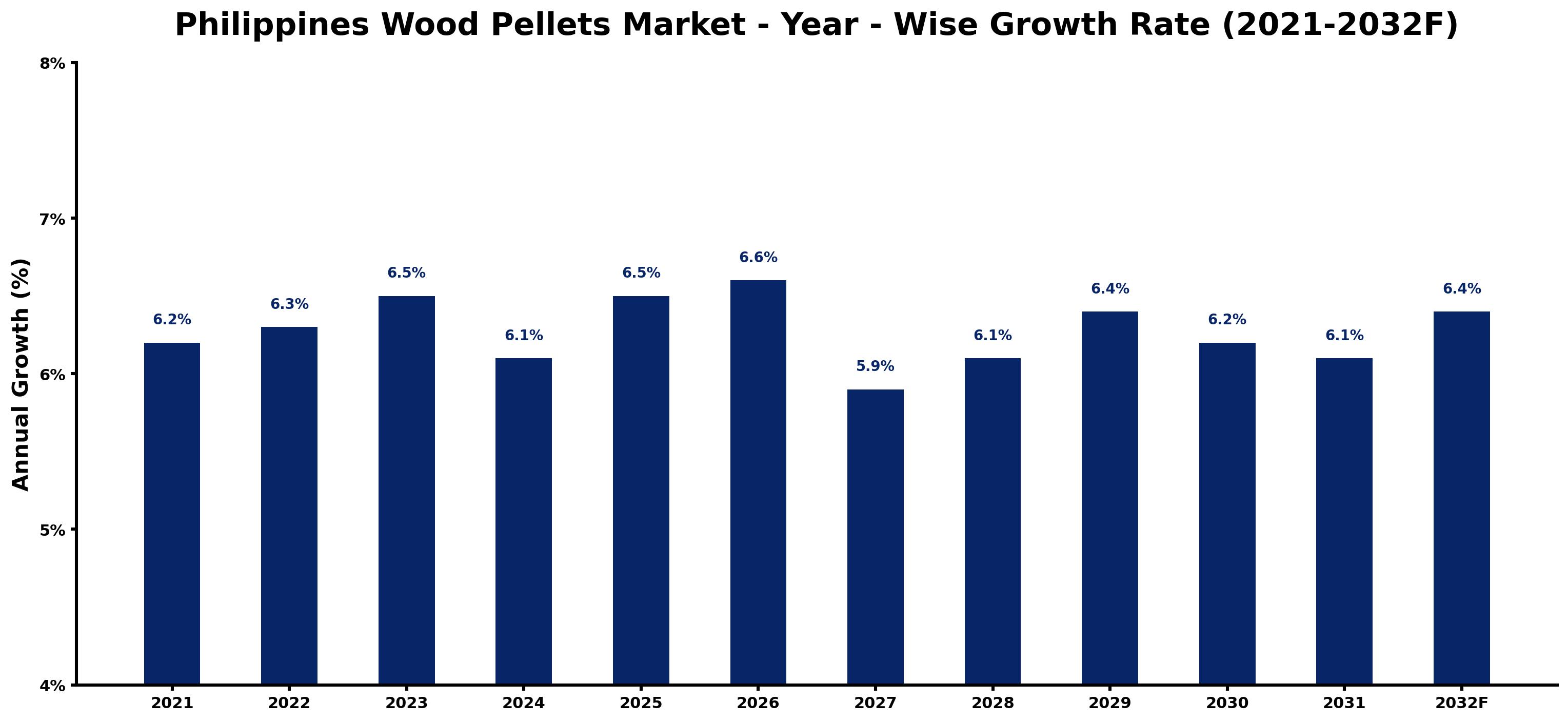
The table below presents the year wise growth rates along with the key drivers influencing the market
| Year | Growth Rate | Major Drivers |
| 2021 | 6.2% | The resurgence of the construction sector increased interest in eco-friendly alternatives. |
| 2022 | 6.3% | Investments in biomass energy projects began to reshape traditional fuel sources. |
| 2023 | 6.5% | Public awareness about renewable energy sources intensified, boosting market visibility. |
| 2024 | 6.1% | Local manufacturers began optimizing wood pellet production processes for efficiency. |
| 2025 | 6.5% | Rural electrification programs prompted demand for alternative energy solutions. |
| 2026 | 6.6% | Competition among suppliers drove innovation and improved wood pellet quality. |
| 2027 | 5.9% | Global supply chain shifts encouraged local sourcing of raw materials. |
| 2028 | 6.1% | Emerging technologies simplified wood pellet combustion, making it more user-friendly. |
| 2029 | 6.4% | Corporate sustainability commitments fueled demand for renewable energy solutions. |
| 2030 | 6.2% | Research collaborations enhanced understanding of wood pellet benefits and applications. |
| 2031 | 6.1% | Community-based initiatives promoted the utilization of biomass in households. |
| 2032 | 6.4% | Investment in infrastructure improvements solidified logistics for efficient wood pellet distribution. |
Note - Market size estimations and growth projections presented in this report are based on 6Wresearch's advanced forecasting approach, validated with industry datasets as of June 2026.
Philippines Wood Pellets Market Synopsis
The Philippines Wood Pellets Market is projected to reach USD 5.4 million and witness significant growth during the forecast period (2026-2032). The market is characterized by a rising demand for renewable energy sources, which is being propelled by growing awareness regarding environmental protection. In addition, supportive government policies are fostering the use of alternative fuels and energy sources, thereby enhancing the market landscape for wood pellets. The increasing popularity of biomass power plants across various sectors, including residential, commercial, and educational institutions, is further anticipated to drive demand within this timeframe.
Philippines Wood Pellets Market Growth Drivers
Several factors are contributing to the growth of the Philippines wood pellets market. One of the primary drivers is the rapidly rising population, which has intensified energy security concerns in the country. The escalating demand for energy has led to increasing investments aimed at developing renewable energy sources, particularly wood pellet-based energy systems. Furthermore, the advancement in production technologies has enabled more efficient extraction and processing of wood pellets, making them a viable alternative energy source for utilities and large-scale industrial facilities.
- Heightened consumer interest in sustainability is driving the adoption of wood pellets as a cleaner energy option compared to fossil fuels.
- Supportive government initiatives aimed at promoting renewable energy usage play a crucial role in bolstering market growth.
- Technological innovations in production processes ensure higher efficiency and lower costs of wood pellet manufacturing.
- Rising disposable income levels among consumers have led to greater preference for eco-friendly products, including wood pellets.
- The thermal insulation properties of wood pellets are gaining attention as a preferred choice in construction, further supporting market growth.
Philippines Wood Pellets Market Trends and Opportunities
The Philippines wood pellets market is witnessing several emerging trends that present new opportunities. The adoption of biomass energy is increasingly popular within residential and commercial settings, which enhances the market potential for wood pellets. Additionally, there is growing interest in green building materials, which could lead to increased application of wood pellets in construction due to their superior thermal performance compared to conventional materials such as concrete and steel.
- The increasing implementation of energy efficiency regulations is likely to further enhance the demand for wood pellets.
- Research into alternative raw materials for pellet production is being expedited, which may diversify the market and provide additional growth avenues.
- Partnerships and collaborations between local producers and international entities could facilitate knowledge exchange and market expansion.
- Public awareness campaigns aimed at educating consumers on the environmental benefits of wood pellets could stimulate demand.
- The rise of the circular economy concept encourages the use of wood pellets, as they aligns with waste reduction and resource efficiency goals.
Philippines Wood Pellets Market Challenges and Restraints
Despite the promising outlook, several challenges may hinder the growth of the Philippines wood pellets market. One significant restraint is the competition posed by cheaper fossil fuels, which may deter potential users from switching to wood pellets. Furthermore, the availability of high-quality raw materials for pellet production could be a limiting factor, as fluctuations in supply can influence prices and production capacity. Additionally, logistical challenges in transporting wood pellets to various end-users can affect the overall market dynamics.
- Regulatory hurdles related to biomass energy generation may slow down project implementations.
- Inconsistent quality of wood pellets from different suppliers could lead to user dissatisfaction and reduced market confidence.
- Market education regarding the benefits of wood pellets is still necessary to overcome consumer skepticism compared to conventional fuel sources.
- The dependency on local supply chains makes the sector vulnerable to economic fluctuations affecting raw material prices.
- Research and development costs associated with advancing wood pellet technology can act as a barrier to new entrants.
Philippines Wood Pellets Market Government Investment and Initiatives
The government of the Philippines is taking significant steps to promote the wood pellets market through various investment and policy initiatives. The government is actively encouraging the development of renewable energy projects as part of its commitment to sustainable energy goals. Public spending directed towards infrastructure development for biomass energy systems is expected to increase, providing the necessary framework for wood pellet utilization. In addition, incentives such as tax breaks for biomass energy producers and grants for research in advanced pellet technology are becoming more commonplace, supporting innovation and growth in the sector.
Philippines Wood Pellets Market Latest Developments (May 2025 - June 2026)
During the period from May 2025 to June 2026, the Philippines wood pellets market has experienced several notable developments. There has been an increased focus on sustainable energy sources, with more stakeholders investing in biomass technologies. Various industry participants have begun exploring innovative applications of wood pellets, including their use in combined heat and power systems. Meetings and dialogues among government agencies, private sectors, and environmental organizations are ongoing to further clarify regulatory frameworks and promote biomass energy.
Philippines Wood Pellets Market - Key Attractiveness of the Report
- 10 Years of Market Numbers
- Historical Data Starting from 2022 to 2025
- Base Year: 2025
- Forecast Data until 2032
- Key Performance Indicators Impacting the Market
- Major Upcoming Developments and Projects
Key Highlights of the Report:
- Philippines Wood Pellets Market Outlook
- Market Size of Philippines Wood Pellets Market, 2025
- Forecast of Philippines Wood Pellets Market, 2032F
- Historical Data and Forecast of Philippines Wood Pellets Revenues & Volume for the Period 2022-2032F
- Philippines Wood Pellets Market Trend Evolution
- Philippines Wood Pellets Market Drivers and Challenges
- Philippines Wood Pellets Price Trends
- Philippines Wood Pellets Porter's Five Forces
- Philippines Wood Pellets Industry Life Cycle
- Historical Data and Forecast of Philippines Wood Pellets Market Revenues & Volume By Types for the Period 2022-2032F
- Historical Data and Forecast of Philippines Wood Pellets Market Revenues & Volume By Hardwood for the Period 2022-2032F
- Historical Data and Forecast of Philippines Wood Pellets Market Revenues & Volume By Softwood for the Period 2022-2032F
- Historical Data and Forecast of Philippines Wood Pellets Market Revenues & Volume By Applications for the Period 2022-2032F
- Historical Data and Forecast of Philippines Wood Pellets Market Revenues & Volume By Power Plants for the Period 2022-2032F
- Historical Data and Forecast of Philippines Wood Pellets Market Revenues & Volume By Residential Heating for the Period 2022-2032F
- Historical Data and Forecast of Philippines Wood Pellets Market Revenues & Volume By Commercial Heating for the Period 2022-2032F
- Historical Data and Forecast of Philippines Wood Pellets Market Revenues & Volume By Combined Heat and Power (CHP) for the Period 2022-2032F
- Philippines Wood Pellets Import Export Trade Statistics
- Market Opportunity Assessment By Types
- Market Opportunity Assessment By Applications
- Philippines Wood Pellets Top Companies Market Share
- Philippines Wood Pellets Competitive Benchmarking By Technical and Operational Parameters
- Philippines Wood Pellets Company Profiles
- Philippines Wood Pellets Key Strategic Recommendations






































