Philippines Wooden Packaging Market Size, Share & Growth Rate
The Philippines Wooden Packaging Market was estimated at USD 1074 Million in 2025 and is projected to reach USD 1565 Million by 2032, growing at a CAGR of 5.5% from 2026 to 2032. This growth trajectory is primarily propelled by an increasing demand for sustainable packaging solutions across various sectors including food, beverages, and pharmaceuticals. The rise of e-commerce and heightened consumer preferences for eco-friendly materials are further fueling market expansion.
Philippines Wooden Packaging Market Year-wise Growth Rate and Key Drivers
This graph highlights how the Philippines Wooden Packaging Market has steadily grown over the years, supported by major growth factors.
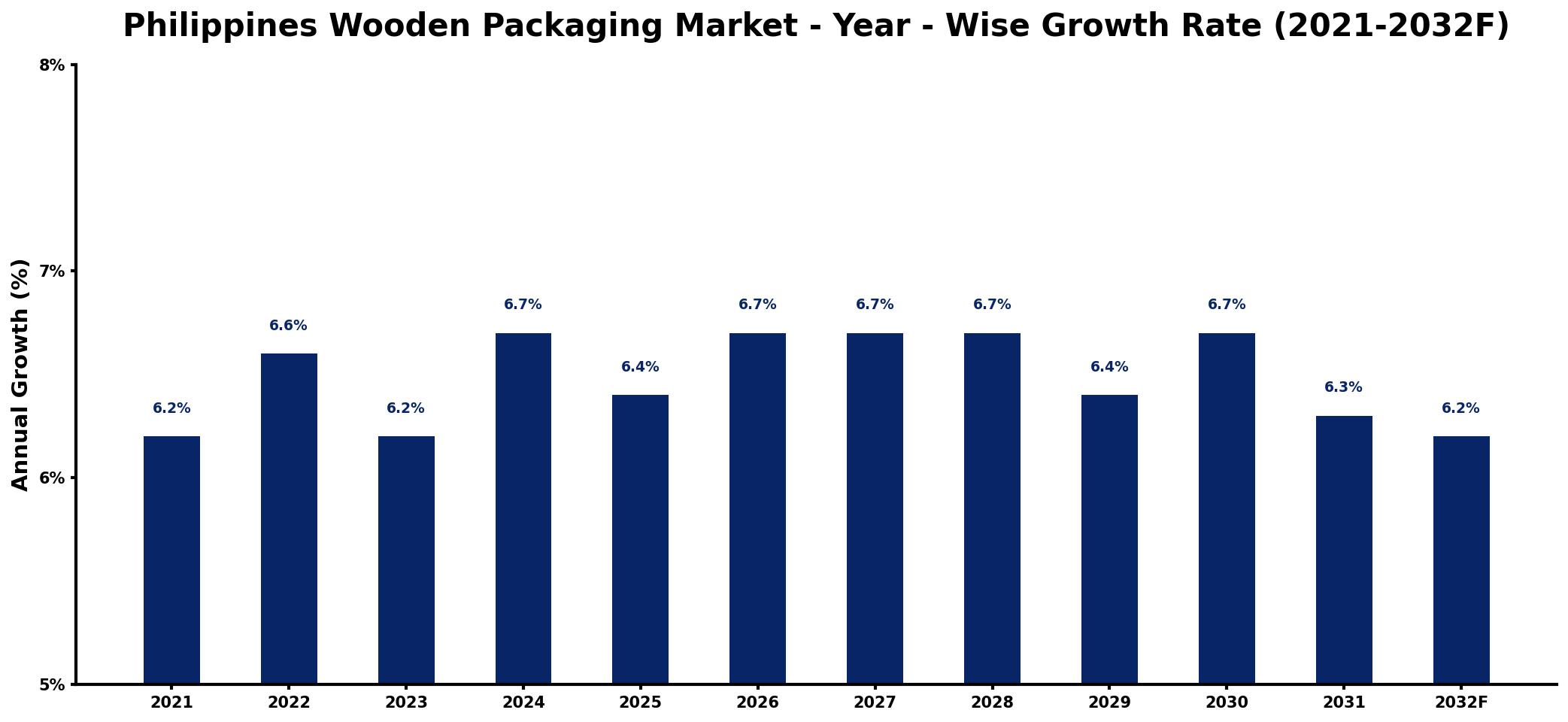
The table below presents the year‑wise growth rates along with the key drivers influencing the market
| Year | Growth Rate | Major Drivers |
| 2021 | 6.2% | Rising eCommerce sector demands growth |
| 2022 | 6.6% | Increased export opportunities drive expansion |
| 2023 | 6.2% | Sustainable materials trend supports demand |
| 2024 | 6.7% | Growing retail sector boosts investments |
| 2025 | 6.4% | Enhanced logistics networks drive need |
| 2026 | 6.7% | Food industry expansion fuels growth |
| 2027 | 6.7% | Local manufacturing investments increase |
| 2028 | 6.7% | Government initiatives encourage sustainability |
| 2029 | 6.4% | Rising consumer preferences shift demand |
| 2030 | 6.7% | Technological advancements enhance efficiency |
| 2031 | 6.3% | Urbanization trends increase market size |
| 2032 | 6.2% | Global trade agreements support growth |
Note: Market size estimations and growth projections presented in this report are based on 6Wresearch's proprietary forecasting methodology, utilizing the latest available industry data, government publications, and primary research inputs.
Philippines Wooden Packaging Market Synopsis
The strongest force shaping the Philippines Wooden Packaging Market today is the burgeoning demand for sustainable packaging options. As industries strive to minimize their carbon footprints, wooden packaging emerges as a compelling choice, blending durability with environmental responsibility.
Increasing awareness regarding the environmental impact of packaging waste has significantly influenced consumer behavior and, subsequently, production practices. This shift in mindset is driving companies to seek innovative wooden packaging solutions, creating a dynamic landscape for growth.
Philippines Wooden Packaging Market Key Takeaways
- Projected market growth of 5.5% CAGR indicates robust demand for wooden packaging solutions.
- Key drivers include rising e-commerce activities and the quest for sustainable packaging alternatives.
- Wooden packaging is gaining traction in diverse industries, notably food, beverages, and pharmaceuticals.
- Heightened regulatory focus on environmentally friendly materials is influencing packaging decisions.
- Opportunities for investment in the sustainable sourcing of wooden materials are emerging.
Evaluation of Restraints in Philippines Wooden Packaging Market
Despite its promising growth, the Philippines Wooden Packaging Market faces several restraints that could limit its potential. The sustainability aspect of wooden packaging is often overshadowed by concerns about deforestation and responsible sourcing. Moreover, navigating international trade regulations poses challenges for exporters. These regulations are designed to prevent the spread of pests and diseases, necessitating compliance that can complicate supply chains. Without addressing these issues, the market may struggle to meet growing demand effectively.
Philippines Wooden Packaging Market Trends
Emerging trends within the Philippines Wooden Packaging Market highlight a shift toward innovative designs that enhance product visibility and consumer appeal. Customization is becoming increasingly important, as brands seek to differentiate themselves through unique packaging. Additionally, the integration of smart technologies into wooden packaging is gaining traction, allowing for better tracking and consumer interaction. These advancements are expected to redefine packaging standards and align with modern consumer expectations.
Philippines Wooden Packaging Market Opportunities
The landscape of the Philippines Wooden Packaging Market is ripe with opportunities for growth and investment. As industries pivot toward sustainability, there is significant potential in developing wooden packaging products that are not only eco-friendly but also economically viable. Moreover, the expansion of export-oriented businesses presents a lucrative avenue for manufacturers to supply wooden packaging to international markets. Investment in sustainable forestry practices will also enhance brand value while meeting regulatory demands.
Government Initiatives in the Philippines Wooden Packaging Market
The Philippine government is increasingly recognizing the importance of sustainable packaging in its environmental policies. Various initiatives aimed at promoting eco-friendly practices are being implemented, which may include incentives for companies that prioritize sustainable sourcing and production methods. Public spending on infrastructure that supports the export of wooden goods, coupled with regulatory frameworks promoting responsible forestry, further underlines the governments commitment to fostering a more sustainable packaging industry.
Future Insights of the Philippines Wooden Packaging Market
Looking ahead to 2026-2032, the Philippines Wooden Packaging Market is expected to evolve significantly. The dual pressures of sustainability and consumer demand are likely to push innovation to the forefront, leading to new materials and designs that enhance functionality while minimizing environmental impact. As the economy continues to expand and e-commerce thrives, the demand for wooden packaging is anticipated to grow, positioning it as a vital element in the overall packaging landscape.
Philippines Wooden Packaging Market Latest Developments (2025 - 2026)
Recent developments within the Philippines Wooden Packaging Market indicate a strong shift towards innovation and sustainability. Companies are beginning to embrace advanced manufacturing techniques, leading to the production of more efficient and eco-friendly packaging solutions. Additionally, collaboration between industry stakeholders is becoming more common, aimed at addressing challenges related to sourcing and sustainability, which suggests a more unified approach to tackling market constraints.
Philippines Wooden Packaging Market - Key Attractiveness of the Report
- 10 Years of Market Numbers
- Historical Data Starting from 2022 to 2025
- Base Year: 2025
- Forecast Data until 2032
- Key Performance Indicators Impacting the Market
- Major Upcoming Developments and Projects
Key Highlights of the Report:
- Philippines Wooden Packaging Market Outlook
- Market Size of Philippines Wooden Packaging Market, 2025
- Forecast of Philippines Wooden Packaging Market, 2032
- Historical Data and Forecast of Philippines Wooden Packaging Revenues & Volume for the Period 2022-2032F
- Philippines Wooden Packaging Market Trend Evolution
- Philippines Wooden Packaging Market Drivers and Challenges
- Philippines Wooden Packaging Price Trends
- Philippines Wooden Packaging Porter's Five Forces
- Philippines Wooden Packaging Industry Life Cycle
- Historical Data and Forecast of Philippines Wooden Packaging Market Revenues & Volume By Type for the Period 2022-2032F
- Historical Data and Forecast of Philippines Wooden Packaging Market Revenues & Volume By Pallets for the Period 2022-2032F
- Historical Data and Forecast of Philippines Wooden Packaging Market Revenues & Volume By Boxes and Bins for the Period 2022-2032F
- Historical Data and Forecast of Philippines Wooden Packaging Market Revenues & Volume By Crates and Cases for the Period 2022-2032F
- Historical Data and Forecast of Philippines Wooden Packaging Market Revenues & Volume By Spools for the Period 2022-2032F
- Historical Data and Forecast of Philippines Wooden Packaging Market Revenues & Volume By Dunnage for the Period 2022-2032F
- Historical Data and Forecast of Philippines Wooden Packaging Market Revenues & Volume By Others for the Period 2022-2032F
- Historical Data and Forecast of Philippines Wooden Packaging Market Revenues & Volume By Application for the Period 2022-2032F
- Historical Data and Forecast of Philippines Wooden Packaging Market Revenues & Volume By Food & Beverages Storage for the Period 2022-2032F
- Historical Data and Forecast of Philippines Wooden Packaging Market Revenues & Volume By Transportation for the Period 2022-2032F
- Historical Data and Forecast of Philippines Wooden Packaging Market Revenues & Volume By Industrial for the Period 2022-2032F
- Historical Data and Forecast of Philippines Wooden Packaging Market Revenues & Volume By Shipping for the Period 2022-2032F
- Historical Data and Forecast of Philippines Wooden Packaging Market Revenues & Volume By Others for the Period 2022-2032F
- Philippines Wooden Packaging Import Export Trade Statistics
- Market Opportunity Assessment By Type
- Market Opportunity Assessment By Application
- Philippines Wooden Packaging Top Companies Market Share
- Philippines Wooden Packaging Competitive Benchmarking By Technical and Operational Parameters
- Philippines Wooden Packaging Company Profiles
- Philippines Wooden Packaging Key Strategic Recommendations






































