Philippines Woodworking CNC Tools Market Size, Share & Growth Rate
The Philippines Woodworking CNC Tools Market was estimated at USD 759 Million in 2025 and is projected to reach USD 1088 Million by 2032, growing at a CAGR of 5.3% from 2026 to 2032. This growth trajectory is largely fueled by the ongoing advancements in CNC technology, which cater to the increasing demand for precision in woodworking. As more professionals seek to elevate their craftsmanship and operational efficiency, the adoption of CNC tools is becoming a necessity rather than an option.
Philippines Woodworking CNC Tools Market Year-wise Growth Rate and Key Drivers
This graph highlights how the Philippines Woodworking CNC Tools Market has steadily grown over the years, supported by major growth factors.
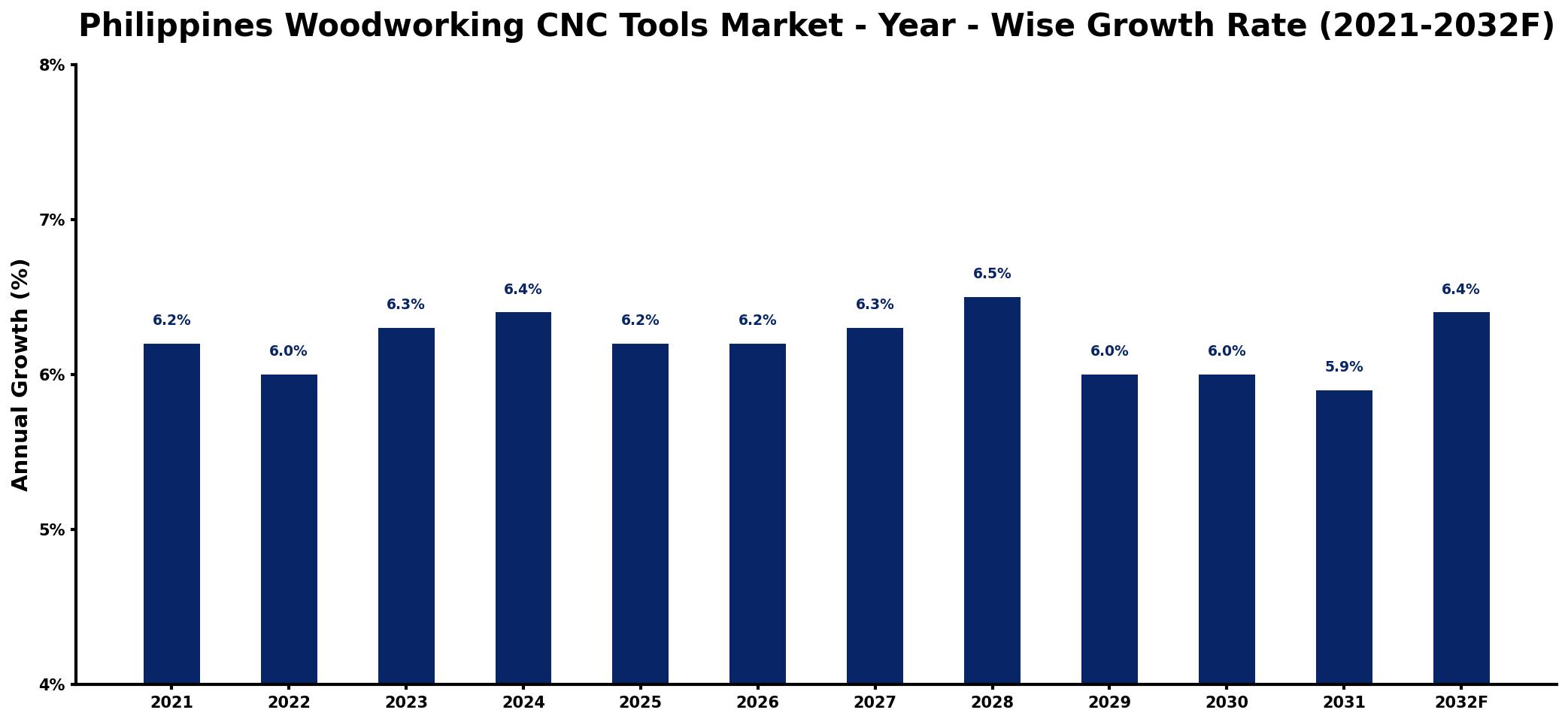
The table below presents the year‑wise growth rates along with the key drivers influencing the market
| Year | Growth Rate | Major Drivers |
| 2021 | 6.2% | Rising construction sector investments |
| 2022 | 6.0% | Increased furniture manufacturing demand |
| 2023 | 6.3% | Growing home renovation projects |
| 2024 | 6.4% | Surge in custom cabinetry orders |
| 2025 | 6.2% | Expansion of local artisan businesses |
| 2026 | 6.2% | Higher demand for interior design |
| 2027 | 6.3% | Growth in eco-friendly materials |
| 2028 | 6.5% | Increased exports to neighboring countries |
| 2029 | 6.0% | Rising popularity of DIY projects |
| 2030 | 6.0% | Enhanced technological adoption trends |
| 2031 | 5.9% | growing automotive sector requirements |
| 2032 | 6.4% | Increase in urban population density |
Note: Market size estimations and growth projections presented in this report are based on 6Wresearch's proprietary forecasting methodology, utilizing the latest available industry data, government publications, and primary research inputs.
Philippines Woodworking CNC Tools Market Synopsis
The Philippines woodworking CNC tools market is witnessing a remarkable transformation, bolstered by an expanding construction sector and a growing interest in customized woodworking solutions. This evolution is not just a trend; it represents a fundamental shift in how woodworking professionals approach their craft, emphasizing accuracy and efficiency.
Despite the challenges posed by recent global events, the market is recovering, showing resilience and adaptability. Increased investments in technology and skilled labor are paving the way for enhanced production capabilities, positioning the Philippines as an emerging hub for woodworking innovation in the region.
Philippines Woodworking CNC Tools Market Key Takeaways
- The market is experiencing a compound annual growth rate (CAGR) of 5.3% from 2026 to 2032.
- Demand for precision woodworking is driving the adoption of CNC tools among professionals.
- The market is rebounding from the impacts of COVID-19, with increased investments expected.
- Small and medium-sized enterprises face barriers in technology adoption due to cost and training challenges.
- Technological advancements continue to enhance product offerings and capabilities within the sector.
Evaluation of Restraints in Philippines Woodworking CNC Tools Market
While the potential for growth in the woodworking CNC tools market is substantial, several restraints hinder its full realization. Chief among these are the high upfront costs associated with CNC technology, which can be prohibitive for small and medium-sized enterprises. Additionally, the necessity for specialized training to operate these advanced tools presents a significant barrier. Many businesses struggle to allocate resources for ongoing education, which can stifle the overall adoption rate of CNC solutions in the industry.
Philippines Woodworking CNC Tools Market Trends
A notable trend in the Philippines woodworking CNC tools market is the increasing preference for smart and automated solutions. As the industry moves towards Industry 4.0, more companies are integrating IoT capabilities into CNC tools to optimize performance and streamline operations. Furthermore, sustainability practices are gaining traction, with manufacturers beginning to prioritize eco-friendly materials and processes.
Philippines Woodworking CNC Tools Market Opportunities
Opportunities abound in the Philippines woodworking CNC tools market, particularly in the realm of customization and niche applications. As consumer preferences evolve, businesses that can offer tailored solutions and services are likely to capture a significant share of the market. Additionally, the growing interest in artisan woodworking presents a unique opportunity for the development of specialized CNC tools that cater to this segment.
Government Initiatives in the Philippines Woodworking CNC Tools Market
The Philippine government has been proactive in promoting advancements in manufacturing technologies, including CNC woodworking tools. Various programs aimed at boosting local manufacturing capabilities and investing in training initiatives are in place. These efforts reflect a commitment to enhancing the competitiveness of the woodworking sector, thereby stimulating demand for innovative tools and solutions.
Future Insights of the Philippines Woodworking CNC Tools Market
Looking ahead to 2026-2032, the Philippines woodworking CNC tools market is set to embrace significant technological advancements, further solidifying its growth trajectory. The integration of AI and machine learning into CNC processes promises to enhance efficiency and reduce waste. Furthermore, as the global market increasingly values sustainability, Filipino manufacturers will need to adapt by embracing greener technologies and practices to remain competitive.
Philippines Woodworking CNC Tools Market Latest Developments (2025 - 2026)
Recent developments within the Philippines woodworking CNC tools market indicate a shift towards more collaborative and integrated manufacturing systems. Companies are increasingly focused on upgrading existing machinery to include advanced automation features. Moreover, there has been a notable increase in workshops and training programs aimed at equipping workers with the necessary skills to operate and maintain these sophisticated tools, reflecting the industry's commitment to nurturing talent.
Philippines Woodworking CNC Tools Market - Key Attractiveness of the Report
- 10 Years of Market Numbers
- Historical Data Starting from 2022 to 2025
- Base Year: 2025
- Forecast Data until 2032
- Key Performance Indicators Impacting the Market
- Major Upcoming Developments and Projects
Key Highlights of the Report:
- Philippines Woodworking CNC Tools Market Outlook
- Market Size of Philippines Woodworking CNC Tools Market, 2025
- Forecast of Philippines Woodworking CNC Tools Market, 2032
- Historical Data and Forecast of Philippines Woodworking CNC Tools Revenues & Volume for the Period 2022-2032F
- Philippines Woodworking CNC Tools Market Trend Evolution
- Philippines Woodworking CNC Tools Market Drivers and Challenges
- Philippines Woodworking CNC Tools Price Trends
- Philippines Woodworking CNC Tools Porter's Five Forces
- Philippines Woodworking CNC Tools Industry Life Cycle
- Historical Data and Forecast of Philippines Woodworking CNC Tools Market Revenues & Volume By Tool Type for the Period 2022-2032F
- Historical Data and Forecast of Philippines Woodworking CNC Tools Market Revenues & Volume By Router Bits for the Period 2022-2032F
- Historical Data and Forecast of Philippines Woodworking CNC Tools Market Revenues & Volume By Insert Knives for the Period 2022-2032F
- Historical Data and Forecast of Philippines Woodworking CNC Tools Market Revenues & Volume By Engraving Tools for the Period 2022-2032F
- Historical Data and Forecast of Philippines Woodworking CNC Tools Market Revenues & Volume By Cutters for the Period 2022-2032F
- Historical Data and Forecast of Philippines Woodworking CNC Tools Market Revenues & Volume By Wood Type for the Period 2022-2032F
- Historical Data and Forecast of Philippines Woodworking CNC Tools Market Revenues & Volume By Plywood for the Period 2022-2032F
- Historical Data and Forecast of Philippines Woodworking CNC Tools Market Revenues & Volume By Chipboard for the Period 2022-2032F
- Historical Data and Forecast of Philippines Woodworking CNC Tools Market Revenues & Volume By MDF (Medium Density Fiberboard) for the Period 2022-2032F
- Historical Data and Forecast of Philippines Woodworking CNC Tools Market Revenues & Volume By HDF (High Density Fiberboard) for the Period 2022-2032F
- Historical Data and Forecast of Philippines Woodworking CNC Tools Market Revenues & Volume By Hardwood for the Period 2022-2032F
- Historical Data and Forecast of Philippines Woodworking CNC Tools Market Revenues & Volume By Operation for the Period 2022-2032F
- Historical Data and Forecast of Philippines Woodworking CNC Tools Market Revenues & Volume By Milling for the Period 2022-2032F
- Historical Data and Forecast of Philippines Woodworking CNC Tools Market Revenues & Volume By Drilling for the Period 2022-2032F
- Historical Data and Forecast of Philippines Woodworking CNC Tools Market Revenues & Volume By Cutting for the Period 2022-2032F
- Historical Data and Forecast of Philippines Woodworking CNC Tools Market Revenues & Volume By Profiling for the Period 2022-2032F
- Philippines Woodworking CNC Tools Import Export Trade Statistics
- Market Opportunity Assessment By Tool Type
- Market Opportunity Assessment By Wood Type
- Market Opportunity Assessment By Operation
- Philippines Woodworking CNC Tools Top Companies Market Share
- Philippines Woodworking CNC Tools Competitive Benchmarking By Technical and Operational Parameters
- Philippines Woodworking CNC Tools Company Profiles
- Philippines Woodworking CNC Tools Key Strategic Recommendations






































