Poland Activated Carbon Market: Import Trend Analysis
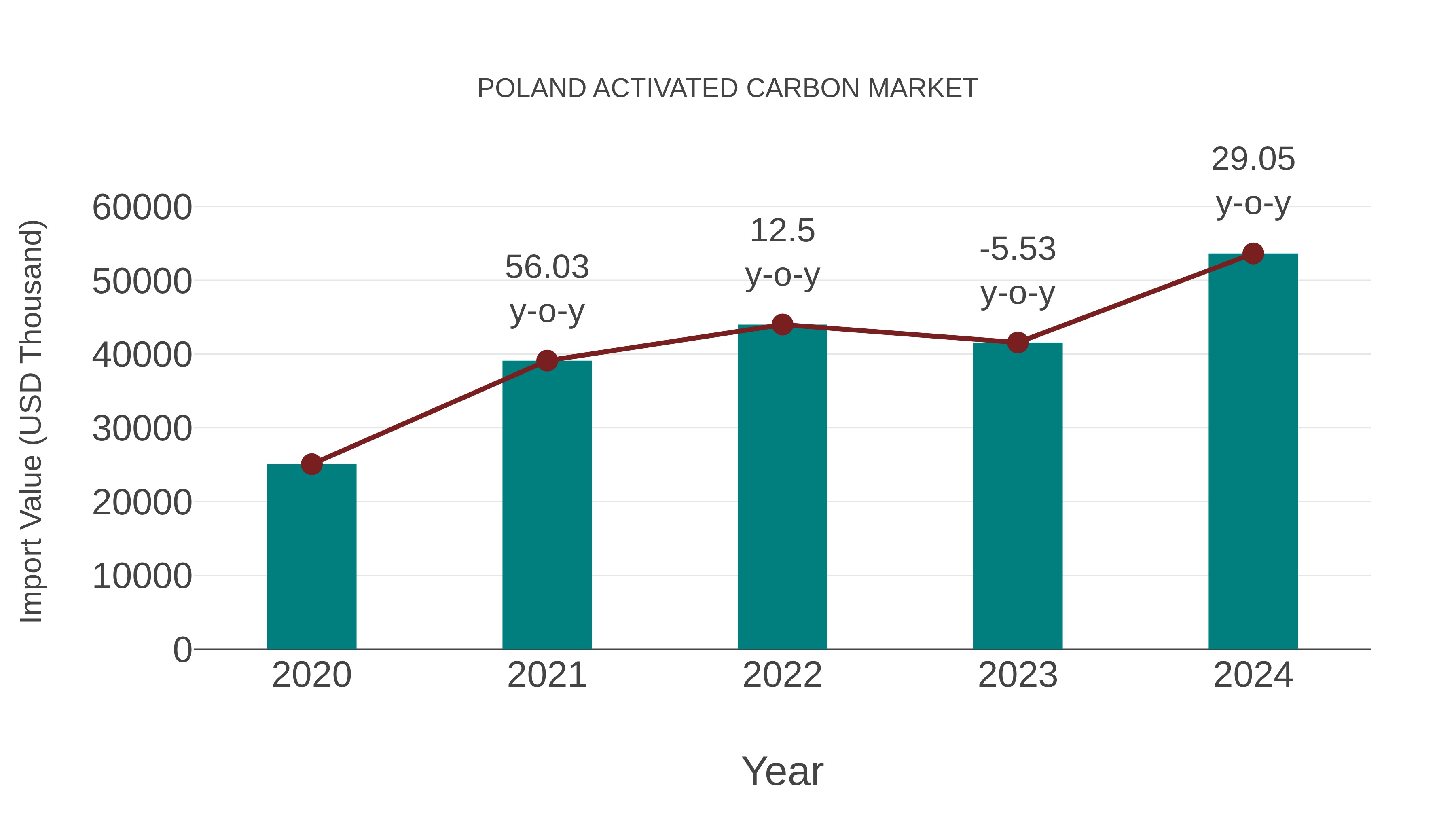
In the Poland activated carbon market, the import trend experienced significant growth from 2023 to 2024, with a growth rate of 29.05%. The compound annual growth rate (CAGR) from 2020 to 2024 stood at 20.95%. This upward momentum in imports can be attributed to a notable shift in demand towards activated carbon products, indicating a strengthening market stability during the period.
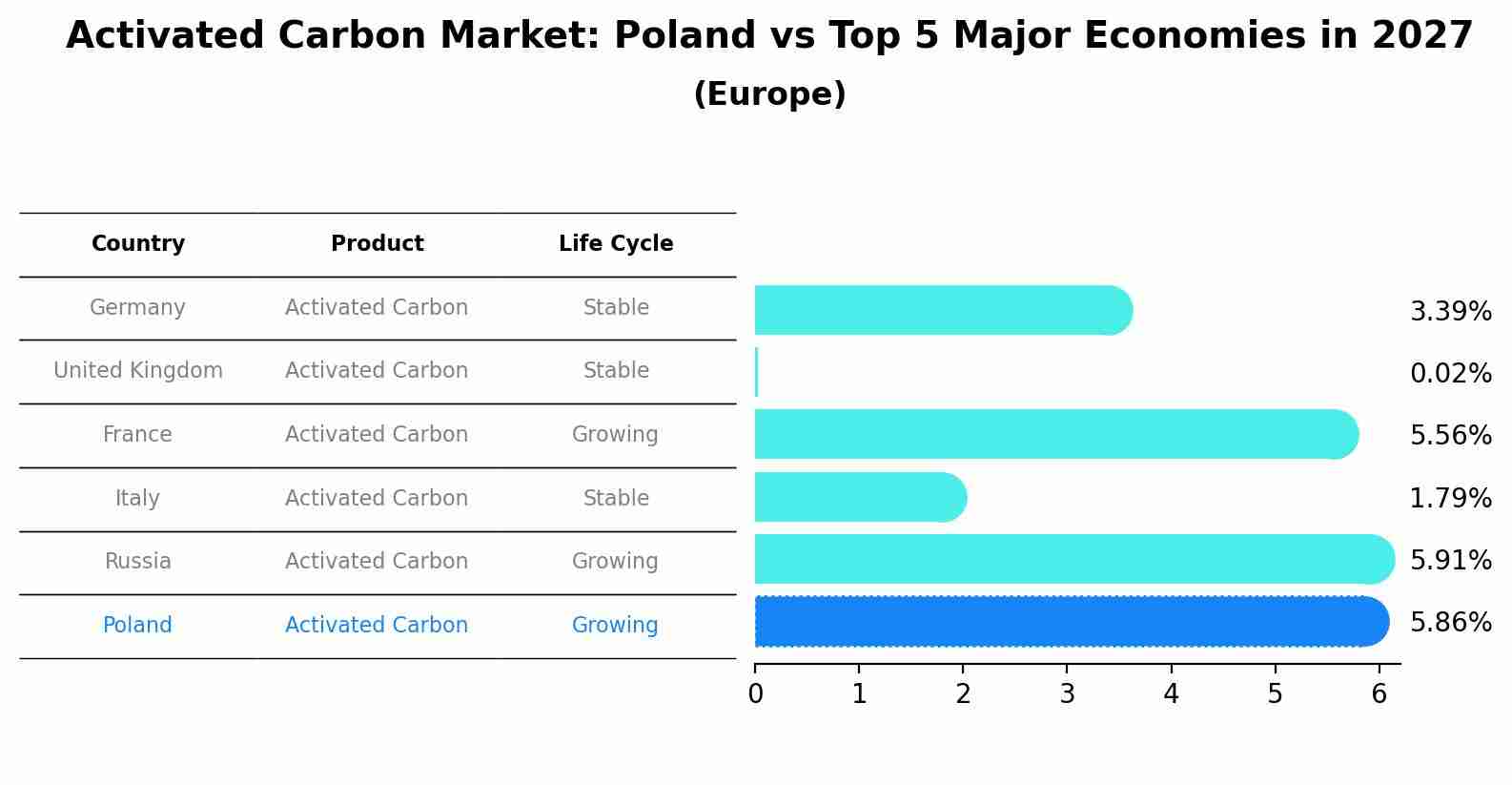
Activated Carbon Market: Poland vs Top 5 Major Economies in 2027 (Europe)
The Activated Carbon market in Poland is projected to grow at a growing growth rate of 5.86% by 2027, highlighting the country's increasing focus on advanced technologies within the Europe region, where Germany holds the dominant position, followed closely by United Kingdom, France, Italy and Russia, shaping overall regional demand.
Poland Activated Carbon Market Overview
The Poland Activated Carbon Market is experiencing steady growth driven by increasing environmental concerns and stringent regulations regarding air and water purification. The market is primarily driven by the industrial sector, including applications in water treatment, gas purification, and automotive emissions control. Additionally, the rising awareness of the benefits of activated carbon in various end-use industries, such as food & beverage, pharmaceuticals, and mining, is further contributing to market expansion. Key players in the Poland Activated Carbon Market are focusing on product innovations, strategic partnerships, and mergers & acquisitions to gain a competitive edge. The market is expected to continue its growth trajectory in the coming years, supported by ongoing investments in environmental sustainability and pollution control measures.
Poland Activated Carbon Market Trends
The Poland Activated Carbon Market is experiencing growth due to increasing environmental regulations and the rising demand for water and air purification. Key trends include a shift towards sustainable production methods and the development of activated carbon from renewable sources such as coconut shells and wood. The market is also witnessing a growing adoption of activated carbon in industries like pharmaceuticals, food and beverage, and automotive for various applications including gas purification, odor removal, and wastewater treatment. Market players are focusing on innovation to create advanced activated carbon products with improved efficiency and performance, while also emphasizing the importance of quality control and compliance with stringent regulations to maintain a competitive edge in the market.
Poland Activated Carbon Market Challenges
In the Poland activated carbon market, some key challenges include increasing raw material costs due to fluctuations in coal and coconut shell prices, which are the primary sources of activated carbon production. Additionally, strict environmental regulations and compliance standards require continuous investment in technology and processes to ensure product quality and sustainability. Competition from low-cost producers in other regions also poses a challenge, leading to price pressures and the need for Polish companies to differentiate their products through innovation and value-added services. Furthermore, the market faces limited consumer awareness and understanding of the benefits of activated carbon across various industries, which requires targeted marketing and educational efforts to expand the market potential and drive demand for activated carbon products in Poland.
Poland Activated Carbon Market Investment Opportunities
The Poland Activated Carbon Market offers promising investment opportunities due to the increasing demand for activated carbon across various industries such as water treatment, air purification, food and beverage, and pharmaceuticals. With growing environmental concerns and stringent regulations on water and air quality, the need for effective purification solutions using activated carbon is on the rise. Investing in companies that manufacture or distribute activated carbon products in Poland could be lucrative as the market is expected to expand further. Additionally, advancements in technology for producing activated carbon and the development of sustainable and innovative solutions present opportunities for growth and differentiation in the market. Overall, investing in the Poland Activated Carbon Market aligns with the trend towards sustainability and environmental stewardship, making it a promising venture for investors.
Poland Activated Carbon Market Government Policy
In Poland, government policies related to the activated carbon market primarily focus on environmental protection and air quality improvement. The Polish government has implemented regulations aimed at reducing emissions from industrial processes and power plants, which has increased the demand for activated carbon for use in air and water purification systems. Additionally, there are initiatives in place to promote the development and adoption of clean technologies, including the use of activated carbon filters in various applications. The government also supports research and development efforts to enhance the efficiency and sustainability of activated carbon production processes. Overall, the regulatory framework in Poland is driving growth in the activated carbon market and encouraging investments in eco-friendly solutions to address environmental challenges.
Poland Activated Carbon Market Future Outlook
The future outlook for the Poland Activated Carbon Market appears promising, driven by increasing awareness of environmental issues and stringent regulations promoting the use of activated carbon for air and water purification. The market is expected to witness steady growth due to rising industrial activities, particularly in sectors such as water treatment, food & beverage, pharmaceuticals, and automotive. Additionally, the growing emphasis on sustainable practices and the increasing adoption of activated carbon in gas-phase applications like automotive emission control systems further contribute to the market`s expansion. Key market players are likely to focus on product innovation and strategic partnerships to capitalize on these opportunities and maintain a competitive edge in the evolving market landscape.
Key Highlights of the Report:
- Poland Activated Carbon Market Outlook
- Market Size of Poland Activated Carbon Market, 2021
- Forecast of Poland Activated Carbon Market, 2027
- Historical Data and Forecast of Poland Activated Carbon Revenues & Volume for the Period 2018 - 2027
- Poland Activated Carbon Market Trend Evolution
- Poland Activated Carbon Market Drivers and Challenges
- Poland Activated Carbon Price Trends
- Poland Activated Carbon Porter's Five Forces
- Poland Activated Carbon Industry Life Cycle
- Historical Data and Forecast of Poland Activated Carbon Market Revenues & Volume By Product for the Period 2018 - 2027
- Historical Data and Forecast of Poland Activated Carbon Market Revenues & Volume By Powdered for the Period 2018 - 2027
- Historical Data and Forecast of Poland Activated Carbon Market Revenues & Volume By Granular for the Period 2018 - 2027
- Historical Data and Forecast of Poland Activated Carbon Market Revenues & Volume By Others for the Period 2018 - 2027
- Historical Data and Forecast of Poland Activated Carbon Market Revenues & Volume By Application for the Period 2018 - 2027
- Historical Data and Forecast of Poland Activated Carbon Market Revenues & Volume By Liquid Phase for the Period 2018 - 2027
- Historical Data and Forecast of Poland Activated Carbon Market Revenues & Volume By Gas Phase for the Period 2018 - 2027
- Historical Data and Forecast of Poland Activated Carbon Market Revenues & Volume By End-use for the Period 2018 - 2027
- Historical Data and Forecast of Poland Activated Carbon Market Revenues & Volume By Water Treatment for the Period 2018 - 2027
- Historical Data and Forecast of Poland Activated Carbon Market Revenues & Volume By Food & Beverage Processing for the Period 2018 - 2027
- Historical Data and Forecast of Poland Activated Carbon Market Revenues & Volume By Pharmaceutical & Medical for the Period 2018 - 2027
- Historical Data and Forecast of Poland Activated Carbon Market Revenues & Volume By Automotive for the Period 2018 - 2027
- Historical Data and Forecast of Poland Activated Carbon Market Revenues & Volume By Air Purification for the Period 2018 - 2027
- Historical Data and Forecast of Poland Activated Carbon Market Revenues & Volume By Others for the Period 2018 - 2027
- Poland Activated Carbon Import Export Trade Statistics
- Market Opportunity Assessment By Product
- Market Opportunity Assessment By Application
- Market Opportunity Assessment By End-use
- Poland Activated Carbon Top Companies Market Share
- Poland Activated Carbon Competitive Benchmarking By Technical and Operational Parameters
- Poland Activated Carbon Company Profiles
- Poland Activated Carbon Key Strategic Recommendations






































