Poland Algorithmic Trading Market Size & Growth Rate (2026-2032)
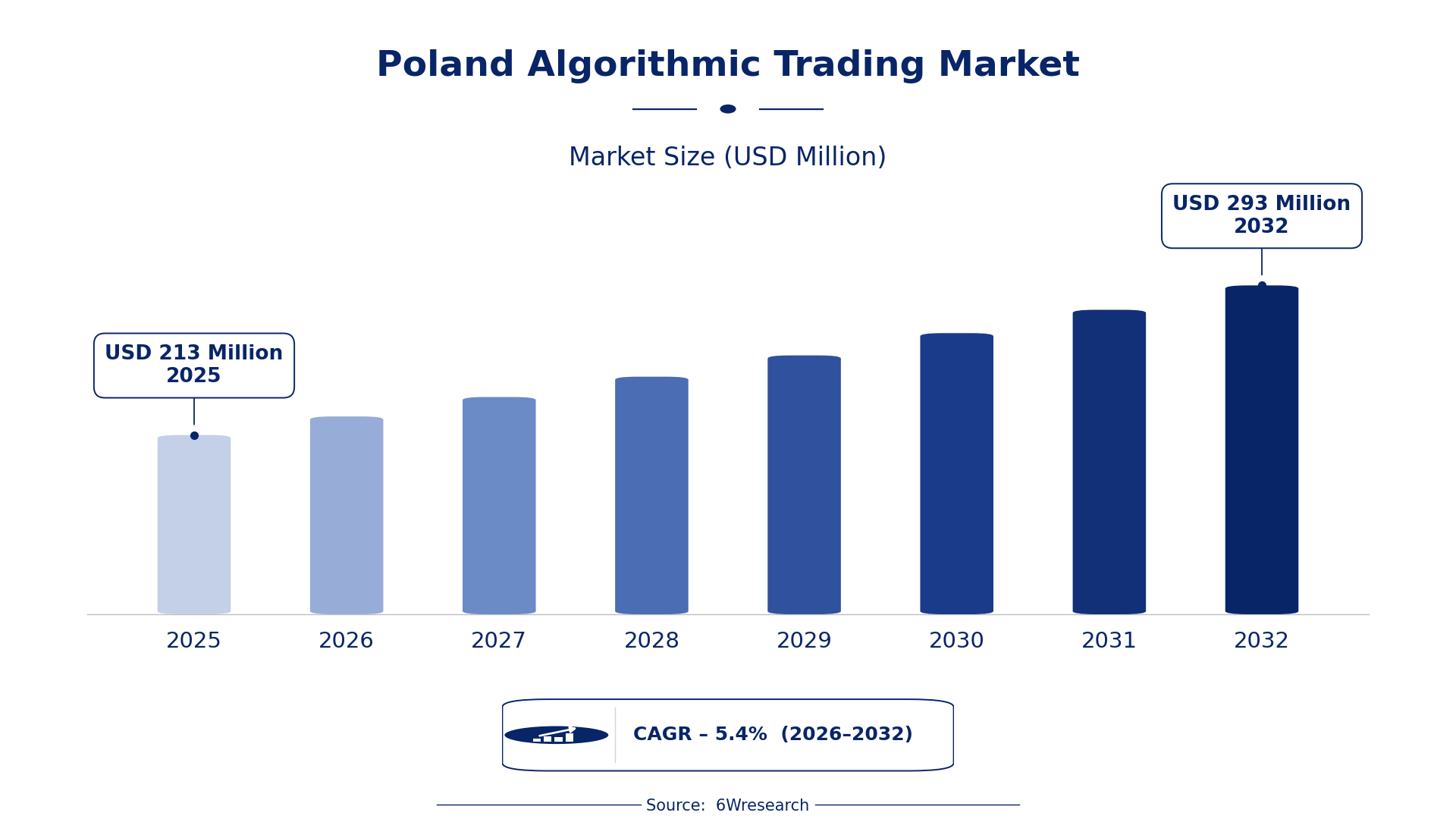
The Poland Algorithmic Trading Market was estimated at USD 213 Million in 2025 and is projected to reach USD 293 Million by 2032, growing at a CAGR of 5.4% from 2026 to 2032.
Poland Algorithmic Trading Market Synopsis
The Poland Algorithmic Trading Market is currently experiencing a notable surge in activity, marked by technological advancements and increased automation. As the market evolves, a broader acceptance of algorithmic trading strategies among institutional and retail investors is anticipated, paving the way for enhanced trading efficiency.
Looking ahead, the landscape is set for transformation as more participants adopt sophisticated trading algorithms. Factors such as regulatory evolution and the integration of artificial intelligence will play crucial roles in shaping the future of algorithmic trading in Poland.
Poland Algorithmic Trading Market Year-wise Growth Rate and Key Drivers
This graph illustrates the annual growth rates of the Poland Algorithmic Trading Market from 2021 to 2032, highlighting a steady upward trajectory and projected expansion over the forecast period.
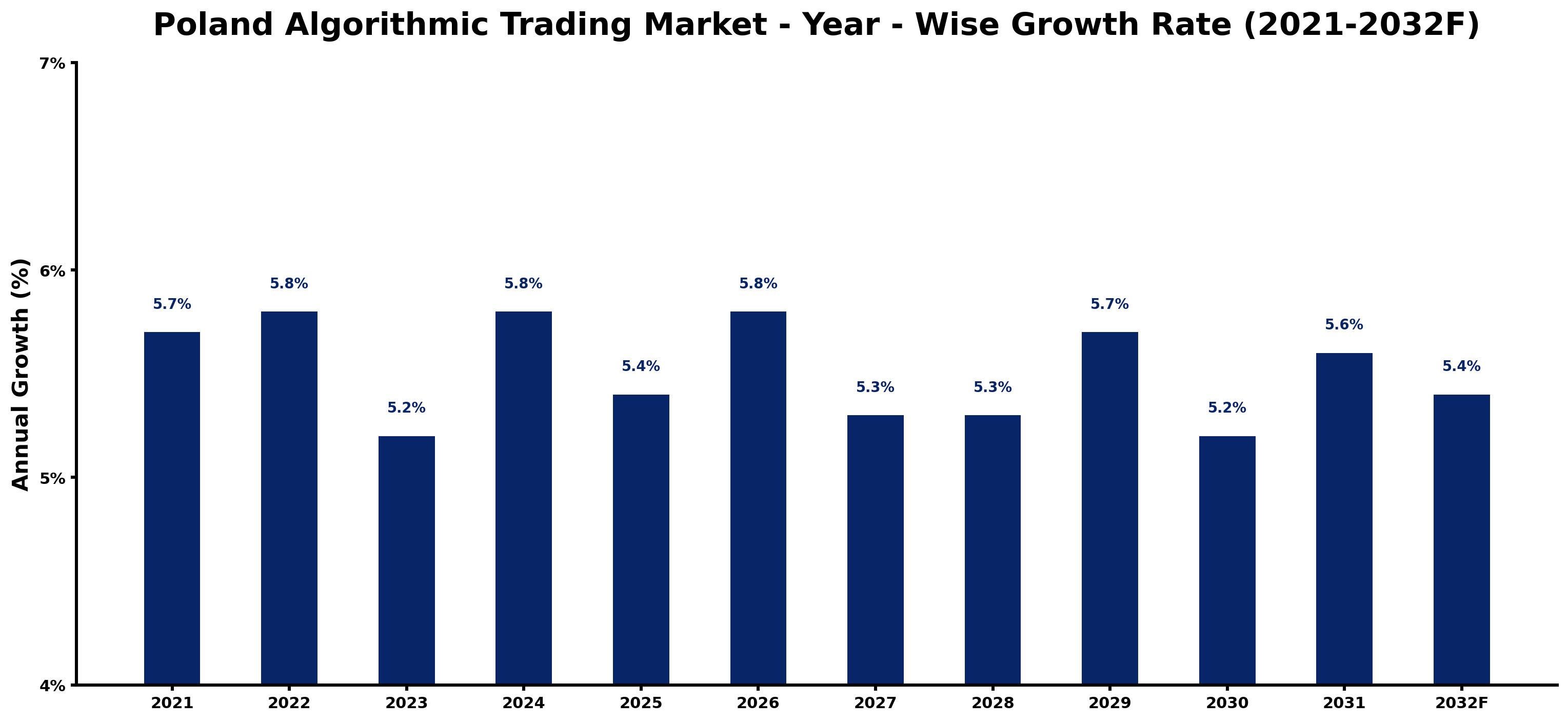
The table below presents the year‑wise growth rates along with the key drivers influencing the market
| Year | Growth Rate | Major Drivers |
| 2021 | 5.7% | Increase in retail investor participation post-pandemic. |
| 2022 | 5.8% | Growing interest in algorithmic strategies among Polish brokers. |
| 2023 | 5.2% | Regulatory support for fintech innovations from KNF. |
| 2024 | 5.8% | Rise of AI-driven trading platforms in local exchanges. |
| 2025 | 5.4% | Increased data availability enhancing algorithm performance. |
| 2026 | 5.8% | Partnerships between banks and tech firms boosting algorithms. |
| 2027 | 5.3% | Surge in demand for fast, automated trading solutions. |
| 2028 | 5.3% | Developments in Polish fintech ecosystem supporting automation. |
| 2029 | 5.7% | International investments flowing into Polish trading technology. |
| 2030 | 5.2% | Robust performance of Warsaw Stock Exchange attracting traders. |
| 2031 | 5.6% | Increased university programs focused on quantitative finance. |
| 2032 | 5.4% | Emergence of local startups specializing in trading algorithms. |
Note: Market size estimations and growth projections presented in this report are based on 6Wresearch's proprietary forecasting methodology, utilizing the latest available industry data, government publications, and primary research inputs.
Poland Algorithmic Trading Market Key Takeaways
Below are some of the specific key takeaways from the market, including:
- The market is characterized by a growing number of participants adopting algorithmic strategies.
- Technological advancements in AI and machine learning are driving market innovation.
- Regulatory developments are reshaping the operational framework for algorithmic trading firms.
- High-frequency trading strategies are becoming increasingly popular among market players.
- Emerging opportunities exist in customizing algorithmic trading solutions for niche strategies.
Evaluation of Restraints in Poland Algorithmic Trading Market
Several restraints are currently impacting the Poland Algorithmic Trading Market. Regulatory uncertainties pose significant challenges for firms striving to comply with evolving guidelines. The complexity of MiFID II requirements adds an additional layer of operational difficulty. on top of that, technological infrastructure issues, including outdated systems, hinder the speed and efficiency of algorithmic trading processes. Cybersecurity remains a persistent threat, as firms are increasingly targeted due to the sensitive nature of financial data they handle.
Poland Algorithmic Trading Market Trends
Current trends in the Poland Algorithmic Trading Market are heavily influenced by the rise of high-frequency trading and the integration of advanced technologies. The incorporation of machine learning algorithms is enhancing the ability to analyze vast data sets, leading to more informed trading decisions. Additionally, there’s a notable shift toward expanding algorithmic trading beyond traditional asset classes, such as equities, into more diverse financial instruments, reflecting a growing sophistication among traders.
Poland Algorithmic Trading Market Opportunities
The market presents several promising opportunities for investment and growth. There is a clear demand for tailored algorithmic trading solutions that cater to specific trading strategies. The integration of alternative data sources into trading algorithms is also set to enhance market analytics, improving overall trading performance. on top of that, as the financial sector continues to digitize, the potential for algorithmic trading to boost market liquidity and efficiency offers a compelling avenue for future development.
Government Initiatives in the Poland Algorithmic Trading Market
Government policies are crucial in shaping the Poland Algorithmic Trading Market. The Polish Financial Supervision Authority (KNF) plays a central role in regulating algorithmic trading practices, ensuring compliance with both national and EU regulations. These policies prioritize market transparency and integrity while addressing potential risks associated with algorithmic trading.
- A regulatory framework established in 2023 mandates enhanced risk management practices for algorithmic trading firms.
- Currently, the KNF is conducting workshops to educate market participants about compliance with MiFID II requirements.
- A national initiative aimed at strengthening cybersecurity measures for trading firms is in the early stages of implementation.
- Upcoming plans include a collaborative effort between the KNF and EU regulatory bodies to standardize algorithmic trading regulations by 2025.
Future Insights of the Poland Algorithmic Trading Market
The outlook for the Poland Algorithmic Trading Market from 2026 to 2032 appears optimistic. As technological adoption accelerates, more firms will likely integrate algorithmic trading solutions to optimize their operations. The continued emphasis on transparency and regulatory compliance will drive firms to innovate further, enhancing their competitive edge. Expect the market to mature significantly, fostering an environment ripe for investment and growth.
Poland Algorithmic Trading Market Latest Developments
Recent months have seen a flurry of activity within the Poland Algorithmic Trading Market, reflecting an increased focus on technological innovation and regulatory compliance. Firms are actively seeking to enhance their algorithmic trading capabilities amid a backdrop of evolving regulations and competitive pressures.
- A major technology vendor launched a new AI-driven algorithmic trading platform in Q2 2025, aimed at improving execution speed.
- In early 2025, a collaboration between several financial institutions resulted in the development of a shared trading infrastructure to boost efficiency.
- Ongoing efforts to integrate advanced machine learning capabilities into existing trading algorithms have shown promising results in backtesting scenarios.
- A planned initiative to enhance connectivity between trading platforms is expected to commence in late 2026.
Poland Algorithmic Trading Market - Key Attractiveness of the Report
- 10 Years of Market Numbers
- Historical Data Starting from 2022 to 2025
- Base Year: 2025
- Forecast Data until 2032
- Key Performance Indicators Impacting the Market
- Major Upcoming Developments and Projects
Key Highlights of the Report:
- Poland Algorithmic Trading Market Outlook
- Market Size of Poland Algorithmic Trading Market, 2025
- Forecast of Poland Algorithmic Trading Market, 2032
- Historical Data and Forecast of Poland Algorithmic Trading Revenues & Volume for the Period 2022-2032F
- Poland Algorithmic Trading Market Trend Evolution
- Poland Algorithmic Trading Market Drivers and Challenges
- Poland Algorithmic Trading Price Trends
- Poland Algorithmic Trading Porter's Five Forces
- Poland Algorithmic Trading Industry Life Cycle
- Historical Data and Forecast of Poland Algorithmic Trading Market Revenues & Volume By Trading Type for the Period 2022-2032F
- Historical Data and Forecast of Poland Algorithmic Trading Market Revenues & Volume By Foreign Exchange (FOREX) for the Period 2022-2032F
- Historical Data and Forecast of Poland Algorithmic Trading Market Revenues & Volume By Stock Markets for the Period 2022-2032F
- Historical Data and Forecast of Poland Algorithmic Trading Market Revenues & Volume By Exchange-Traded Fund (ETF) for the Period 2022-2032F
- Historical Data and Forecast of Poland Algorithmic Trading Market Revenues & Volume By Bonds for the Period 2022-2032F
- Historical Data and Forecast of Poland Algorithmic Trading Market Revenues & Volume By Cryptocurrencies for the Period 2022-2032F
- Historical Data and Forecast of Poland Algorithmic Trading Market Revenues & Volume By Others for the Period 2022-2032F
- Historical Data and Forecast of Poland Algorithmic Trading Market Revenues & Volume By Deployment Mode for the Period 2022-2032F
- Historical Data and Forecast of Poland Algorithmic Trading Market Revenues & Volume By Cloud for the Period 2022-2032F
- Historical Data and Forecast of Poland Algorithmic Trading Market Revenues & Volume By On-premises for the Period 2022-2032F
- Historical Data and Forecast of Poland Algorithmic Trading Market Revenues & Volume By Component for the Period 2022-2032F
- Historical Data and Forecast of Poland Algorithmic Trading Market Revenues & Volume By Solutions for the Period 2022-2032F
- Historical Data and Forecast of Poland Algorithmic Trading Market Revenues & Volume By Services for the Period 2022-2032F
- Historical Data and Forecast of Poland Algorithmic Trading Market Revenues & Volume By Enterprise Size for the Period 2022-2032F
- Historical Data and Forecast of Poland Algorithmic Trading Market Revenues & Volume By Small and Medium-sized Enterprises (SMEs) for the Period 2022-2032F
- Historical Data and Forecast of Poland Algorithmic Trading Market Revenues & Volume By Large Enterprises for the Period 2022-2032F
- Poland Algorithmic Trading Import Export Trade Statistics
- Market Opportunity Assessment By Trading Type
- Market Opportunity Assessment By Deployment Mode
- Market Opportunity Assessment By Component
- Market Opportunity Assessment By Enterprise Size
- Poland Algorithmic Trading Top Companies Market Share
- Poland Algorithmic Trading Competitive Benchmarking By Technical and Operational Parameters
- Poland Algorithmic Trading Company Profiles
- Poland Algorithmic Trading Key Strategic Recommendations






































